




Published on June 12, 2025
Shift from training to performance enablement in manufacturing with expert insights from Charles Jennings.
“In the rapidly evolving world of manufacturing, the traditional “train and deploy” approach is no longer enough. Building high performance requires a shift from a focus on compliance and classroom-based learning to a model that integrates learning into daily work and drives continuous improvement.
To explore how manufacturing leaders can make this shift, we spoke with Charles Jennings, one of the world’s leading thinkers on workplace performance. Here’s what he shared.”
Charles Jennings is a leading thinker in innovative performance and learning approaches. An author and well-known speaker, he is particularly known for his work with the 70:20:10 model and workplace performance.
His career includes roles as a business school professor, as head of the UK national centre for networked learning, as an executive for global companies, and as a member of advisory boards for international learning, performance, and business bodies.
He is a Fellow of the UK’s Royal Society for Arts (FRSA) and a Fellow of the Learning & Performance Institute (FLPI). He is also a Senior Advisor at the European Foundation for Management Development (EFMD) and other bodies.
You talk about the shift from “order taking” to “value creating.” What does that mean in a manufacturing context?
In most manufacturing environments, training typically stops at “competence.” People are taught the basics, they prove that they can operate safely, and then they’re put on the factory floor. That’s crucial for compliance and safety, but it doesn’t create much value beyond basic safe working. The real leap is moving from basic competence to expertise — and that requires both a shift in mindset from learning to performance and a change in the way workers are supported so they, and the company, gets better outcomes.
“Order taking” learning is about ticking boxes — ensuring people are safe, processes are followed, and regulatory standards are met. That’s necessary, but it’s not enough.
For learning to contribute as a “value creator,” organizations need to see learning not as a standalone function but as an integral part of performance improvement. It’s about moving beyond processes such as developing learning pathways and providing learning which interrupts work and focusing instead on how to enable people and processes to create better outcomes, faster and with fewer resources.
You’ve shared a four-box model that maps this shift. Could you explain that?
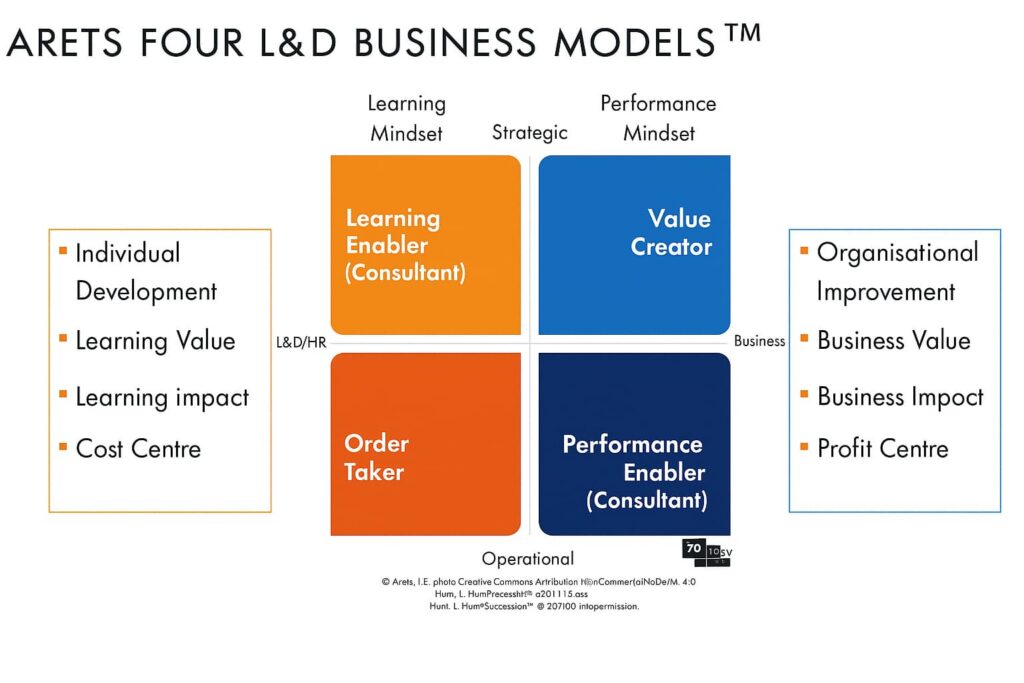
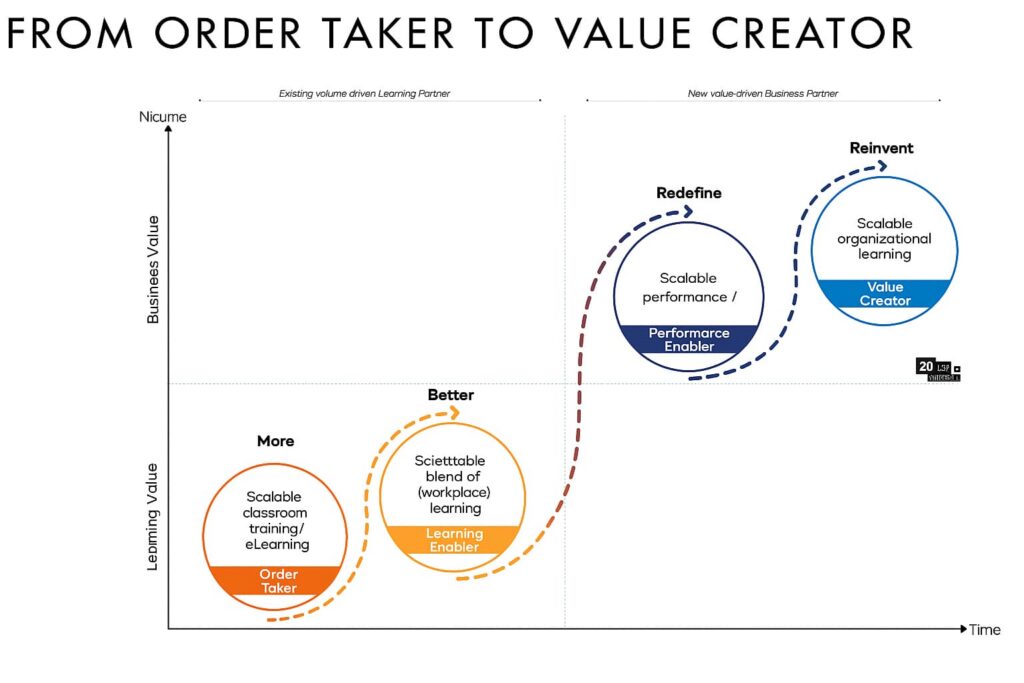
This ‘value creating’ model was created by my colleague Jos Arets. It plots the potential value provided by learning and development solutions on two axes: operational to strategic (vertical), and learning mindsets to business imperatives (horizontal). In the bottom left corner are “order takers” — focusing purely on compliance and safe work practices. Moving up, you reach “learning enablers” who develop learning programs, learning pathways and other formal learning solutions, but still think from a training mindset.
The real transformation happens when you move from “learning enabler” to “performance enabler,” and finally to “value creator.”
In the right-hand L&D business models, L&D stops being a cost center and becomes a value center — focusing on business impact, not just individual learning. The key question becomes: how can we enable people to perform better in real-time, in their actual work environment?
Practically, how does this shift look on the factory floor?
Traditionally, onboarding might take three or four weeks in a classroom setting. Workers wouldn’t touch the factory floor until they’d been thoroughly trained in a separate training environment. But performance in training environments does not indicate actual performance in the work environment, so that’s become increasingly outdated.
A modern approach focuses on getting people up to speed with the basics of safety — maybe over two or three days — and then integrating them directly into the work environment with the right support systems. That’s performance augmentation: giving workers the guidance and access to information they need in real-time to do the job safely and well.
For example, instead of expecting someone to memorize complex procedures, you make sure they know where to find validated, reliable information about the procedures whenever they need it.
That’s where tools like Poka’s platform come in — providing step-by-step instructions, quick references and access to expert knowledge at the point of need.
Can you share a real-world example of this approach?
Sure. One of the best examples I’ve seen was at Friesland Campina, the world’s largest dairy cooperative. They had issues in their packaging factories that were causing 15 hours of lost production every week. Initially, they assumed the problem was skill gaps — they thought they needed to retrain the workers.
But when we looked closer, we realized the real issue was process-related. When there was a stoppage in one part of the line, workers in other areas didn’t know. Everything backed up, causing massive delays.
Instead of more training, the solution was to create better real-time communication. They built a simple notification system — even adding a physical traffic light on the factory floor — and developed quick-reference guides to help troubleshoot problems. In the first week alone, one factory saved €59,000. That’s performance enablement in action: solving the actual performance problem, not just the perceived skill gap.
You’ve said that the complexity of factory work has increased. How does that change the role of training and performance support?
Complexity changes the role of training and performance support fundamentally. Jobs that were purely transactional 20 or 30 years ago now require far more decision-making and cognitive work. Take the example of a mechanic. Decades ago, a mechanic’s job was about tightening bolts and replacing parts. Now, a mechanic’s job involves diagnosing complex electronic systems and problem-solving.
The same is true on the factory floor. Workers can’t be expected to memorize everything — the volume of information is now too great, and things change too quickly. Research by Robert Keeley and his team at Carnegie Mellon University suggested that in 1986, workers needed to hold about 75% of their job knowledge in their heads. By 2006, that had dropped to 8-10%. It’s probably even lower today.
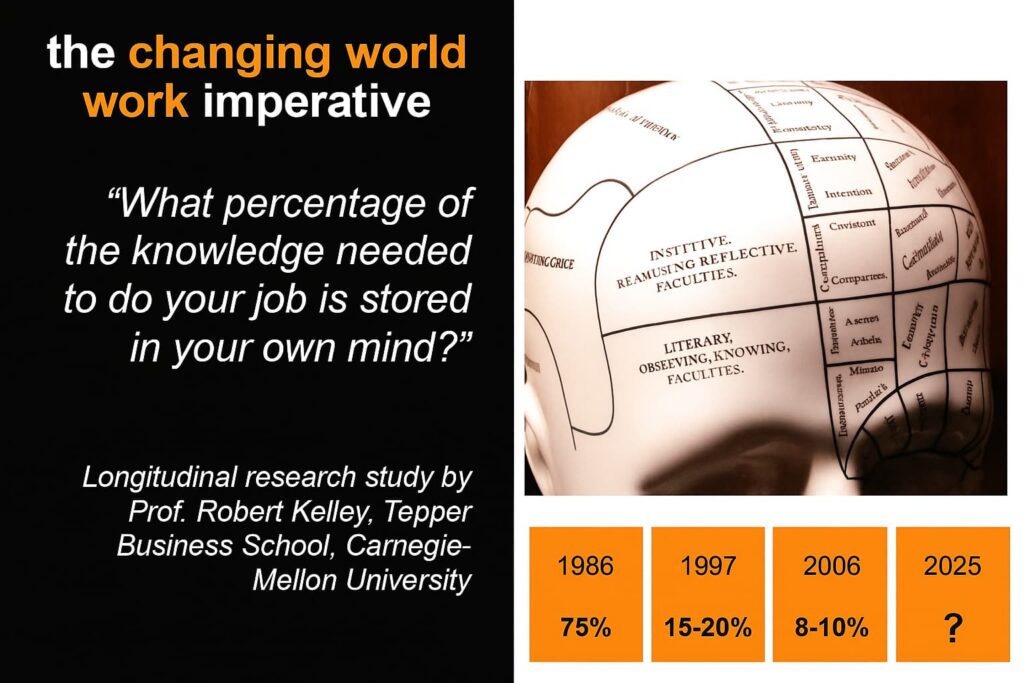
That’s why access to information at the point of need is so important. It’s no longer about “knowing everything” — it’s about knowing where to find the right information to solve a problem quickly and correctly.
So how does AI fit into this?
For me, the real power of AI isn’t in creating new learning content alone. It’s also in filtering and delivering exactly the right information at exactly the right time. AI brings a new order of magnitude to performance augmentation, not just knowledge delivery.
Imagine an operator assembling a circuit board in an electronics factory. With an AI-enabled AR system, if they skip a step or pick the wrong component, they’re instantly notified. Or if they’re not sure how to troubleshoot an error, AI can draw on the knowledge of the best people in the company, or the people who designed the circuit board, and present it right there, in the moment. That’s how you bridge the gap between knowing and doing.
AI also breaks down barriers to access. In environments where literacy or language might be a challenge, AI can present information visually, audibly, or in multiple languages. And it does all this at scale — turning tribal knowledge from your best performers into accessible guidance for everyone.
What’s the risk of relying too much on AI in learning and development?
One clear risk is that if the core data that AI draws on isn’t verified, you could end up with misinformation or errors — the so-called “hallucinations” of generative AI. That’s why it’s critical to build AI systems on reliable, up-to-date and internally validated data.
If L&D professionals don’t embrace these changes, they risk becoming irrelevant. AI can already handle many traditional training tasks, such as instructional design. If L&D teams don’t pivot to focus on performance enablement and continuous improvement, other parts of the organization will bypass them.
What mindset shift do manufacturing leaders need to embrace to succeed in this new environment?
Manufacturing leaders need to move away from a learning mindset – where training is seen as the answer for every challenge – and embrace a performance mindset and focus on the desired outcomes they want to achieve. In traditional approaches, whenever there’s a performance gap, the instinct of manufacturing leaders is to send people back to training. But that’s like telling a runner to go back to track school every time they miss a stride. In reality, elite athletes — and high-performing factories — are always analyzing, adjusting and improving in real-time.
Manufacturing managers need to focus on incremental improvement rather than expect ‘big bang’ results from training.
Leaders also need to focus on starting with the outcome: What are we trying to achieve? Then work backward to identify the people, processes, tools and information needed to get there. Focus on performance, not just compliance or classroom learning.
Conclusion: Building the Future of Factory Performance
Charles Jennings’ perspective challenges us to rethink how we build expertise in manufacturing. It’s not about adding more training. It’s about integrating learning and work, enabling real-time performance support, and creating a culture of continuous improvement.
With tools like Poka’s connected worker platform and the emerging power of AI, manufacturers have the opportunity to transform learning from a compliance exercise into a true driver of value and efficiency.