



Published on January 31, 2025
The difference between competency and expertise is subtle yet profound. Discover how to drive expertise on your factory floor and beyond.
Charles Jennings is a leading thinker in innovative performance and learning approaches. An author and well-known speaker, he is particularly known for his work with the 70:20:10 model and workplace performance.
His career includes roles as a business school professor, as head of the UK national centre for networked learning, as an executive for global companies, and as a member of advisory boards for international learning, performance, and business bodies.
He is a Fellow of the UK’s Royal Society for Arts (FRSA) and a Fellow of the Learning & Performance Institute (FLPI). He is also a Senior Advisor at the European Foundation for Management Development (EFMD) and other bodies.
1. Introduction: The Shift from Competency to Expertise
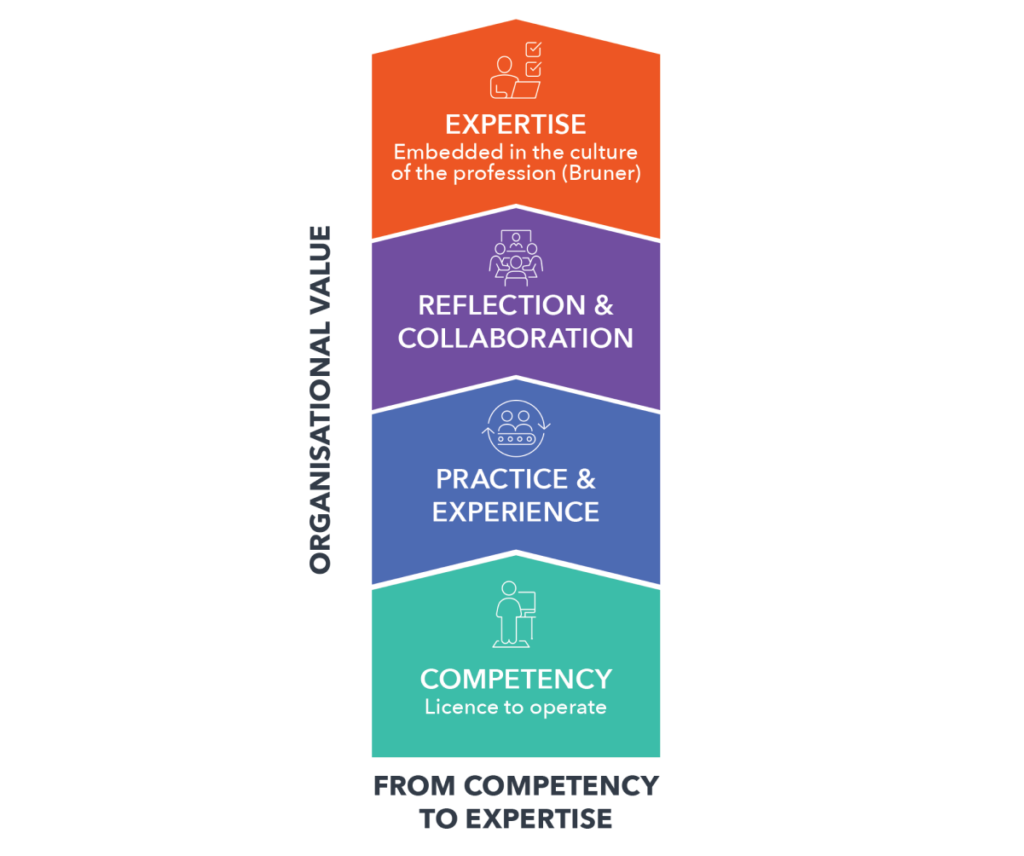
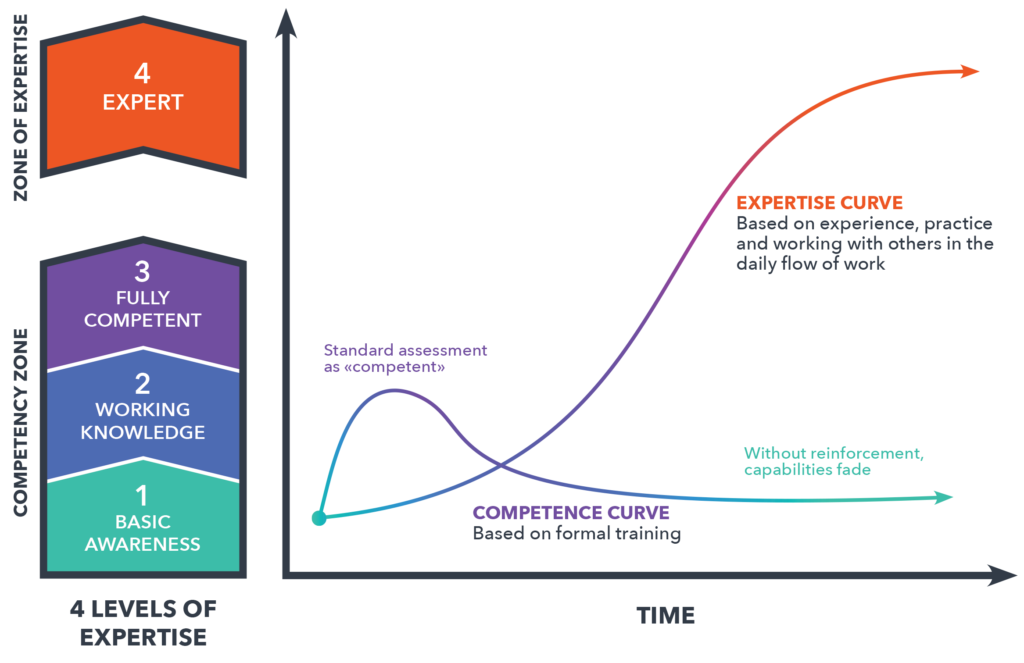
In traditional learning and development (L&D), much emphasis is placed on achieving competency—a baseline level of skill that enables employees to perform their roles effectively. In manufacturing, this often involves certifying that workers can execute core tasks, covering everything from equipment operation to basic safety protocols. However, once this basic competency is met, many L&D programs consider the journey complete. While competency is necessary, organizations focused on continuous improvement (CI) require something more: expertise.
The difference between competency and expertise is subtle yet profound. Competency ensures that an individual can perform a task to a basic standard, much like passing a driver’s test. Expertise, on the other hand, involves deep knowledge and understanding of the processes, nuances and unique variables within that task—essentially mastering it in a specific context. In manufacturing, where tasks and equipment are complex and vary widely, expertise is essential for driving efficiency, safety and innovation.
Competency frameworks often rely on generalized skills matrices where proficiencies are categorized by levels, such as beginner, intermediate and advanced. These matrices seldom include task-specific expectations, making it challenging to gauge how well employees actually understand the unique demands of their specific environments. A skills matrix might assess “technical operations proficiency” without distinguishing the complexity and subtleties of the specific situation. This gap results in a system that doesn’t promote continuous growth; it only validates minimum standards.
The reality in manufacturing is that the top 5% of workers—those who reach beyond competency to higher levels of expertise—often drive more than a quarter of the overall impact, a statistic that emphasizes the value of nurturing true mastery. To stay competitive, manufacturing organizations must rethink L&D, prioritizing pathways to expertise rather than stopping at basic proficiency. As Prof. Rob Cross’s social network analysis (SNA) research shows, expertise is not just knowledge but also the ability to leverage connections and access specialized insights. By shifting the focus from competency to expertise, organizations can foster a workforce ready to meet the demands of today’s complex and rapidly evolving manufacturing landscape.
2. The Importance of Continuous Improvement in Manufacturing
Continuous Improvement (CI) lies at the heart of operational excellence in manufacturing. CI focuses on small, iterative changes that accumulate into significant performance gains over time. However, a CI culture requires more than just basic skills; it demands a workforce equipped with levels of expertise based on deep context-specific experience that goes beyond routine competency. Employees with higher levels of expertise can identify inefficiencies, propose improvements and take initiative to implement these changes, driving CI efforts forward.
The impact of expertise within a CI framework can be transformative. Workers with deep understanding can push boundaries and innovate in ways that others cannot. By focusing on expertise, manufacturing companies can not only improve productivity and quality but also reduce downtime, enhance safety and promote innovation. The top-performing 5% of workers—those with high levels of expertise—often drive these outcomes by taking on more challenging roles, guiding peers and setting new standards.
A key goal for any manufacturing organization should be to move as many employees as possible toward this top tier. This means not only investing in upskilling but also in providing opportunities for employees to engage in new environments, take on stretch projects and develop networks within the company. Expertise-driven workers learn through exposure to complex problems and by accessing information and knowledge beyond their immediate roles. By promoting cross-functional collaboration and broad access to organizational knowledge, manufacturing companies can foster a resilient and adaptable workforce that continually fuels CI.
3. The Challenge: Limited Resources for L&D in Manufacturing
Manufacturers often face a challenging resource environment when it comes to L&D. The nature of manufacturing demands tight schedules, lean staffing and a focus on maximizing production efficiency. This leaves limited room for dedicated training, making it difficult to justify time and financial investments in learning beyond basic competency. The result is a balancing act where companies want to develop employees but find it challenging to allocate the necessary resources.
Moreover, traditional training methods require significant time, effort and resources to implement effectively. Classroom learning and lengthy online modules can disrupt production schedules, and their effectiveness is often constrained by how quickly new skills can be integrated into actual work environments. The pace and complexity of manufacturing leave little room for continuous, in-depth learning using traditional models. As a result, companies struggle to foster expertise on a broad scale, leading to an environment where only a small number of workers achieve the level of impact required to drive CI.
Manufacturers need a solution that can provide efficient, scalable L&D that adapts to the unique demands of the industry. To effectively build a high-performing workforce, L&D approaches must incorporate more agile, in-context learning solutions that provide targeted support without significantly impacting productivity.
4. The Solution: Leveraging Connected Worker Platforms for L&D
Emerging technologies such as connected worker platforms present a new frontier for L&D in manufacturing. Unlike traditional methods, these tools support learning directly within the workflow, transforming how knowledge and skills are acquired and applied. This turns learning into a continuous, on-demand process, helping employees propel their transition from competency to expertise.
Connected worker platforms allow manufacturers to deliver training content exactly when and where it’s needed. Workers can access step-by-step instructions, troubleshooting guides and safety information at their workstations, eliminating the need for extensive offsite training sessions. By embedding learning directly within the workflow, connected platforms follow a new model: work > learn > work better. Rather than separating learning from doing, these tools make learning a natural extension of the work itself, creating a model of continuous performance augmentation that drives expertise and organizational performance.
Consider, for example, a connected worker platform that provides a technician with instant guidance on resolving a machine malfunction. Instead of waiting for a supervisor or consulting a manual, the technician can access relevant information in real time, allowing them to troubleshoot issues with higher confidence and efficiency. This not only accelerates the learning curve but also ensures that each experience builds expertise. By integrating learning at the point of need, these platforms make expertise development more accessible, sustainable and cost-effective.
For organizations struggling with resource constraints, this model is particularly valuable. It reduces the time required for training, minimizes the impact on production and allows for a broader distribution of expertise. connected worker platforms thus offer a scalable solution that aligns with the resource realities of manufacturing environments while pushing L&D beyond competency toward expertise and increased productivity.
5. Driving Expertise Through Continuous Improvement
The potential to align CI with workforce development offers an extraordinary opportunity for manufacturing organizations to amplify the impact of both. Traditionally, CI and L&D efforts have been siloed, with separate objectives, budgets and methodologies. By merging them, companies can create a high-performing, expertise-driven culture that generates exponential value across the organization.
Connected worker platforms and AI tools enable continuous feedback loops that are essential for both CI and expertise development. Generative AI can rapidly update content based on user interactions, ensuring that workers always have access to the most relevant and effective resources. Connected platforms provide the delivery mechanism for these insights, ensuring that employees receive feedback in real time and can apply it immediately. This creates an environment where every task becomes an opportunity for learning and improvement, supporting both individual and organizational growth.
To truly move from competency to expertise, workers need opportunities to tackle complex, unfamiliar challenges with the support of just-in-time resources. Through continuous feedback and improvement loops, connected worker platforms help employees navigate these challenges, fostering the critical thinking and problem-solving skills that define expertise. By combining CI principles with expertise-driven L&D, manufacturers can build a workforce that not only excels in their current roles but actively contributes to the organization’s long-term success.
6. Conclusion: The Future of Learning & Development in Manufacturing
The shift from competency to expertise is essential for manufacturing organizations that want to remain competitive, resilient and capable of continuous improvement. CI requires a workforce that is adaptable, skilled and able to innovate—qualities that are fostered through expertise, not just competency. In this context, L&D must move beyond traditional methods and embrace new tools and models that support the development of expertise at scale.
Connected worker platforms offer a transformative approach, embedding learning into the workflow and providing real-time support that empowers workers to develop expertise in context. By facilitating learning at the point of need, these tools enable organizations to overcome the resource challenges of traditional training and foster a culture of expertise that fuels CI.
L&D leaders in manufacturing are now at a crossroads. The traditional path of competency-based training is no longer sufficient for organizations striving to build high-performing, resilient workforces. Embracing technology-driven learning not only enhances L&D’s effectiveness but also positions the organization for long-term success. By shifting the focus from competency to expertise, manufacturers can create a workforce that thrives in today’s complex, fast-paced environment—setting a new standard for excellence in the industry.