



Published on July 27, 2026
Key Takeaways
- Successful connected worker platforms require much more than AI-generated applications.
- Institutional knowledge, governance, and standardized work are critical for enterprise-scale industrial transformation.
- Most factory AI pilots fail because organizations focus on software instead of operational readiness.
- Connected workers need trusted knowledge, training, and procedures, not just an AI assistant.
- Organizations that combine AI with strong operational systems are far more likely to achieve sustainable industrial transformation.
Not long ago, creating a custom connected worker platform required months of development effort. Today, generative AI lets teams produce working interfaces, automate workflows, and generate functional code in a matter of hours, maybe days. For enterprise leaders, that’s incredibly exciting.
Operations teams can quickly prototype digital work instructions. Engineers can experiment with AI-powered troubleshooting assistants. IT teams can rapidly create custom dashboards tailored to specific workflows.
But there’s a catch.
Many of these applications look complete because the visible components are finished. Screens work, workflows function, AI produces answers. Everything appears ready for deployment. But that’s where many organizations begin confusing software creation with true frontline workforce enablement.
What Is a Connected Worker?
A connected worker is a frontline employee with real-time, governed access to the training, procedures, OEE data, and expertise needed to do the job safely and correctly on every shift. That’s the connected worker definition, and many enterprise brands begin their AI journey focused on building applications instead of understanding it first.
Holding a tablet or using a mobile app on the line doesn’t make someone a connected worker. An effective connected worker platform requires much more than user interfaces. It requires systems that connect people, knowledge, workflows, and continuous improvement into a single ecosystem. Without that foundation, even the most impressive apps become isolated tools rather than lasting operational capabilities.
Why Enterprise Operational Software Is More Complex Than It Looks
Why do custom manufacturing apps fail to scale? They fail because a user interface is only 10% of the solution, while the remaining 90% relies on strict SOP governance, continuous ERP and CMMS integration, and compliance tracking.
The connected worker platform interface is only the visible tip of the iceberg, a tiny fraction of the full requirements. Beneath it sits an enormous operational infrastructure that determines if software actually drives industrial transformation or simply becomes another abandoned pilot.
A few numbers put that gap in perspective:
| 45% average cost overrun on large IT projects | 56% less value delivered than planned | 80%+ of AI projects never reach production | 95% of generative AI pilots fail to deliver measurable ROI |
Sources: McKinsey & Company and the University of Oxford, RAND Corporation, 2024, MIT Project NANDA, 2025
The risk compounds when AI writes the code, too. Veracode’s 2025 GenAI Code Security Report found that 45% of AI-generated code introduces OWASP Top 10 vulnerabilities, a rate that climbs to 72% for Java.
What an App Requires After Initial Design
The hidden foundation of your built-in-house app includes:
- Operational methods refined over years of continuous improvement
- Business rules that reflect how work is actually performed
- Standard operating procedures with governance, revision control, and compliance traceability, including FDA 21 CFR Part 11 and ISO 9001 requirements where they apply
- Worker qualifications and skills matrices
- Training records and competency verification
- Institutional knowledge captured from experienced employees
- Change management processes that encourage adoption
- Data governance, security, and compliance requirements
- Cross-site standardization balanced with local flexibility
All these capabilities are rarely visible in a demo. They’re also extremely difficult to recreate from scratch.
Why AI Can’t Replace Institutional Knowledge
Can AI generate manufacturing standard operating procedures from scratch? No, because AI cannot replicate decades of continuous improvement, site-specific Lockout/Tagout (LOTO) protocols, and regulatory compliance audits.
GenAI is remarkably good at synthesizing existing information. But what it can’t do is invent decades of experience that exists only inside your frontline operations. Every industrial enterprise has literally thousands of small operational decisions that collectively determine success:
- Which procedures require supervisor approval?
- Which maintenance tasks demand specialized certifications?
- How should operators escalate recurring equipment failures?
- Which safety protocols vary by facility?
- How are best practices shared across locations?
- Who owns revisions to critical work instructions?
These decisions weren’t made all at once. They evolved through years of operational learning, audits, incidents, continuous improvement initiatives, and frontline feedback, none of which exists in a public training dataset that AI can draw from.
| AI can generate | AI can’t generate |
|---|---|
| User interfaces | Institutional knowledge |
| Code | Governance |
| Dashboards | Change management |
| Workflows | Skills matrices |
| Documentation drafts | Years of operational experience |
Why Most Connected Worker Platform Pilots Never Scale
Why do 95% of GenAI pilots never reach production? Pilots fail because they lack the architecture needed for multi-site rollouts, role-based permissions, and continuous enterprise system integrations. That figure comes from MIT Project NANDA’s 2025 report, and the pattern shows up just as sharply on the factory floor, where safety and compliance requirements raise the bar further.
Achieving impressive pilot results with AI-generated connected worker platforms is common enough. But using those tools to drive industrial transformation is rare. Why? The secret hurdle lies in scaling.
| A small pilot project involves | Scaling introduces new challenges |
|---|---|
| One site | Multiple facilities with different operational practices |
| A handful of subject matter experts | Thousands of frontline workers |
| Limited governance | Regulatory compliance across jurisdictions |
| Highly motivated users | Version controls and user permissions |
| Carefully managed data | Ongoing content management and long-term maintenance |
In short, the software itself isn’t usually what breaks; the issue is that the operational processes surrounding the software weren’t designed for enterprise scale.
What Industrial Transformation Really Requires
AI helps automate tasks and surface insights, but lasting industrial transformation requires a governed foundation that captures and distributes institutional knowledge.
The objective behind connected work solutions isn’t just to digitize procedures. It’s about creating an operations system that preserves and continuously improves institutional knowledge while making it accessible where and when frontline workers need it. AI is an accelerator, not the foundation.
Industrial transformation is often framed as a technology initiative. In reality, it’s an organizational capability.
- Technology can automate workflows
- AI can summarize information
- Algorithms can identify patterns
- But sustainable transformation depends on how effectively organizations capture, govern, share, and continuously improve operational knowledge
Companies that recognize this distinction are far more likely to scale AI successfully because they’re investing in the core infrastructure that makes AI useful, not just the applications AI helps create.
Prototype Speed Isn’t Production Readiness
A promising AI prototype is a valuable first step, but it’s only the beginning. Before you decide whether to proceed with building internally or adopt an established connected worker platform, consider what’s required to move from a successful demo to enterprise-wide deployment.
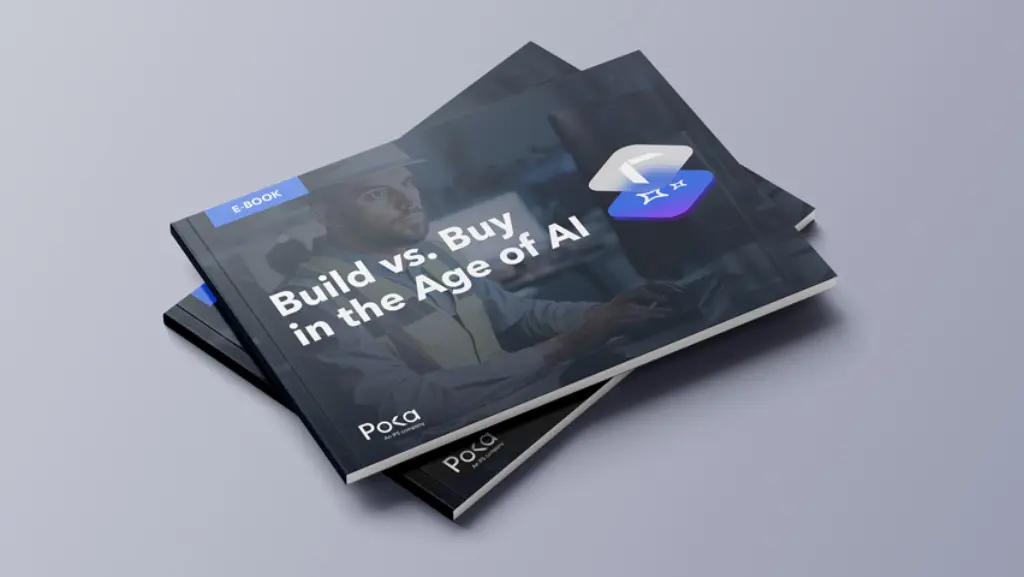 | Free Executive eBook Build vs Buy? An Executive eBook for Industrial Leaders See the hidden operational costs of building internally, and why demo speed does not equal production readiness. |
FAQs About Connected Worker Platforms and AI Pilots
What is the connected worker definition?
A connected worker is a frontline employee with real-time access to the information, training, procedures, and expertise needed to perform work safely and effectively.
What is a connected worker platform?
A connected worker platform centralizes digital work instructions, training, knowledge sharing, and frontline collaboration to improve operational performance.
Why do so many AI pilots fail to scale?
Many pilots prove the technology works, but fail to address the governance, training, change management, and operational processes required for enterprise deployment.
How does AI support industrial transformation?
AI helps automate tasks, surface insights, and improve decision-making, but lasting industrial transformation also requires strong processes and institutional knowledge.
Sources
- McKinsey & Company and the University of Oxford, Delivering Large-Scale IT Projects on Time, on Budget, and on Value
- RAND Corporation, The Root Causes of Failure for Artificial Intelligence Projects and How They Can Succeed, 2024
- MIT Project NANDA, The GenAI Divide: State of AI in Business 2025
- Veracode, 2025 GenAI Code Security Report