



Published on June 10, 2025
By Yannick Haeck, Vice President of Product at Poka
Why Empowering People is Just as Critical as Automating Machines in Manufacturing
For over three decades, manufacturers have invested in digitizing machines, materials and production processes. Manufacturing Execution Systems (MES), Computerized Maintenance Management Systems (CMMS), and Quality Management Systems (QMS) have become the backbone of plant operations, enabling traceability, uptime and process control. But there’s one major element that was overlooked for far too long: the frontline worker.
Despite being the most critical asset in any factory, operators have historically been “off the grid” when it comes to digital transformation. Legacy systems weren’t designed for them. MES systems were built for process engineers, QMS for quality teams and CMMS for maintenance—yet none focused on the operator’s daily needs, learning curve or engagement.
This is where Connected Worker (CW) platforms come in. Rather than compete with MES systems, CW solutions complement them. Where MES orchestrates machines and material flows, CW platforms empower the people who operate, maintain and improve those systems. When used together, they enable a fully optimized factory that combines automation with human excellence.
Why the Question Matters: MES vs Connected Worker
Understanding the distinct roles of MES and Connected Worker platforms isn’t just an academic exercise—it has real business implications. Drawing a clear line between what each system does helps organizations:
- Clarify digital investment strategy – Avoid overlapping functionality, redundant licenses and wasted spend.
- Operator‑first change management – People adopt tools that are built for them; forcing operators into back-end systems leads to frustration and poor adoption.
- Build scalable, interoperable architecture – Integration becomes easier when roles and data ownership are well defined.
In short, knowing where MES ends and Connected Worker platforms begin can prevent digital transformation from becoming digital confusion.
System DNA: What Each Platform Was Designed For
Let’s break down the core purpose and persona of each platform:
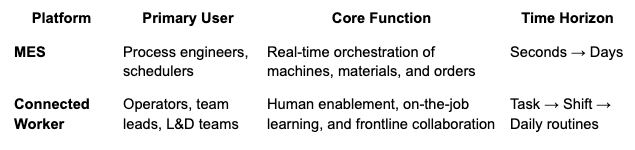
Think of MES as your system of record and Connected Worker as your system of engagement and learning. MES ensures production runs on time and within spec. CW ensures operators have the knowledge, skills and feedback loops to make that possible every day.
Where Connected Worker Platforms Lead: The Operator’s Daily Loop
CW platforms shine in workflows that are high-frequency, people-driven and require flexibility—exactly the conditions operators face every shift.
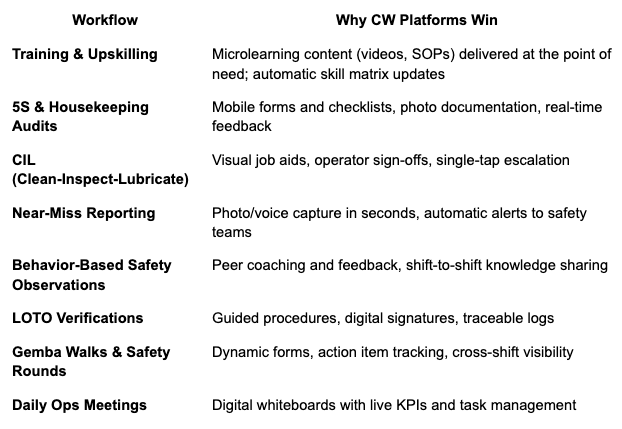
These activities form a continuous learning flywheel:
Learn → Execute → Capture Insight → Improve → Learn Again.
This loop drives not only operational performance but also employee engagement, knowledge retention, and safety culture.
Where MES Systems Should Stay in the Driver’s Seat
MES platforms are ideal for tasks that can be fully automated, time-stamped and validated without human input:
- Data capture from PLCs, SCADA and IoT sensors
- Finite-capacity scheduling and machine sequencing
- Work-in-progress (WIP) tracking and electronic batch records
- Recipe enforcement and real-time parameter control
- Equipment and order-based audit trails
These are essential capabilities—but not operator-facing ones. That’s why trying to push MES into operator workflows often results in poor UX, low adoption and limited visibility into frontline performance.
Why Operators Were “Off-Grid” Until Now
Let’s look at why frontline workers were left behind in the first waves of digital transformation:
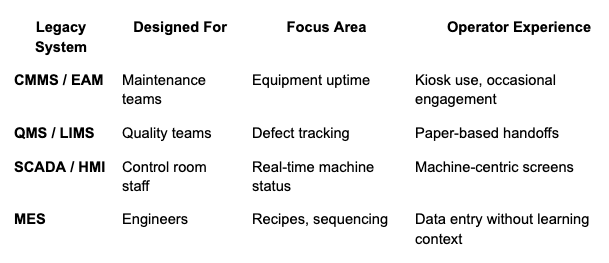
Operators were essentially second-class users in these systems. But the rise of rugged mobile devices, cloud-based SaaS and the growing skilled labor gap changed the game. Connected Worker platforms emerged with a UX designed for tap, swipe, voice and AR—making them the first digital tools truly built for the factory floor.
How Connected Worker Platforms Keep Their Edge
CW platforms aren’t just easier to use—they’re smarter by design:
- Human-centric UX – Designed for mobile, voice, offline sync and wearable compatibility
- Skills intelligence – Live training matrices, certification expiry alerts and AI-matched task assignments
- In-context knowledge delivery – SOPs, videos and checklists embedded in the flow of work
- Collaborative problem-solving – Threaded comments, escalation workflows and multimedia logging
- AI co-pilots for operators – Auto-generated summaries, troubleshooting tips and near-miss reports
- Plug-and-play integrations – Seamless data sharing with MES, ERP and EAM systems
- People-first analytics – Track time-to-competency, safety behaviors and content effectiveness
This combination creates a powerful feedback loop where learning, doing, and improving all happen in real time.
Convergence and Specialization: What’s Next?
Just like CRM systems expanded to include email and social marketing, MES platforms are now embedding basic operator tools to appeal to manufacturers looking for a one-vendor solution. But that doesn’t mean CW platforms are obsolete—far from it.
- MES will continue to be the backbone for orchestrating production and automation.
- Specialized CW platforms will drive innovation in UX, training, and AI-guided frontline support.
- Integrated ecosystems will outperform single-platform monoliths in both adoption and impact.
Smart manufacturers will pair the strengths of both rather than choosing between them.
Takeaways for Your Digital Roadmap
- Map workflows – Ask whether each task involves automated data or human input.
- Let MES run machines – Automate and orchestrate wherever possible.
- Let CW empower people – Support learning, decision-making and daily routines.
- Integrate early – Use APIs, SSO and shared data models to avoid silos.
- Measure what matters – Track OEE for MES; time-to-competency and safety metrics for CW.
- Start small, scale fast – Pilot one impactful CW use case before rolling out more.
Final Word
Connected Worker platforms aren’t a trend—they’re the human layer of Industry 5.0. As automation increases, the role of skilled, adaptable, and engaged frontline workers becomes even more vital. These platforms deliver the structure, insights, and support workers need to thrive in modern factories.
When MES and CW platforms work in harmony, factories don’t just stay compliant—they become high-performing operations where both machines and people do their best work.