






Published on July 29, 2024
Make the most of your frontline workers’ skills on the factory floor.
Properly managing factory floor skills ensures manufacturing operations’ efficiency, productivity and safety. With the constant evolution of production technology and processes, new and seasoned employees must receive effective and timely training to stay up-to-date with the latest practices.
This not only enhances the workforce’s overall performance but also contributes to the company’s success as a whole. And with attracting and retaining talent being the biggest challenge for 65% of U.S. manufacturers, you need to be able to do more with less and retain skilled team members.
In this blog, we’ll cover the 5 steps to effectively develop, manage and oversee shop floor skills and training for employees:
- Step 1: Making Standard Training Content Easier to Access, Understand, and Share
- Step 2: Automatically Assigning and Tracking Skills
- Step 3: Eliminating the Paper Trail
- Step 4: Giving Workers Visibility Into Their Learning Plan
- Step 5: Identifying Skills Gaps
By following these steps, manufacturing companies can streamline their training processes, close skill gaps and enhance operational excellence.
Step 1: Make Standard Training Content Easier to Access, Understand and Share

The Challenges of Traditional Factory Worker Training Methods
Traditional training methods in the manufacturing industry often involve shadowing, classroom-style lectures and written SoPs, all of which can pose several challenges.
First, these formal training events often cover a large amount of content, making it difficult to retain the information when it is needed down the road. In fact, only about 5% of all information learned during a lecture is retained after 24 hours. The 70:20:10 methodology of training has proven that the best way for someone to learn is by doing, with ‘social’ learning falling a distant second. And the closer the learning can occur to the point of use, the better.
Additionally, traditional written training content introduces lots of opportunity for misinterpretation and misunderstanding. Lengthy SOPs stored off the shop floor in binders or on a network drive are rarely accessed in a moment of need, and if they are, the time to access and reference the documentation takes away from critical production activities.
Overall, the challenges of traditional training methods on the shop floor include lack of consistency, difficulty scheduling time for shadowing with trainers, high costs associated with shadowing and a lack of ongoing support for employees beyond the formal training event. To overcome these challenges, giving workers access to a modern learning platform, specifically built for role-specific skills in manufacturing, is the alternative.
How Digital Solutions Can Allow Easy Access and Sharing of Training Content
- Visual, One-Point Lessons: Start by creating visual or video-based one-point lessons. By incorporating photos and videos, content is more engaging and easier for employees to understand. One-point lessons can focus on role-specific tasks or processes, making the training more targeted and effective.
- Easy Access on the Factory Floor: Next, make it easy for employees to access these lessons, at the point and location of need. A scan of a QR code at a workstation can help employees find the answer they need quickly – either as a refresher on something they’ve learned before or a new task they’re being asked to complete. Having training content readily available on the production floor will enable employees to quickly reference information when needed, leading to improved performance and retention.
- Easy-to-Share and in Multiple Languages: Once you’ve curated a library of powerful work instructions, you can share them across a network of factories for improved standardization, and you can automatically translate training materials into multiple languages, ensuring that all employees, no matter their location, completely understand the material.
Step 2: Automatically Assign and Track Skills
The Challenge of Managing Factory Floor Skills
The standard way of tracking and managing role-specific skills on the factory floor is spreadsheets. This is challenging as spreadsheets require manual updating, often by a Learning and Development representative. The result is that skill trackers are often out of date, and make it difficult to provide a real-time view into skills gaps and training priorities.
The Benefits of Automated Skills Assignment and Tracking
By replacing spreadsheets with an automated skills tracker, you empower employees and team leads to keep their training, endorsements and assessments up to date on their own. No more chasing down the L&D person to ask if someone has a specific skill or to share that someone has completed a training.
Once the responsibility for updating the skills matrix is shared and automated, team leads will have more confidence when assigning an employee to a workstation or task. If a worker is absent one day, it becomes easy to see who else has the necessary skill to step in and replace them.
Automated skill tracking also supports compliance by ensuring employees are adequately trained and certified to perform specific tasks. Adherence to regulatory and safety requirements is crucial as non-compliance can lead to severe consequences, including fines, legal action and increased risk of accidents.
By reducing the manual work involved with keeping skills matrices up to date, L&D professionals can spend more time ensuring the training program fairly reflects the competencies of the factory. In fact, by switching from spreadsheets to an advanced skills matrix, organizations such as l’Oréal have increased the number of tracked skills by 547%.
And with accurate skills data, it becomes easy to identify gaps in employee skills and training needs, facilitating targeted training programs that enhance workforce capabilities and performance.
How to Automate Skills Tracking & Assignment
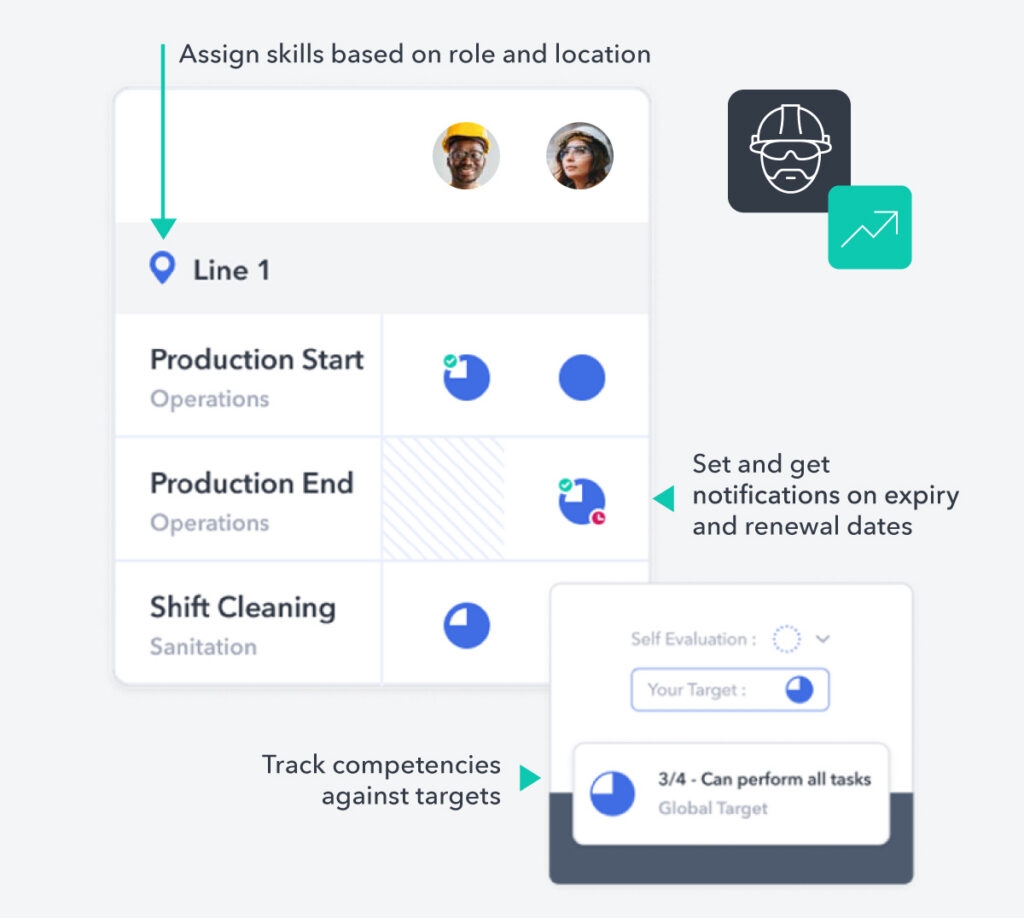
- Create and assign skills based on role and location: Start by building out multi-step training programs for every role and location in your factory. When skills are built this way, they can be automatically assigned to new hires or to an employee moving into a new position.
- Set and get notifications on expiry and renewal dates: Set notifications for when specific skills are set to expire or require renewal, ensuring that employees stay up-to-date with their training and certifications.
- Track competencies against targets: Track employees’ competencies against set targets, providing insights into areas where additional training or development may be needed to meet performance goals.
Step 3: Eliminate the Paper Trail
The Inefficiencies of Paper-Based Systems
Paper-based training records are cumbersome and inefficient. This is never more apparent than when audits occur. Locating the training records for a given employee can be time consuming, and missing records often lead to audit findings. As manufacturing operations grow and evolve, the inefficiency of paper-based systems becomes more apparent, creating bottlenecks and hindering overall productivity.
Also, paper-based systems are detrimental to the environment. The manufacturing industry is already resource-intensive, and relying on paper adds to the ecological burden. Transitioning to digital training solutions not only enhances efficiency and engagement but also aligns with sustainable practices, reducing the industry’s carbon footprint and promoting environmental responsibility.
How to Digitize Records and Streamline Processes
Digitally connecting your frontline factory workers allows you to do away with binders full of work instructions, piles of paper forms and overflowing filing cabinets of training records.
In fact, companies such as Danone and Upfield have been able to create completely paperless factories through technology. In addition to sustainability improvements, modern solutions allow manufacturers to increase workforce productivity and visibility into operations.
By digitizing your factory floor training and skills tracking, you will be able to:
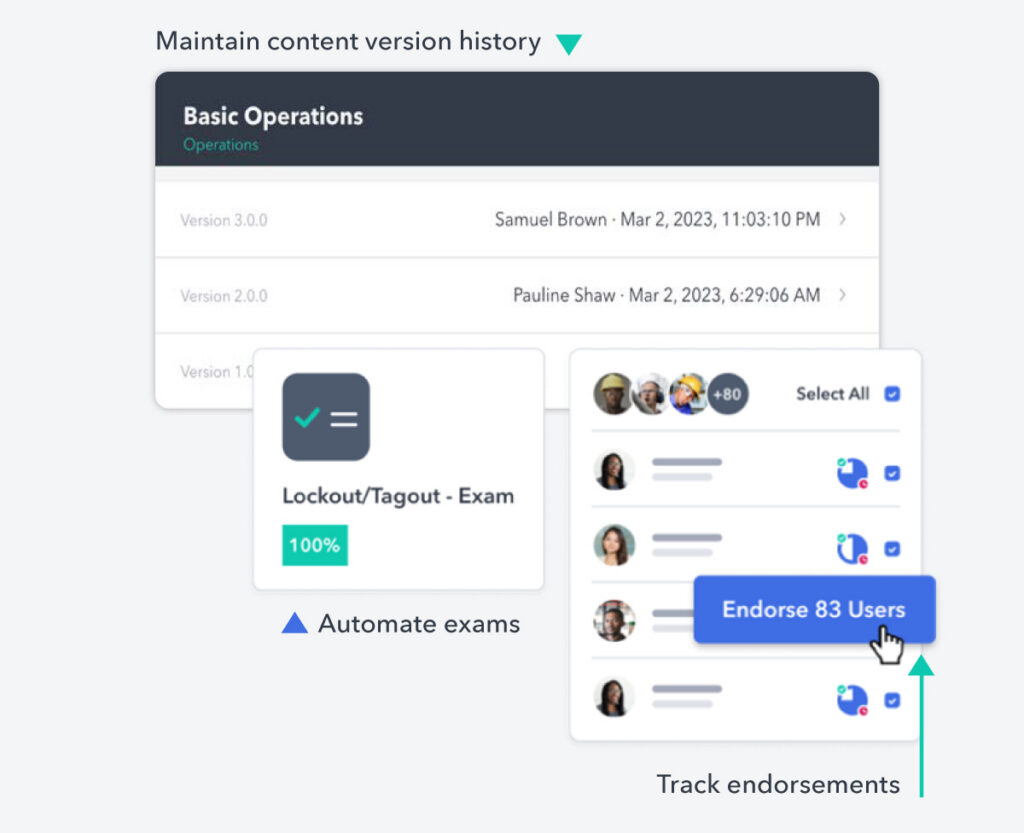
- Maintain content version history: Manufacturers can easily maintain a history of training content versions and approvals. This ensures that any changes to documents or processes are tracked and recorded, making audits a breeze.
- Automate exams: Manually correcting exams for plant-wide compliance skills can be time consuming and error prone. Instead, manufacturers can automate the exam process with the help of connected worker solutions. Exams integrated into training programs are automatically graded, and every attempt is logged. This reduces the time and effort needed to maintain training compliance documentation.
- Tracking endorsements: Validating that an employee has mastered a skill is important. While this can be done through exams, it is often best to watch the worker perform the task. Trainer assessments like this and supervisor endorsements can be tracked digitally. This includes tracking approvals, certifications, and authorizations for each stage of the training process, ensuring that all necessary endorsements are obtained before a worker gets accredited for a specific skill.
Step 4: Give Workers Visibility Into Their Learning Journey
The Importance of Transparency in Training Plans
Transparency in training plans is crucial for several reasons, primarily because it fosters trust, clarity and employee engagement. When transparent about their training plans, organizations communicate openly about the skills, knowledge and competencies they expect employees to develop. This transparency sets clear expectations and goals, aligning individual learning paths with organizational objectives.
Visibility into training plans also empowers employees by providing them with a roadmap for career development. Employees who see the opportunities available through training programs are more likely to take ownership of their learning journey. Knowing what skills are valued and how they can progress within the organization can inspire individuals to pursue professional growth actively. This proactive approach enhances job satisfaction and contributes to the retention of a skilled workforce.
How to Provide Workers with Access to Training Progress
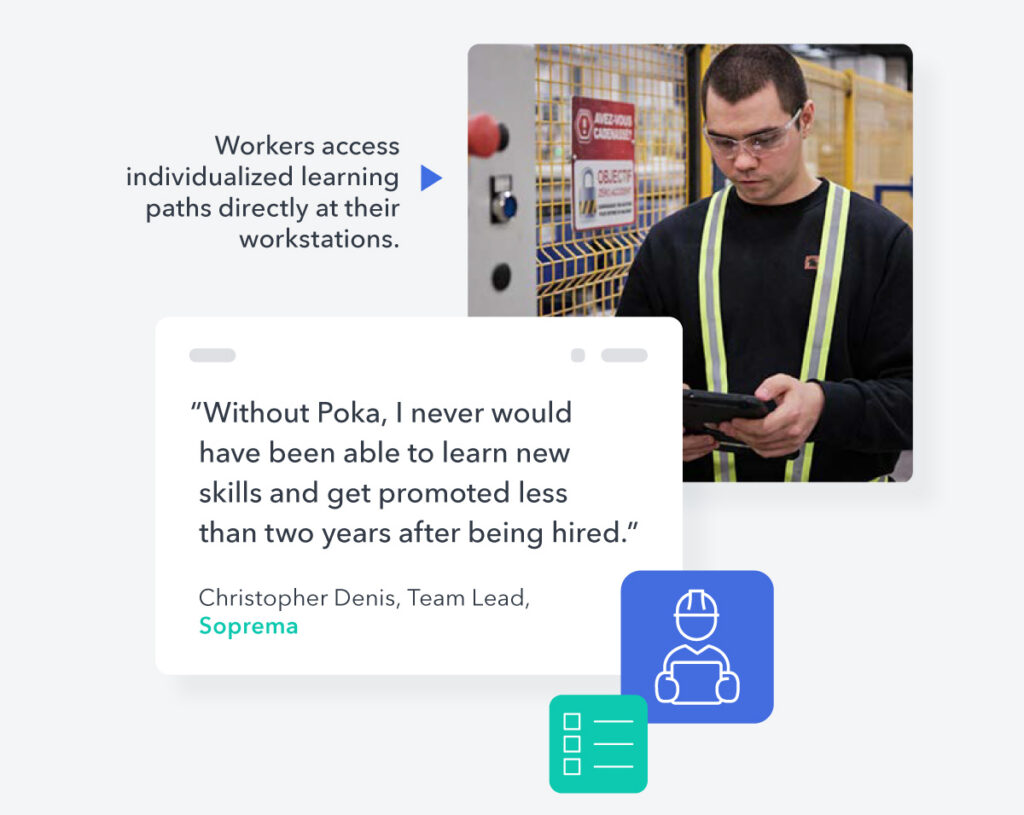
- Start by making mobile devices like iPads available on the factory floor. Workers can then login to view their assigned skills and individualized learning paths directly at their workstations.
- Support employees to track their progress and take ownership of their training and development.
- When the opportunity arises (a quiet moment in production) workers can take initiative and start working on a new skill with the help of video work instructions. This real-time feedback helps employees stay on track. It ensures they continuously improve their skills and knowledge to meet the company’s evolving needs.
“Without Poka, I never would have been able to learn new skills and get promoted less than two years after being hired.”
— Christopher Denis, Team Lead, Soprema
Step 5: Identifying Skill Gaps
Importance of Identifying and Addressing Skills Gaps
Closing skill gaps is important for ensuring maximum versatility and coverage in production. It helps ensure your workforce is capable of keeping up with evolving technologies and operational requirements, which can improve product quality, reduce downtime, and increase profitability.
But understanding where those gaps exist is not always easy. Training completion is just one metric. Looking at performance indicators in production and correlating that to competencies is the ideal.
How to Identify and Close Skills Gaps
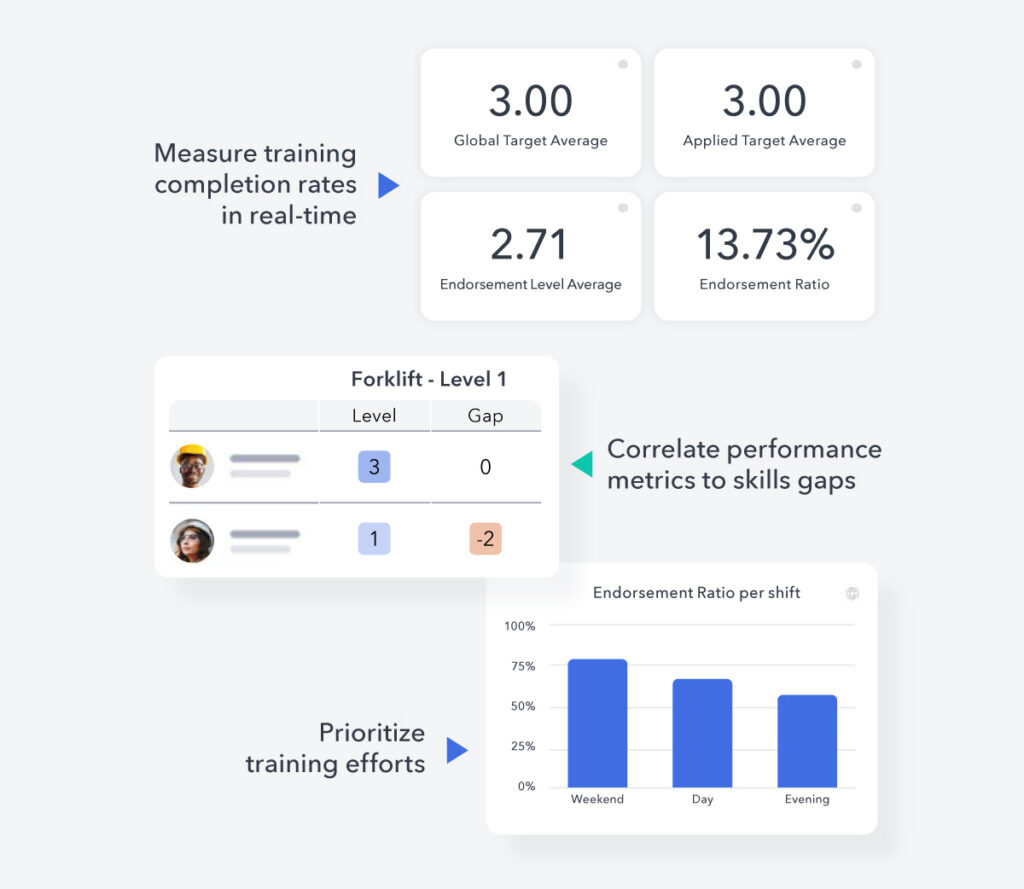
Technology plays a crucial role in identifying and filling skills gaps. Companies can effectively measure real-time training completion rates, correlate performance metrics to skills gaps, and prioritize training efforts:
- Measure training completion rates in real time: Track and monitor employee training progress. This allows organizations to quickly identify who has completed training programs and who hasn’t. By having real-time visibility into training completion rates, companies can ensure that all employees are equipped with the necessary skills to perform their roles effectively.
- Correlate performance metrics to skills gaps: Analyze performance metrics, such as production efficiency and quality, and correlate them to specific skills gaps. Companies can target training efforts toward addressing these gaps by identifying areas where performance is lagging due to skill deficiencies. This data-driven approach ensures that training programs align with the workforce’s and the business’s specific needs.
- Prioritize training efforts: Skills matrices help companies prioritize training efforts based on the criticality of skills gaps. Having a macro view of the skills of a team or across an entire plant allows for easy prioritization of L&D programs.
Embrace the Future with a Connected Workforce
Managing factory floor skills is crucial to ensure manufacturing operations’ efficiency, productivity, and safety. Old methods just don’t cut it anymore—embracing powerful, modern technology is no longer a good to have. It’s a must.
In this blog, we explored five essential steps for effective factory floor skills management:
- Step 1: Making Standard Training Content Easier to Access, Understand, and Share
- Step 2: Automatically Assigning and Tracking Skills
- Step 3: Eliminating the Paper Trail
- Step 4: Giving Workers Visibility Into Their Learning Plan
- Step 5: Identifying Skills Gaps
If you want to learn more about how Poka’s Connected Worker platform can enhance your factory floor skills management, contact one of our dedicated experts today!