




Published on January 28, 2025
Boost workforce skills and retention with Poka’s connected worker app for efficient manufacturing training.
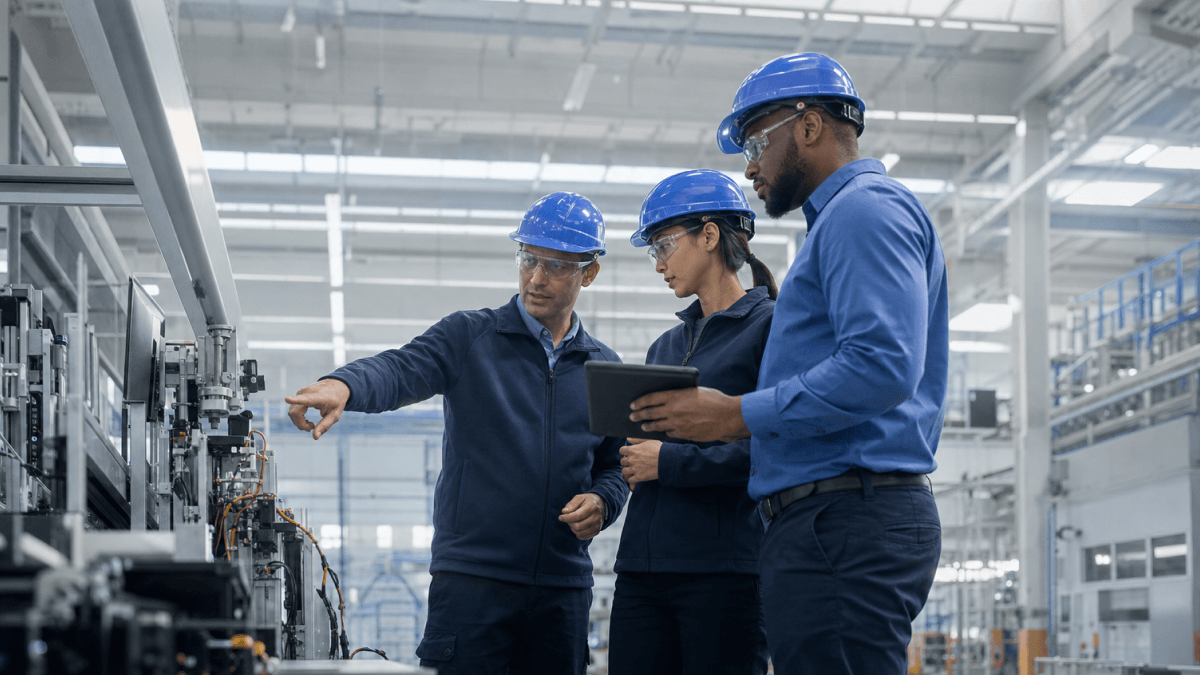
Many manufacturers struggle to recruit at a level that matches employee turnover. At the same time, new machinery and automation require highly skilled workers that are in short supply.
Investment in workforce training and development boosts retention and helps fill the talent pipeline, but also carries a cost. Maximizing training resources therefore requires precise targeting and effective delivery, which is something a connected worker app can support.
Let’s explore the role of connected worker apps in training delivery.
The Need for Ongoing Workforce Training and Development
Despite promises of “lights out” manufacturing, workers remain a vital component of modern production. Machinery is more automated, but operating and maintaining this expensive equipment efficiently requires the ingenuity of human workers. In fact, most manufacturers will argue that more complex machinery needs a more highly skilled workforce, leading to a gap in skills between what’s needed and what’s available.
Meanwhile, businesses face demographic and retention challenges. The manufacturing workforce is aging and moving into retirement, while younger workers are seeking careers with more opportunities for personal growth.
These labor trends make it harder than ever to fill talent pipelines. One solution is to ramp up investment in training and development in order to:
- Better attract and retain new hires
- Accelerate new hire time to productivity upskill and develop existing employees for more challenging roles that help them and their employers grow
- Improve training effectiveness by supporting how people actually learn, such as the 70:20:10 method
Traditionally, manufacturers used a mix of classroom learning, on-the-job training by shadowing experienced employees. Training material is based on lengthy written SOPs stored in binders or on network drives. The drawbacks of this approach are reduced visibility by management into skill gaps, the risk of passing along incorrect and incomplete information, and a lack of accessibility to critical operational knowledge on the factory floor at the time of need.
The 70:20:10 learning methodology is an approach that’s proven to provide effective and efficient training in manufacturing, especially when supported by connected worker solutions like Poka. The 70:20:10 Methodology is a learning model that breaks down like this:
- 70% of learning comes from on-the-job experiences—hands-on work that builds real-world skills.
- 20% comes from social learning—mentoring, coaching, and peer collaboration.
- 10% comes from formal education—structured courses and training sessions.
By integrating the 70:20:10 methodology with a connected worker platform, manufacturers can create a more agile, skilled and empowered workforce. It’s not just about delivering training—it’s about embedding learning into every aspect of work, making continuous improvement a natural part of the day-to-day.
Integrating visual one-point lessons for micro-learning with images and video can also have huge benefits in terms of efficiency and knowledge retention.
Understanding Workforce Development
Every person in a factory needs to master a number of skills. These start with factory-wide skills like how to work safely, or ensure quality standards are met, and extend into the role-specific tasks to be completed. Depending on a worker’s role, they may have different levels of competency they need to achieve, for instance basic knowledge of a skill vs the ability to teach others.
Employee or workforce development is more strategic. The goal is to build a more capable workforce equipped with the skills and knowledge the business needs now and in the future. This includes identifying skill gaps, prioritizing training in a way that maps to continuous improvement efforts and creating a clear skill progression for workers. This includes upskilling, where workers are encouraged to enhance the skills they have and cross-training, where they learn to do other jobs within the factory.
For the worker, this makes work more interesting and engaging, which is particularly important to Gen Z workers entering the workforce. It improves their career prospects, and may lead to higher rewards. The employer gains from increased employee versatility, a closing of the skills gap and improved retention rates.
Modern development programs seek to maximize employee engagement in the process. They do this by delivering information in a variety of ways, minimizing classroom time and focusing on transferring practical manufacturing skills. Effectiveness is measured through regular assessments and performance feedback, with completion of individual modules opening the door to new and more varied assignments.
The Role of a Connected Worker App in Manufacturing Learning & Development
Modern factories are increasingly more digital. Production schedules, Standard Operating Procedures (SOPs), Safety Data Sheets, training records and much more are all available and accessed digitally.
This solves many problems, like ensuring everyone works to the latest standards, but these resources need to be available in the regular flow of work on the factory floor. Unable or unwilling to step away from where they work, frontline workers need something portable and easy to use, like a connected worker app on a tablet that can access information anywhere.
Poka’s connected worker app supports always-on workforce training and development through:
- Digital training modules that give the worker and supervisor visibility into training progress
- Certification training
- Training records, version control, assessments and exams
- Digital work instructions that incorporate pictures and video
Plus, it acts as a communications hub, letting workers post information and tag relevant teams and people (like many social media apps) to communicate with subject-matter experts. Poka’s Factory Feed feature also helps share news and information and share success stories with other teams.
Key Use Cases for Building Workforce Skills
Some examples of how Poka’s connected worker app has helped manufacturers improve workforce training and development help make the case for its adoption.
New Hire Training
Onboarding can be a frustrating experience for new hires, when they find themselves watching presentations and reading SOPs in a meeting room, or having to rely on more experienced colleagues for long periods. There’s also a risk of trying to pass on too much information, or information they won’t need for some time.
Poka serves up digital training content that can be consumed at the point of need on the factory floor. This makes it more relevant, so information is absorbed better. It also means training can be done as-needed, rather than bombarding new recruits with things they won’t need to know for a while. Together, these bring new hires up to speed faster than before.
Skills Target & Gap Management
Managers and supervisors have lists of tasks they want workers to be able to do. At the same time, factory workers want to see opportunities for growth and advancement. Poka connects the two, making skills requirements visible so workers can see what they need to learn to progress.
Digital training modules available on demand, combined with online checklists and assessments and Poka’s Skills Matrix, let workers learn and supervisors manage their skills. This way, workers grow in confidence while at the same time, closing the skills gap.
Making it Easier to Create Training Content
While many team members may have the knowledge and best practices for how to perform role-specific tasks, the responsibility for documenting procedures and creating training content has historically been limited to a handful of individuals. This created bottlenecks in content creation and limited the number of people who could contribute.
Poka streamlines and democratizes training material creation. Team members or trainers that were previously reluctant to write an instruction, are often much more comfortable being filmed performing a task. They can quickly put together guides and instructions that, because they use pictures and video captured in the workplace, are more easily understood. These then get incorporated into the skills development process where they help workers become more effective.
Poka also incorporates generative AI to help companies turn their written SOPs into visual, one-point lessons. Real-world experience has shown this can save as much as x% time when creating digital work instructions.
Training Audit & Compliance Management
Maintaining training records is a non-negotiable for EHS, Quality and regulatory compliance. Managing factorywide compliance training is time consuming and costly. And role-specific certifications, such as operating a fork lift, add more work for the training team.
By delivering compliance training in Poka, in a self-serve way, including digital exams, Poka customers have reduced the time spent in compliance training by as much as 50%. Factoring in overtime pay, this represents significant savings. Additionally, training associates no longer have to manually correct and rekey data from exams, reducing their workload significantly.
Poka makes it easy to connect skills and training requirements with specific jobs within the factory. This lets auditors quickly and easily verify that workers are doing work for which they are trained and, if necessary, certified. It can even set alerts for expiring certifications so re-assessment can be scheduled.
Revision Training Management
When hiring, businesses that can demonstrate a commitment to employee learning and development have a clear advantage over those that don’t. In particular, the visible use of modern tools like tablets and digital training modules, coupled with on-the-job training is especially attractive to younger workers.
In the same way, investing in skills revisions shows existing workers the company supports their growth. This helps improve retention and reduce turnover, thus lowering recruitment costs and on-boarding workload.
Benefits of a Connected Worker App for Learning & Development
The benefits of using a connected worker app for skills training and workforce development include:
- Improve the comprehension, retention and access to training content
- Reduce the effort to manage training, certifications and skills tracking
- Improve collaboration and knowledge transfer between workers
- Ensure training is carried out consistently
- Improve visibility into training to better identify and close gaps as needed
Beyond these benefits, a connected worker app helps build a more skilled, more confident and more engaged workforce. That means lower turnover and higher efficiency and productivity.
Achieve Industrial Excellence Through Workforce Investment
It’s a cliché, but it’s also true: your workforce is your biggest asset. It’s also an asset that needs nurturing and developing if you’re to retain skilled and experienced workers and help new hires become effective quickly.
Poka’s connected worker app provides tools and capabilities that simplify and improve knowledge delivery. This helps manufacturers build a more skilled, more confident and more versatile workforce, with all the benefits that brings. Are you ready to boost workforce development with Poka? Contact our helpful team today to get started.