



Published on May 10, 2023
A high-quality onboarding experience helps new hires feel confident and connected from day one. Discover 7 ways to modernize onboarding manufacturing employees with digital employee onboarding solutions for manufacturing that boost skills, culture, and productivity.
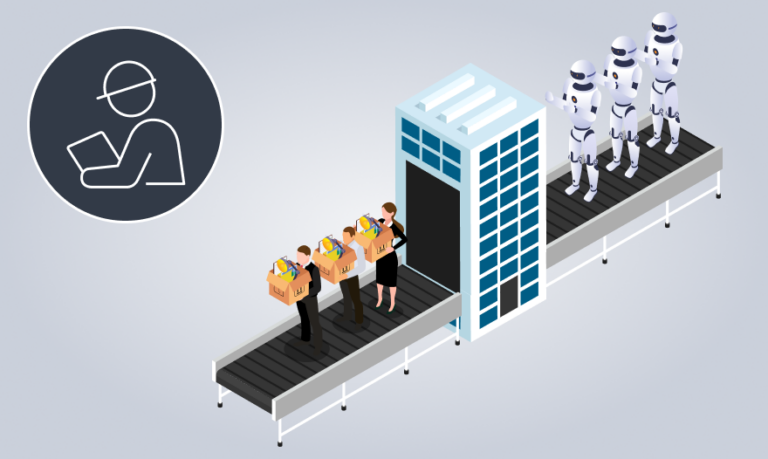
The industrial skills crisis has been made worse by pandemic-driven employee turnover and surging onboarding costs. Seventy-five percent of manufacturers are facing challenges in attracting and retaining quality employees. The labour shortage has forced companies to raise wages to attract qualified candidates, while chronic understaffing has resulted in production cuts adding further financial insult to injury.
A high-quality onboarding experience involves setting expectations, building skills, and introducing company culture. Poorly onboarded employees can become frustrated and confused, while companies with standardized onboarding have better productivity and retention. A Purdue University study found new hires at US manufacturers often experience insufficient, non-standardized onboarding training, limited management support, and poor communication.
Fortunately, tools are available to help manufacturers tackle these common challenges.

Key Takeaways
- Modern onboarding improves retention and engagement.
- Digital tools make training consistent and scalable.
- Safety and compliance training start on day one.
- Continuous learning keeps skills sharp and relevant.
- Connected Worker apps speed up employee productivity.
Why Onboarding Manufacturing Employees Is So Important?
Onboarding is critical for any manufacturing organization as it sets expectations and equips new employees with the necessary tools to succeed. A positive onboarding experience ensures that workers feel valued and supported, while a negative experience can lead to high turnover and decreased morale. However, studies show that only 66% of frontline workers are satisfied with their company’s training and development opportunities and only 59% are happy with corporate communication practices. This indicates a need for improved onboarding programs that meet employees’ needs. Younger employees are more likely to stay with a company that offers quality training, making it an essential part of any retention strategy.
Here are the top reasons why a comprehensive onboarding program is critical:
- First impressions matter: A good onboarding experience can make new employees feel valued and that their employer is invested in their success. This can lead to a more engaged workforce right from the start.
- Safety: According to the Institute for Work & Health, employees in their first month on the job are three times more likely to suffer a lost-time injury than those who have been working for more than a year. Providing comprehensive safety training during onboarding can help reduce the risk of accidents and injuries.
- Employee retention: The first six months of employment are the most critical period for employee retention, a study by the Aberdeen Group found. A positive onboarding experience can help reduce turnover during this important time, by encouraging new hires to feel more engaged and invested in their role.
- Faster time to productivity: While it’s important to ensure new hires are adequately trained and supported, manufacturers also want their employees to become productive team members as soon as possible. A well-designed onboarding program can strike a balance between equipping new hires with the necessary skills and knowledge and ensuring they are productive as quickly as possible.
What Should Onboarding Include?
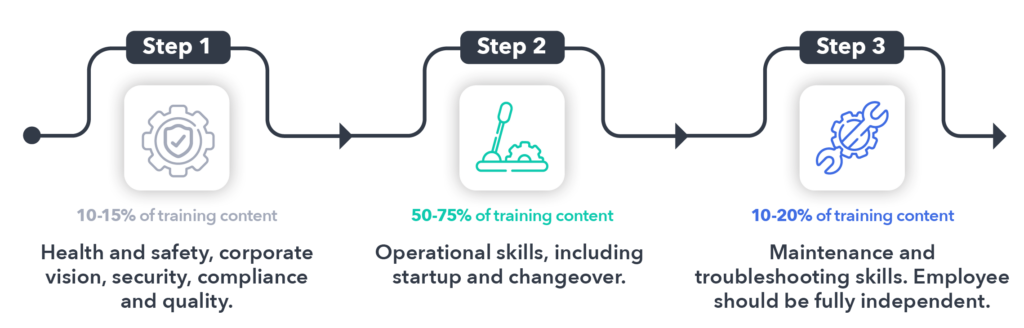
It’s essential to have a standardized training process that covers all the necessary skills for new frontline employees. These are the three main categories that we recommend covering in your onboarding program:
- Corporate and Factory-Wide Foundations: This includes health and safety, corporate vision, security, and quality training that is necessary for compliance and required for all employees. Although this type of training typically only makes up 10-15% of all onboarding content, it can be resource-intensive due to the number of team members needed to track and run the sessions, plus the ongoing recertification requirements. Foundational training is often conducted in a classroom or via eLearning, with online exams.
- Safety Training covers safety regulations, emergency procedures, and PPE requirements.
- Quality Training is critical for maintaining quality standards and ensuring adherence to regulations. It covers product quality control, process validation, documentation, audits, and non-conformance management.
- Company Culture and Values introduced during onboarding include the company’s mission, vision, core values, and the employee’s role in achieving the organization’s purpose.
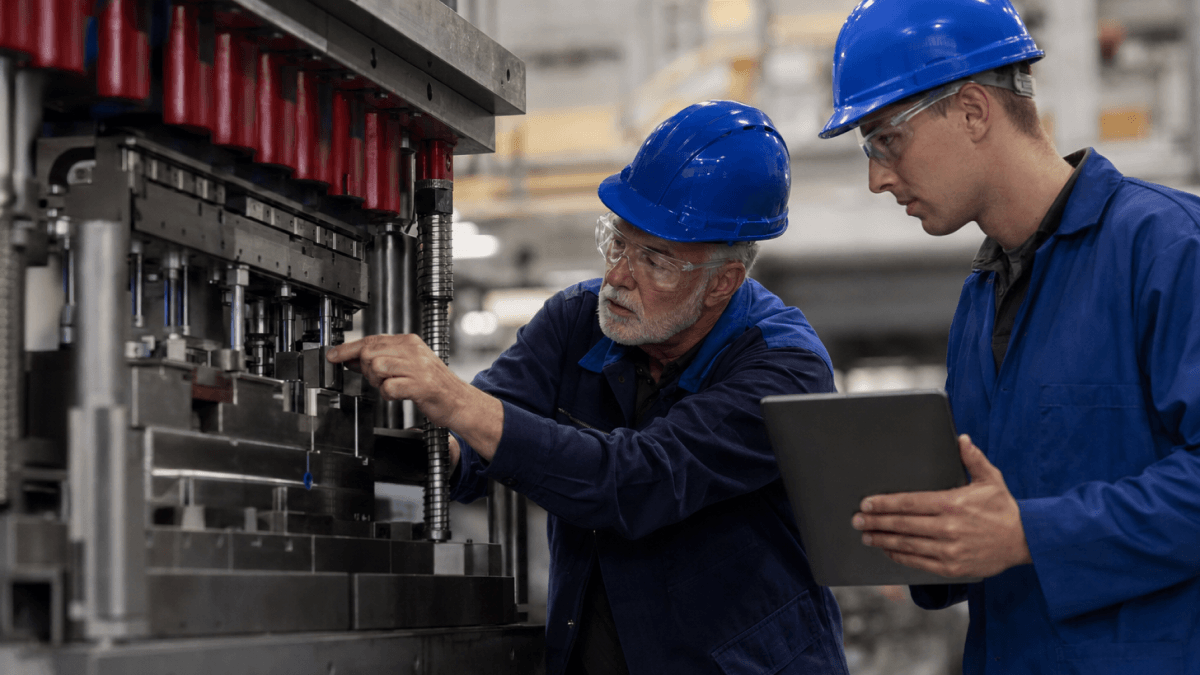
- Role-Specific Operations: This category covers the role-specific skills required for effective job performance. Training content should continuously evolve to reflect best practices gained from production. This category should make up the majority of the training content, ranging from 50-75%. On-the-job shadowing is a traditional way to deliver this training, but it can result in inconsistencies and scheduling can be difficult when senior team members are unavailable.
- Troubleshooting & Maintenance: The final category covers troubleshooting and maintenance skills, which is typically 10-20% of the training content. The emphasis placed on this content varies by role and whether a Total Productive Maintenance (TPM) program is in place.
Modernize Onboarding With a Connected Worker App
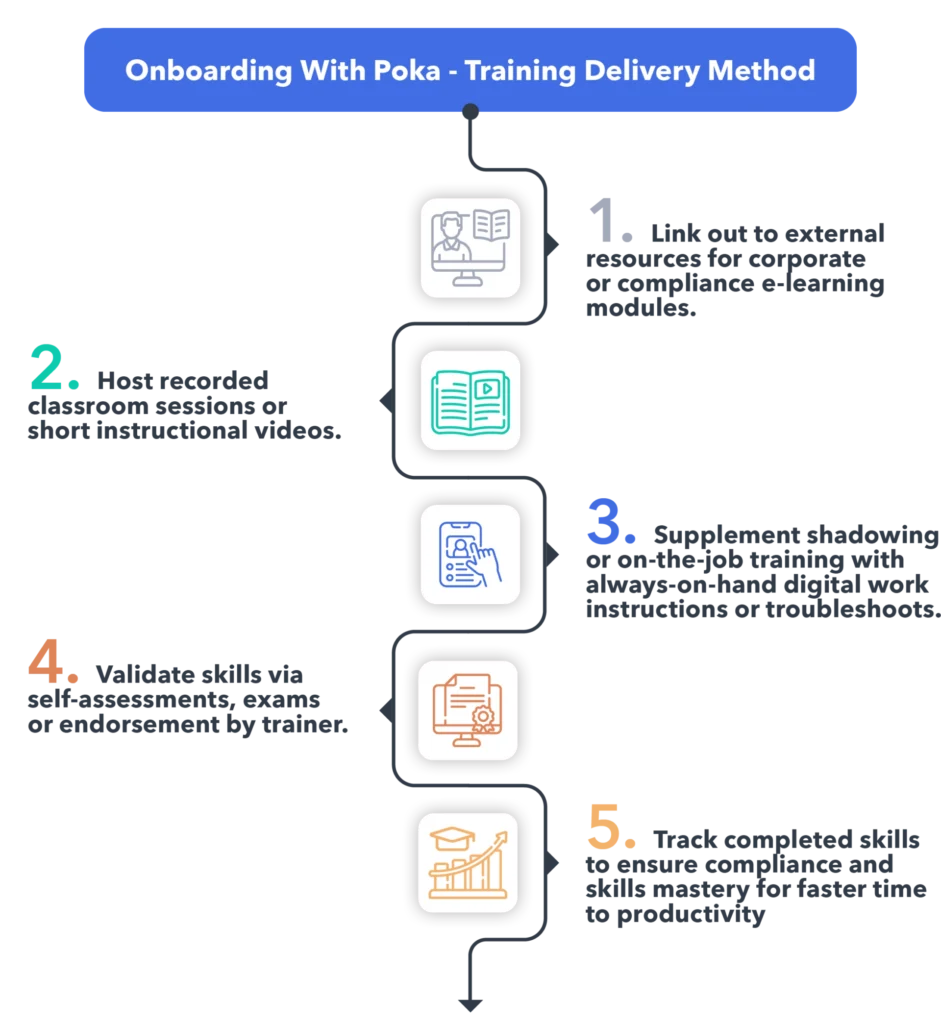
Traditional factory training has its limitations, especially in the current context of labour shortages and high employee turnover. Connected Worker apps supplement traditional training methods and reduce reliance on these limiting techniques, resulting in more efficient and effective onboarding. The goal of a Connected Worker app is to modernize the training process by providing real-time access to standardized training material and transparent career development tracking – thereby supporting continuous learning beyond formal training events. By doing so, apps like Poka turns new hires into autonomous learners and collaborators.
How to Use Poka’s Connected Worker App
If you’re looking to optimize your manufacturing onboarding process, a Connected Worker app like Poka can help you tackle common challenges in a variety of ways:
- Create a training plan: Poka’s Skills feature makes it easy to build a three-step training plan that prioritizes critical areas first, providing new hires a clear roadmap with professional development milestones.
- Standardize your training content: Digital Work Instructions offer role-specific training content that ensures all employees receive the same high-quality training.
- Conduct uniform evaluations: Poka offers various methods to evaluate competencies, providing a reliable and consistent way of verifying understanding and tracking compliance.
- Simplify training administration and content creation: Automatic skills management reduces L&D workload and improves administrative efficiency by assigning skills automatically, logging progress, and enabling faster content creation and revision
- Improve communication during onboarding: Poka’s Factory Feed and Issues Management features allow new hires to get to know team members and reach out for help when needed, improving engagement and knowledge sharing.
- Give control to learners: Poka allows learners to access training content anytime, anywhere. Autonomous learning empowers them to be proactive in their development, leading to better engagement and retention.
- Ensure compliance and safety: Track and audit training records in real-time with Poka to mitigate risk and ensure compliance, ultimately keeping the workforce safe and knowledgeable.
Benefits of Digital Training in Onboarding
Skills gaps and labour shortages are driving up training delivery costs. One of the best ways to counteract these challenges is to get new hires up to speed quickly. This is where digital training tools can make a difference. Autonomous learning supported by traditional training methods is proven to shorten onboarding times. Using a digital learning tool like Poka, new hires have independent access to training content whenever they need it, leading to faster time to productivity and a more efficient workforce. Poka has helped reduce onboarding times by as much as:
- -15% at Tyson Foods,
- -50% at Barry Callebaut,
- and -40% at Danone
Poka not only streamlines the onboarding process and reduces reliance on in-person training. It also helps manufacturers improve productivity. By quickly learning and mastering the necessary job skills, new hires can help realize significant productivity gains. L’Oréal Canada was able to onboard 26 new employees in one year using Poka while achieving a 5% month-over-month improvement in Overall Equipment Effectiveness (OEE), instead of suffering the temporary dip that normally accompanied their new hire training.
Getting New Hires On Board
Connected Worker apps provide a modern approach to onboarding for manufacturers that can improve the quality of the experience for new hires, reduce costs and save time. By delivering personalized, role-specific training that is easier to retain and comprehend, manufacturers can better engage employees, reduce turnover, and increase productivity, making employee onboarding vital for a company’s success in the manufacturing industry.
For more details on how a Connected Worker app can revitalize your training and real-world case studies on how to get new hires up to speed faster through onboarding best practices, download our e-book.
FAQs About Onboarding Manufacturing Employees
It helps new hires understand expectations, safety rules, and company culture, improving retention and performance.
Inconsistent training, lack of standardization, and difficulty tracking progress across shifts or sites.
They centralize training, enable self-paced learning, and give managers real-time visibility into progress.
Safety, quality, company values, and role-specific operations tailored to the employee’s job.
Track metrics like time-to-productivity, training completion, safety incidents, and retention rates.