



Published on June 4, 2024
How is AI transforming the connected worker experience?
For the past few years, Artificial Intelligence aka: AI has been the buzzword in technology. Never in our history has a technology brought with it the opportunities to transform the way we learn, interact and work. However, it wasn’t until the recent and sudden popularity of Generative AI found in tools like ChatGPT, that the true potential benefits of AI started to go mainstream for businesses and technology companies alike.
Read on, but first a little history…
AI – The Concept is Born
The concept of using machines to help solve complex problems and drive new efficiencies is nothing new. In fact, the evolution of artificial intelligence (AI) began during the second world war with the work of Alan Turing, a British mathematician. He is most famous for being credited (and the team at Bletchley Park) for building a machine called the Bombe. This machine used logic to decipher encrypted messages generated by the German Enigma Machines that helped to end the war an entire two years earlier than anticipated – saving millions of lives in the process!
In the 1950s, Turing proposed the idea of a “universal machine” that could perform computations similar to those of any human computer. His 1950 paper, “Computing Machinery and Intelligence,” introduced the concept of what is now known as the “Turing Test”, a criterion of intelligence that a machine could pass by exhibiting indistinguishable behavior from that of a human. This ushered in the concept of AI.
The Genesis of AI in Manufacturing
For over 100 years, the world’s most successful manufacturers have excelled at two things: speed and execution. Pick any business and any market – moving faster and being more responsive is always better. Modern concepts such as Lean, Industry 4.0, Digital Factory / Transformation all benefit when technology can be used to advance an organization’s speed and execution.
Few industries are better poised to benefit from applied AI capabilities than manufacturing. Therefore, major manufacturers are turning to the power of AI to enhance their efficiency, accuracy, and productivity across their various processes. Not waiting around, traditional business systems vendors such as ERP and MES are well on their way to evolving their solutions with AI capabilities to improve things like:
- Supply chain management
- Assembly line optimization
- Predictive maintenance and more…
This evolution is to help drive a transition from manual, error-prone processes to more predictable and reliable systems. But what about front line workers? Their performance has a huge impact on achieving manufacturing excellence, but of course they are human. This sets the stage for AI adoption in today’s connected worker platforms.
The Rise of AI in Connected Worker Platforms
Given the current labor challenges (i.e.: attract, train, retain, upskill, capture retiring knowledge, etc.) facing manufacturers, coupled with the need to drive speed and execution to remain competitive, the industry has seen a rise in connected worker platforms.
Today’s connected worker platforms are traditionally a combination of cloud-based software, mobile apps and devices that improve the way frontline workers operate in manufacturing settings.
Complete (fully-integrated) connected worker platforms (like Poka Inc.) provide everything a manufacturer needs to optimize worker performance in a single, unified platform such as:
- Knowledge Management – Access to Information, when and where you need it
- Training & Skills Management – Accelerate skills development and reduce training time
- Communication – Connect team members and improve collaboration
- Forms and Checklists – Standardize operations and improve workforce productivity
- Issues Management – Track, understand and assign ownership to solve problems faster
- Analytics – Track KPI’s and gain insights for better decisions, faster
- AI – For optimal efficiency
Focussing in on the last bullet, AI greatly enhances the value proposition of connected worker platforms by empowering the worker with capabilities and insights designed to reduce an organization’s time to value and further empower new levels of efficiency.
Examples include:
Reducing Time to Value:
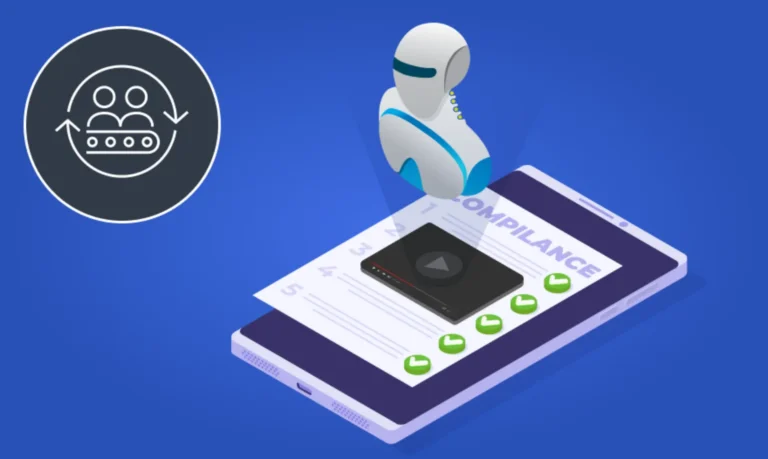
Convert Documents to Digital Work Instructions with AI
The full value of connected worker solutions can be delayed due to the time and effort required to import and build the required digital work instructions into the platform. Using AI, you can accurately convert lengthy, written standard operating procedures into digital work instructions in a matter of minutes, dramatically reducing deployment times, allowing for more rapid adoption and providing the organization a much faster time to value.
Empower New Levels of Worker Efficiency:
AI-Powered Search
An unproductive worker is an expensive worker. AI can empower workers to work smarter, not harder by providing them with intelligent search capabilities that not only grasps their inquiry’s intent, but also adapts to human nuances like typos or vague terms. This ensures quick and accurate responses to inquiries like how to troubleshoot a broken mixing machine with a jammed mechanism. AI makes sure they are presented with the right information at the right time.
Intelligent Multilingual Transcriptions
Most global manufacturers struggle to ensure critical operational content is available in all the languages of a diverse workforce. Not anymore… AI-powered transcription can break down global language barriers and encourage worker inclusion. This is an intelligent capability that automatically translates the audio from videos into relevant subtitles in the preferred language of the user. Not only does this reduce the effort to create and maintain content, it improves the comprehension and retention of information leading to better safety, quality and productivity.
AI-powered Text Enhancement
Concise communication and comprehension is key to helping improve worker and team productivity. When you’re working in a fast-paced and loud manufacturing environment, errors are naturally going to happen. But what if workers had a tool that could intelligently interpret the user’s input, and beautify it by automatically improving its grammar, vocabulary and punctuation to ensure optimal readability.
For example: Within the application, if a user types: “I need hlp with ths mackine it is giving theror code #234”. The AI would automatically interpret it and return the output to the desired recipient, in this case maintenance as: “I need help with this machine, it is giving error code #234.”
You can see by communicating more accurately and naturally how maintenance could instantly respond while the user wouldn’t need to spend time correcting their input. Especially important in plants where multiple languages are the norm. All these small things that add up to a big increase in accuracy and time savings.
The Impact of AI on Workers and Operational Efficiency
The most significant impact of AI-powered connected worker solutions is the potential to drive efficiency and remove any barriers that could impact performance. By equipping workers with connected worker platforms with AI-enhanced capabilities, workers are empowered to perform tasks safer, faster and with greater accuracy and confidence. In doing so, shouldn’t this help your organization achieve its speed and execution goals?
Conclusion: The Future of Manufacturing is AI-Enhanced
The future of manufacturing lies in the further integration of AI capabilities within primary systems including connected worker platforms. As AI technology continues to evolve, its potential to transform the manufacturing industry becomes even more pronounced.
It is our opinion that despite the rise of automation and AI, we believe humans will remain indispensable in manufacturing due to their decision-making, creativity, and adaptability, something AI can’t do yet. As roles evolve, workers will need new skills. Providing them with the necessary tools and training to work alongside and be augmented by AI will ensure a productive synergy between human ingenuity and machine efficiency.
For companies like Poka Inc., staying at the cutting edge of AI integration is not just about keeping up with competitors, but about our goal of helping our customers set new standards for operational excellence, worker empowerment and time to value