





Published on November 17, 2023
Learn how Poka supports quality checks like equipment calibration, sanitation, and foreign material investigation, integrating digital reporting and issue resolution.

Key Takeaways
- Quality checks ensure consistent, compliant, and safe products.
- Paper-based checks are slow, inconsistent, and hard to track.
- Connected Worker apps digitize and standardize key quality checks.
- Real-time alerts speed up issue detection and resolution.
- Digital records support continuous improvement and knowledge sharing.
Quality checks play a pivotal role in maintaining the highest standards throughout the production process, ensuring that products leaving the assembly line meet customer expectations. In this blog, we’ll dive into three common types of checks you can digitize and streamline using Connected Worker apps, and why it’s important to engage your frontline workers in support of a quality culture. When integrated into daily management practices—such as shift handovers, team huddles, and Gemba walks—these checks become part of the everyday rhythm of operations, helping teams catch issues early, reinforce accountability, and continuously improve product quality.
The Importance of Quality Checks
Quality checks are of utmost importance for several reasons. First and foremost, they ensure that products meet the required standards and specifications set by both regulatory bodies and customers. By conducting thorough quality checks at various stages of the manufacturing process, manufacturers can detect and rectify any deviations, defects, or non-conformities, thereby preventing the production of subpar or faulty products. This, in turn, leads to higher customer satisfaction, increased brand reputation, and repeat business.
Moreover, quality checks play a pivotal role in enhancing overall operational efficiency. By identifying and addressing issues early on, manufacturers can reduce the likelihood of production delays, rework, and wastage of resources. Streamlining the production process through effective quality checks minimizes the risk of costly mistakes and ensures a smooth and continuous flow of operations, optimizing productivity and reducing manufacturing costs.
In addition to meeting regulatory requirements and improving operational efficiency, quality checks directly impact consumer safety. Faulty or defective products can pose serious safety risks to end-users, resulting in legal liabilities and reputational damage for manufacturers. Regular quality checks help mitigate such risks by identifying potential hazards and ensuring that products are safe before they reach the market.
Ultimately, quality checks contribute to building a culture of continuous improvement within the manufacturing organization. Manufacturers can identify trends, defects’ root causes, and improvement areas by closely monitoring and analyzing quality data. This data-driven approach empowers them to make informed decisions, implement corrective actions, and refine their processes, leading to higher product quality, greater efficiency, and a competitive edge in the market.
Drawbacks of Traditional Quality Checks
Several significant challenges can impede the overall efficiency and effectiveness of traditional quality checks. Among these are issues related to standardization, communication, and centralized documentation of troubleshoots.
Traditional quality checks often rely on manual paper-based processes. Data is on paper and stays there or at best, is re-keyed into Quality Management Systems. The process is inefficient, error-prone and limits the ability of leaders to identify issues in real-time and take quick action. Quality checks are often skipped or inconsistent, making it difficult to analyze trends across shifts and workers.
Communication about quality issues between departments and team members often relies on verbal exchanges or paper documentation. This can lead to delays in relaying critical information, misinterpretation of issues, and difficulties in tracking the status of ongoing investigations. Important details about quality deviations may not be effectively shared, leading to missed opportunities for collaborative problem-solving and continuous improvement.
Traditional quality check methods may not have a centralized and standardized method for documenting the troubleshooting process and its resolution. Vital information related to root causes, corrective actions, and successful solutions may be scattered across various paper-based forms, making it cumbersome to access and retrieve this knowledge for future reference. As a result, similar quality issues may reoccur, leading to repeated problem-solving efforts and inefficiencies in addressing known challenges.
Types of Quality Checks Possible Using Connected Worker Apps
The following section will explore how Poka’s Digital Forms and Issues Management features empower manufacturers to perform essential quality checks, such as equipment calibration, sanitation checks, and foreign material investigation, ensuring the delivery of top-notch products.
1. Equipment Calibration
Ensuring precise and accurate equipment calibration is essential for maintaining consistent product quality. Tools like gauges, thermometers, and pressure sensors must be calibrated to provide reliable measurements. Poka facilitates this process by enabling the creation of QR codes that link to equipment. Quality personnel can conduct calibration checks by scanning the QR codes and verifying the necessary information. Poka’s innovative auto-flagging feature introduces a dynamic layer of quality control, allowing each piece of equipment to be associated with a tailored form housing predefined acceptable value ranges. This ensures that any deviation outside these ranges triggers immediate alerts, proactively preventing potential quality discrepancies. With Poka’s user-friendly interface, calibration checks become seamless, allowing manufacturers to uphold high standards of accuracy and control in their operations.
2. Sanitation Check for Lines & Equipment
Poka empowers quality personnel to conduct sanitation checks by performing audits of line or equipment cleanliness, to prevent cross-contamination and ensure product safety. After sanitation is carried out, the team can verify if the line is ready for use. This often includes a review and sign-off by a supervisor and documenting photos of the completed wash to demonstrate thoroughness. Using Poka, a detailed audit trail can be created, documenting the sanitation process and confirming that all hygiene protocols were met. By seamlessly managing sanitation checks, manufacturers can ensure that their production lines adhere to the highest cleanliness standards, safeguarding product integrity and consumer safety.
3. Foreign Material Investigation
Root-cause analysis and troubleshooting foreign material investigations are crucial in identifying and resolving deviations that could compromise product quality. Poka facilitates this process by enabling the capture of pictures and documentation of foreign material incidents. Operators can initiate investigations, which are then tracked by quality personnel through dashboards to troubleshoot processes and perform root-cause analysis. By leveraging Poka’s features, such as form-based questions and logic with answers, manufacturers can efficiently communicate and collaborate across departments to address the issue. This collaborative approach ensures that deviations are thoroughly analyzed, preventing recurrence and continuously improving product quality.
How to Use Connected Worker Apps For Quality Checks
Now that we’ve established the types of quality checks you can perform with Connected Worker apps, let’s dive into what the workflow looks like.
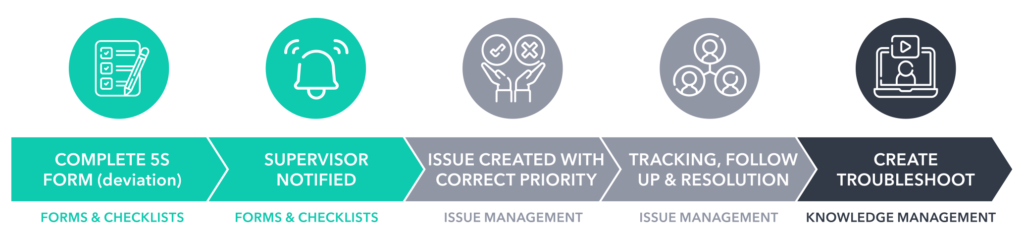
Step 1: Form Completion
This goes without saying, but a quality check starts with a checklist. Using Poka, frontline workers complete the digital form associated with the correct type of quality check. These forms have required fields ensuring a standardized process and that all relevant information is included. Furthermore, digital media can be included in the form to provide richer information if a quality issue is detected
Step 2: Notifications
In the event of a problem being identified during the quality check, operators no longer need to rely on verbal communication with supervisors or Quality personnel – they are automatically notified about the critical situation. This prompt communication ensures that the issue is addressed quickly and prevents any further impact on the production process.
Step 3: Creation of Issue
Upon receiving the notification, the supervisor escalates the process by creating an Issue in Poka. The Issue serves as a formal record of the incident. It captures essential details, such as the nature of the issue, its location, and any relevant media (e.g., images or videos) to provide a comprehensive understanding of the problem. Incidents can even be automatically synchronized with a Quality Management System.
Step 4: Tracking, Follow-up, and Resolution
Poka allows real-time tracking of the Issue’s progress, ensuring that it is actively monitored and followed up by the concerned team members. This collaborative approach enables effective communication and coordination, leading to a swift resolution of a major problem.
Step 5: Troubleshoot Creation
After successfully resolving the issue, the recorded data and solution can be transformed into a Troubleshoot. This advanced feature allows the team to create a knowledge base that documents problems and their solutions for future reference. Troubleshoots facilitate quicker problem-solving in case of similar quality issues, promoting continuous improvement in the manufacturing process.
Conclusion
Connected worker apps provide standardized digital checklists for quality checks, promoting consistency and accuracy. They enable instant issue reporting and real-time communication, ensuring prompt resolution of problems and preventing production delays. Additionally, these apps facilitate centralized troubleshooting documentation, creating a knowledge base for continuous improvement and preventing recurring quality issues.
If you want to learn more about how Poka can help modernize your plant and improve operations, contact one of our experts today!
FAQs About Quality Checks with Digital Forms
Equipment calibration, sanitation checks, and foreign material investigations.
They standardize data, ensure completeness, and reduce human error.
Yes, it’s mobile-friendly and designed for frontline workers.
Automatic alerts and centralized tracking enable quick action.
They document solutions to build a shared knowledge base.