



Published on November 19, 2024
Lifecycle of the Connected Worker: From Recruitment to Retirement & Back Again
In today’s fast-evolving manufacturing landscape, the connected worker has become a critical asset in bridging the gap between human expertise and technological advancement. As industrial companies move toward digitalization, the role of a connected worker is more vital than ever. But what exactly is the impact of digitally connecting workers from the lens of the employee journey or experience?
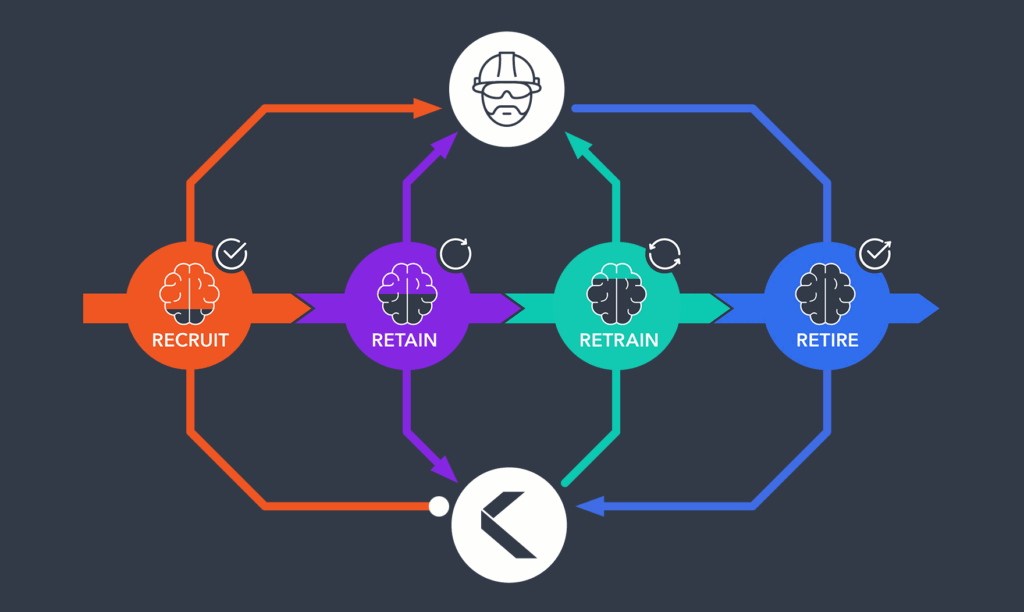
At Poka, we’ve developed a framework called “The Lifecycle of the Connected Worker.” This model consists of four key phases that form a continuous loop: Recruit, Retain, Retrain and Retire.
Each phase has unique challenges and opportunities, and when supported by a connected worker solution, organizations can optimize the lifecycle to enhance performance, retention and overall operational excellence.
Let’s take a deeper dive into these phases and see how connected worker solutions play a pivotal role.
Phase 1: Recruit
The first phase in the lifecycle of the connected worker begins with recruitment.
In this stage, organizations seek to attract qualified candidates for operator roles, while candidates evaluate the company and the job role.
This process involves the company assessing the candidate’s fit for the role, and it extends to the first week on the job once hired.
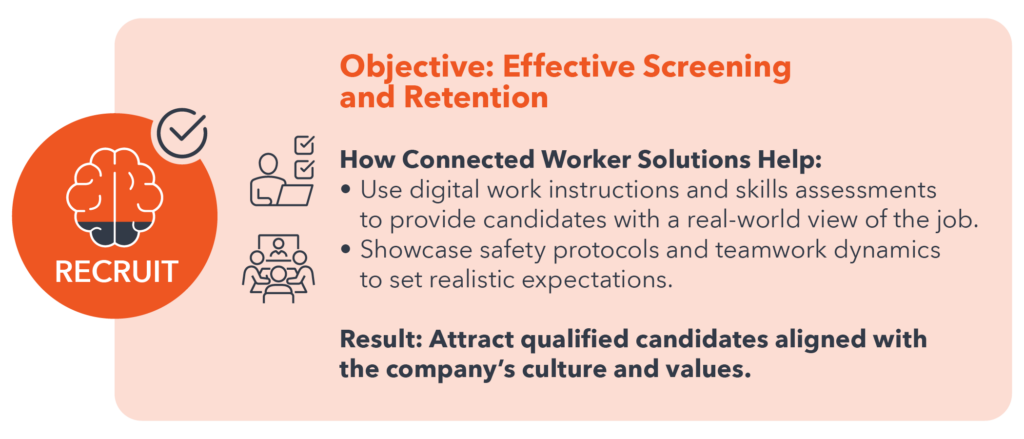
Objective: Effective Screening and Retention
The recruitment phase is crucial, as it sets the tone for long-term retention and job satisfaction. It’s not just about finding candidates with the right qualifications; it’s about identifying motivated individuals who align with the company’s values and culture. During the early stages of screening, companies can leverage connected worker solutions to illustrate what the job will actually entail while showcasing their commitment to innovation and employee development.
The Role of the Connected Worker Solution in Recruitment
Connected worker platforms can be instrumental in the late phase of the screening process. By integrating digital work instructions, skills assessments, and real-world examples of daily tasks into the hiring process, companies provide candidates with a transparent view of the job. This might include safety protocols, teamwork requirements, and other critical aspects that set realistic expectations.
For example, candidates can interact with digital work instructions that outline the tasks they will perform on the factory floor. These tools not only help candidates understand the job but also send a strong signal about the company’s investment in its workforce. By demonstrating the use of modern, frontline-focused technologies, businesses can challenge outdated perceptions that factory environments are antiquated. This is especially critical in competitive labor markets, where a company’s ability to position itself as forward-thinking and employee-centric is a key differentiator.
Additionally, these tools reinforce the company’s Employee Value Proposition (EVP) by highlighting a commitment to safety, teamwork and continuous improvement. Candidates who see this investment are more likely to feel valued and confident in their potential role, helping to attract the right talent and ensure they are engaged from the start.
Phase 2: Retain
Once hired, the focus shifts to retaining and onboarding new employees. This stage spans from the employee’s first day through the point when they achieve a minimum proficiency level, allowing them to perform the job with confidence.
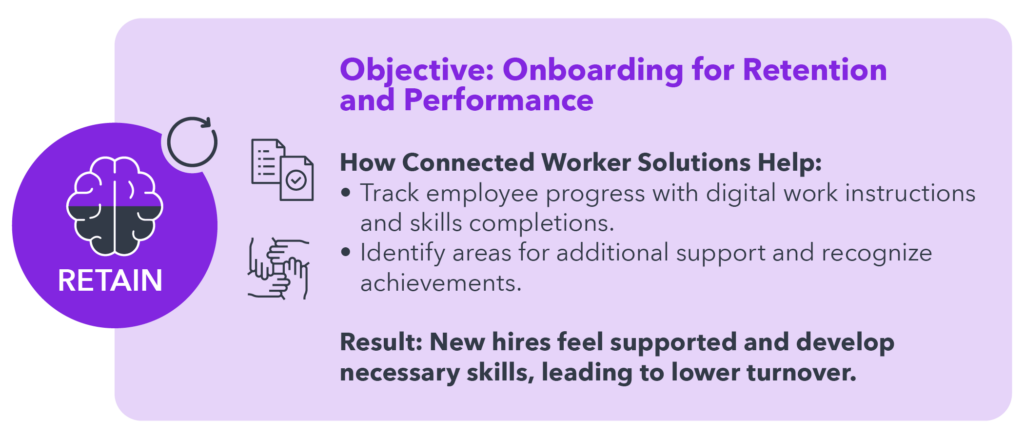
Objective: Onboarding for Retention and Performance
The retention phase is pivotal for ensuring that new hires not only stay with the company but also develop the skills necessary to contribute effectively.
It’s during this period that the balance between retention and performance becomes critical. New employees need to feel supported while also being pushed to meet performance expectations.
The Role of a Connected Worker Solution in Retention
In this phase, connected worker solutions are invaluable for onboarding. Supervisors can track how employees engage with digital work instructions, monitor their skill completions and assess their progress.
This ensures that new hires are gaining the knowledge and skills they need to perform their tasks to an acceptable level. The digital records of task completions and interactions also provide managers with a way to follow up on any areas where employees might be struggling or need additional support.
For example, a new employee might be assigned a series of digital work instructions to perform as part of their onboarding. As they work through these, supervisors can see where they excel or where they might need extra training. The platform also allows for the tracking of skills and certifications, making it easier to identify opportunities for rewards, such as pay raises, shift upgrades or additional responsibilities.
Additionally, connected worker platforms like Poka empower employees by giving them the tools to find answers on their own or reach out for help when needed. This “lifeline” ensures that workers feel less isolated and intimidated when they hit the shop floor, helping them feel better prepared and supported from day one. As a result, employees are more likely to stay with the company, reducing turnover.
In fact, a leading global confectionary manufacturer reduced their turnover rate by 9% after implementing Poka,, thanks to the platform’s ability to enhance engagement, confidence and ongoing development. Incorporating connected worker solutions in the retention phase allows for a more tailored and continuous development process, leading to better employee engagement and, ultimately, lower turnover rates.
Phase 3: Retrain
The third phase of the connected worker lifecycle addresses retraining. As industries evolve and technologies advance, it’s essential that all employees—regardless of tenure—keep their skills up to date. This phase is all about maintaining, and even improving, operational efficiency by ensuring continuous improvement (CI) in the workforce.
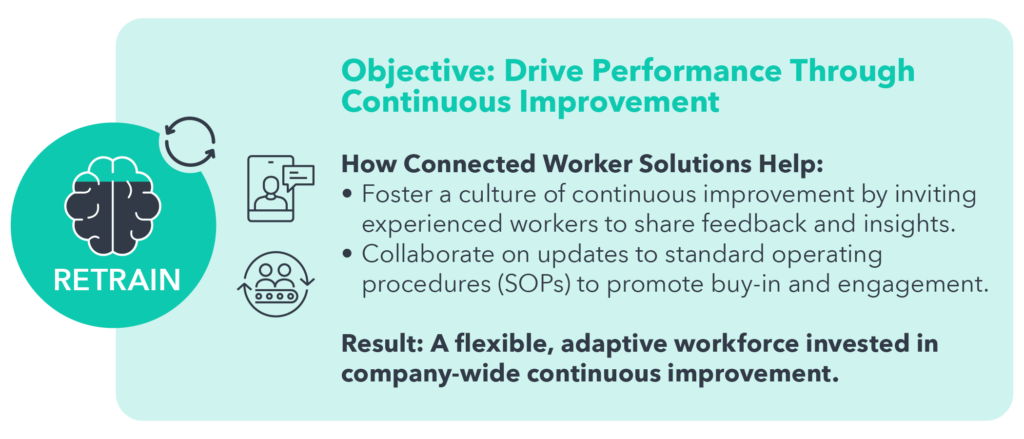
Objective: Drive Performance Through Continuous Improvement
Retraining is about more than just meeting baseline expectations; it’s about fostering a culture of continuous improvement. However, this can be a challenging phase, especially for experienced workers who might feel that they already “know it all.” It requires a strategic approach that invites employees to engage in the process of learning new methods and adopting new technologies.
The Role of the Connected Worker Solution in Retraining
Connected worker platforms can play a transformative role in retraining efforts. One of the most effective ways to leverage these platforms is by encouraging experienced workers to participate in discussions about standard operating procedures and continuous improvement initiatives. Instead of merely pushing new information, connected worker solutions allow for a “pull” dynamic, where employees are asked for their opinions, feedback and suggestions.
For example, a company could invite veteran employees to review new work instructions or CI initiatives and provide their input. This not only ensures that they feel valued but also helps to gather valuable insights from those who have extensive experience. Additionally, the collaborative nature of connected worker solutions can help build consensus around new standards, making it easier to implement changes without resistance.
The result is a workforce that is not only more adaptable but also more invested in the success of the organization’s continuous improvement efforts.
A Kaizen event serves as an excellent example of how continuous improvement (CI) can be implemented in a factory setting with the help of a connected worker app like Poka.
A Kaizen event is a structured, team-driven initiative focused on improving a specific area of production. It often involves gathering diverse perspectives—from engineers, operators and even sales—to analyze a problem and brainstorm the best possible solutions.
For instance, imagine a scenario where a machine’s infeed is frequently jammed, causing costly downtime. A Kaizen event would be organized to address this issue. The first step is setting a baseline, as there can be no Kaizen without a standard. Understanding the current state is crucial before any improvements can be made.
Once the problem is identified—such as the product getting stuck in the infeed—the team would delve into the root cause by dissecting the process in meticulous detail. Potential solutions might range from adjusting machine parts to changing operational procedures. Once a solution is agreed upon, the team formalizes a new standard work procedure in Poka and implements the necessary changes.
However, one of the critical challenges during the retrain phase is the resistance that can arise, particularly from experienced workers. For example, long-time operators might say, “I’ve been doing this for 30 years, why change now?” Overcoming this resistance is key to ensuring the full benefits of the Kaizen event are realized.
To facilitate this, connected worker platforms can be leveraged. New work instructions can be uploaded and assigned to operators digitally, allowing supervisors to track who has viewed and acknowledged them.
Additionally, the associated skill sets should be updated to reflect the changes, ensuring that workers are re-certified in the new process. This way, everyone—whether on day or night shift—receives consistent information, and supervisors can confirm that all team members are not only aware of but also trained in the new standards.
Through this structured approach and the use of connected worker tools, the Kaizen event not only drives immediate improvements but also reinforces a culture of continuous learning and adaptability across the workforce.
Phase 4: Retire
The final phase of the connected worker lifecycle is retirement. In this stage, employees have accumulated years of experience and expertise, making them valuable assets for knowledge transfer. Instead of letting their insights and lessons learned walk out the door when they leave, companies can capture this knowledge and use it to inform future recruitment and training efforts.
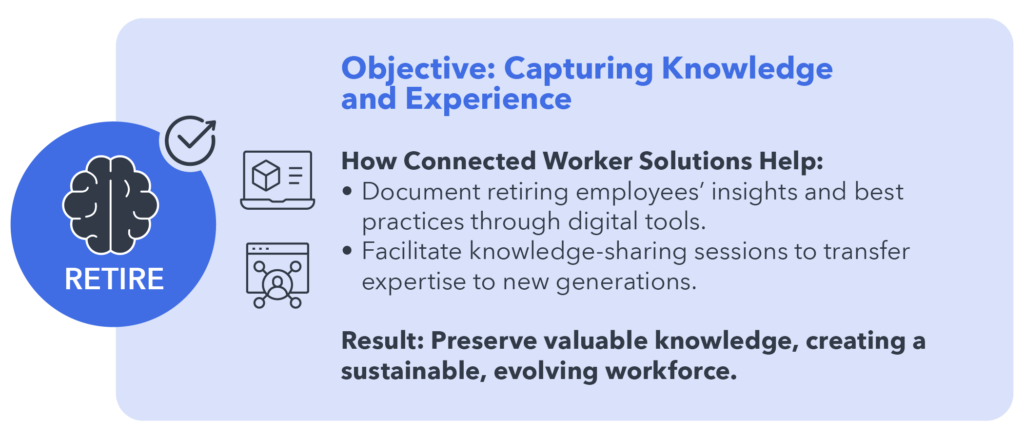
Objective: Capturing Knowledge and Experience
Retirement is not just the end of an employee’s career—it’s an opportunity to capture decades of experience and add it to the company’s collective knowledge base.
This phase is all about ensuring that the knowledge and expertise of retiring employees are retained, allowing the company to continue benefiting from their contributions even after they leave.
The Role of the Connected Worker Solution in Capturing Tacit Knowledge
Connected worker platforms provide a powerful way to capture and preserve the knowledge of retiring employees. For instance, employees nearing retirement can be asked to document their best practices, insights and personal experiences using the same connected worker tools that they’ve been using throughout their careers. This knowledge can then be fed back into the system, where it becomes a valuable resource for new hires and experienced workers alike.
Furthermore, connected worker solutions can facilitate interviews or knowledge-sharing sessions with retiring employees, where their insights are recorded and integrated into training materials. This not only helps to retain valuable knowledge but also ensures that the next generation of workers benefits from the expertise of those who came before them.
By taking the time to capture the experiences of retiring employees, companies can create a continuous loop of learning and improvement that strengthens the workforce at every stage of the connected worker lifecycle.
The Lifecycle is Not Always Linear: Navigating Time & Space with Connected Worker Solutions
While the Connected Worker Lifecycle may be described in sequential phases—Recruit, Retain, Retrain and Retire—in reality, the journey for each worker is far from linear. Workers may find themselves in different stages of the lifecycle simultaneously, depending on their skills, tasks or the specific demands of their roles.
For instance, an operator might be in the retrain phase for a new process but in the retain phase for their expertise with a different machine. This dynamic flow between phases highlights the flexibility required for true continuous improvement in the workplace.
A connected worker solution is uniquely suited to accommodate this non-linear progression, enabling workers to seamlessly access the resources they need, no matter where they are in their lifecycle. A connected worker solution transcends “time and space,” making it easier for employees to access vital information and support regardless of their current shift or location in the plant.
Real-Time Access Across Shifts and Departments
Imagine a worker on the third shift who encounters a problem—perhaps a machine is malfunctioning, or there’s an unexpected equipment issue. In a traditional setting, they might need to wait until the next day to seek help from a subject matter expert working on a different shift.
However, a connected worker solution allows the employee to log the issue, request assistance and even receive a response from someone across the plant—or from a colleague working on the previous shift. The worker knows that they can ask the question, and when they come in the next day, they should have an answer to their issue.
This access to collective knowledge across shifts not only resolves problems faster but also creates a continuous learning loop. The worker experiencing the issue is not only able to troubleshoot it in real time but also benefits from a broader pool of expertise that would otherwise be inaccessible at that moment.
In this way, connected worker apps help bridge the gap between different stages of learning and mastery, making information available to all workers when and where it’s needed.
Fluid Transitions Between Learning and Applying Knowledge
A connected worker might be in the retrain phase for a new piece of equipment, needing to review updated work instructions and adjust their skills accordingly. At the same time, they may be fully proficient in other processes or equipment, continuing to apply their expertise without additional training. This dynamic transition between learning and applying knowledge underscores the importance of flexibility in the connected worker model.
That’s why connected worker solutions offer pull-based learning, where workers actively pull the information they need at the point of use. Instead of relying on scheduled training sessions or waiting for an instructor to walk them through a process, operators can independently access training materials, troubleshoot issues and collaborate with others in real time.
The Impact on Continuous Improvement
This fluidity between the phases of the lifecycle not only benefits individual workers but also enhances the overall process of continuous improvement. Workers who can move quickly between acquiring new skills and applying their expertise help to maintain efficiency and consistency across production cycles. The ability to capture and share best practices also ensures that knowledge is not siloed, but instead flows freely throughout the organization.
The non-linear nature of these phases, supported by connected worker technology, creates a cycle of constant development and improvement. Workers are empowered to take control of their learning, while organizations benefit from a more agile, informed, and connected workforce.
Conclusion: Creating A Continuous Cycle of Growth & Development
The lifecycle of a connected worker—Recruit, Retain, Retrain and Retire—is not a linear process. Instead, it forms a continuous loop that ensures the constant growth, development, and improvement of the workforce.
By leveraging connected worker solutions at each stage, companies can enhance recruitment efforts, improve retention rates, foster a culture of continuous improvement and capture invaluable knowledge from retiring employees.
At Poka, we believe that connected worker platforms are the key to unlocking the full potential of the modern manufacturing workforce. Whether you’re looking to improve onboarding, foster continuous learning or capture the wisdom of retiring employees, a connected worker solution can help you succeed at every phase of the lifecycle.
By embracing this lifecycle approach, manufacturers can ensure that their workforce is always evolving, adapting, and contributing to the success of the organization. Contact our helpful team today to discuss how Poka can optimize the lifecycle of your workforce.