




Published on October 26, 2023
Unravel the manufacturing labour shortfall and its impact. Dive into the importance of role-specific training and practical steps for effective implementation, guided by Poka.

Manufacturers, once viewed as prestigious employers attracting lifetime workers, are now facing a chronic worker shortage. US manufacturing jobs peaked at 19.6 million in 1979 and declined 35% by 2019. Although there’s been some post-pandemic recovery, companies still struggle to fill roles. Open positions surged by 180% in the US during 2021-2022. Skilled production and management roles are particularly hard to fill. In a 2022-23 surveys, 82% of Canadian and 75% of US manufacturers experienced hiring challenges, especially in finding technical skills.
Labour shortages are costing import and export manufacturers, leading to delivery delays, higher costs, and customer issues. Most surveyed said the shortage had asignificant impact on revenue. In 2022, workforce scarcity lost companies an average of $2.8 million due to unmet contracts and late deliveries while also forcing them to postpone or drop $2.1 million in capital projects, affecting future growth and earnings.
How Are Manufacturers Responding to The Labour Crisis?
Manufacturers are addressing labour shortages by focusing on training initiatives, with 80% of American manufacturers enhancing workforce training. This not only combats shortages but also uplifts employee productivity, morale, and career growth. Reflecting this, enterprise employers are refining skill-specific training programs. Large manufacturers are primarily crafting bespoke in-house training, focusing on equipping employees with skills specifically aligned with their tasks.
What is Role-Specific Training?
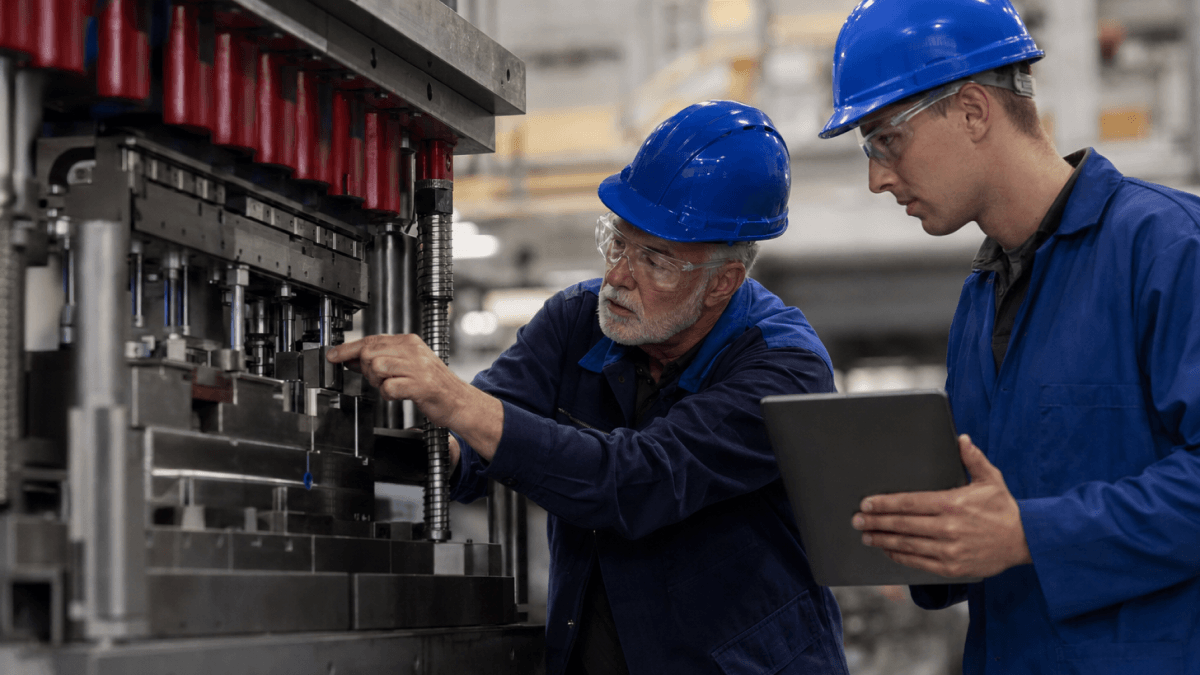
Skill-based training, also known as job-specific training, or competency-based training, is training that focuses on equipping employees with the specific competencies and knowledge required to perform their jobs effectively, rather than providing a general education. It’s tailored to the needs and responsibilities of individual job positions, while training delivery and content are aligned with the activities performed on the shop floor.
As production has become increasingly complex and automated, training programs have also had to adapt to reflect the new roles and responsibilities.
Skills-based training typically begins during onboarding once company foundations have wrapped up. From here on out, we see training as role-specific, separated by skill level:
- New Employees: Workers are learning new skills for the first time via buddying or job shadowing. These skills are typically basic operations, maintenance and cleaning tasks and are usually located in an entry-level area of production that is relatively less complicated.
- Mid-tenure: Proficient employees at the mid-pay grade, renewing skills and continuously expanding their skill set through upskilling and cross-skilling.
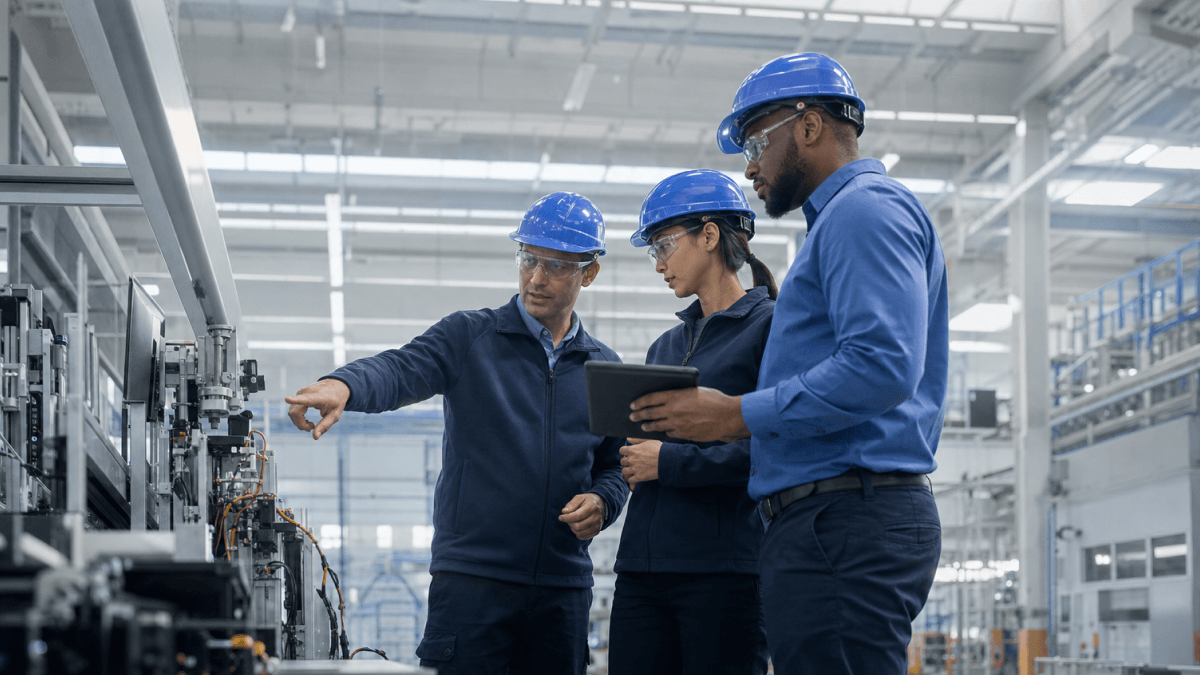
- Senior: A top-pay-grade senior staff member who demonstrates outstanding proficiency in advanced tasks, troubleshooting, and machinery operation after extensive upskilling and cross-skilling. As subject matter experts, they also act as a trainer and conduct skills assessments.
The Four Stages of Training and Their Role in Employee Retention
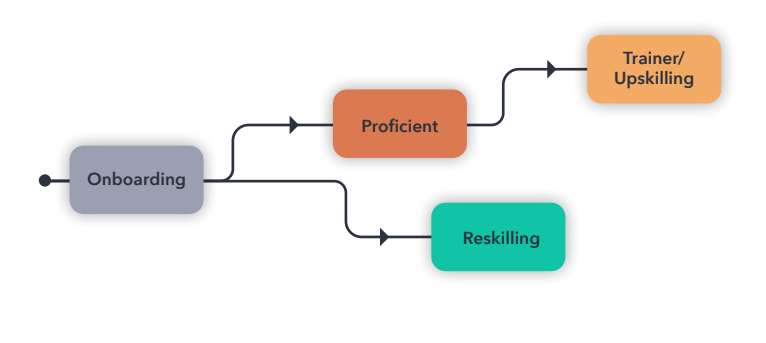
You can slice and dice a training program in a variety of ways. For the sake of this blog, we’ll be looking at the various stages of role-based training within manufacturing. We call this a company’s “training journey,” and it can be summarized like this:
Onboarding
Upon joining an organization, workers undergo an extensive onboarding phase that typically spans a few days to several weeks. The onboarding process encompasses essential factory-wide skills such as quality, health and safety and the entry-level role-specific skills necessary for equipment operation and basic troubleshooting. By the end of the onboarding period, the worker should have undergone assessments to confirm that they can work independently.

Proficiency
After the initial onboarding process, role-specific training takes center stage, guiding workers on their journey to proficiency and mastery within their designated roles. This ongoing process is tailored to their specific job functions, enabling them to gain in-depth knowledge and hone their skills. Through a variety of practical training methods, staff complete discrete skills for each job position that are tracked in their personal learning matrix. Skills mastery is demonstrated by completing quizzes, self-assessments or practical evaluations, which are also recorded. Digital solutions make training more efficient by providing a library of content that workers can refer to when needed – for independent learning or as a performance aid. The powerful ability to track training step-by-step, skill level by skill level, ensures workers cultivate comprehensive, high-quality skills so they can succeed in their roles.
Upskilling and Cross-Skilling
There’s some overlap between these two terms, but there are nuances to be made:
- Upskilling: Workers are learning and developing the complexity of their skills – think upgrading from an Operator Level 1 to Level 2. Once proficient at the task, they become your gurus and your trainers.
- Cross-skilling: This refers to cross-training workers on other job roles, lines, or equipment to provide redundancy in an emergency or labour shortage. It also provides flexibility in workforce coverage.
Upskilling and cross-skilling have gained momentum in the manufacturing sector, with 60% of manufacturers actively implementing cross-training programs, mainly focused on enhancing employee productivity and addressing labour shortages during the pandemic. These initiatives not only boost efficiency but also help combat employee turnover. The Manufacturing Institute’s 2021 Manufacturing Engagement and Retention Study highlighted the importance of growth opportunities and training programs for retaining a motivated and satisfied workforce. Reskilling
Reskilling involves retraining individuals for new roles, offering a cost-effective solution to labour shortages, technological changes, and business disruptions. As the World Economic Forum predicts that 50% of employees will need reskilling by 2025, manufacturers are increasingly embracing this approach, with 63% already starting to do so. Establishing an organization-wide reskilling strategy reduces the need for untested external hires and showcases the company’s commitment to loyal and dependable employees.
How To Execute Roll-Specific Training with Poka
A Connected Worker application like Poka can replace Excel skill tracking spreadsheets and training binders filled with hundreds of pages of printed work instructions. Poka digitally connects skills tracking and training content for a seamless training experience.
[Watch Skills Management Feature Demo]
We capitalize “Skills” to emphasize its significance as a product feature consisting of three integral components.
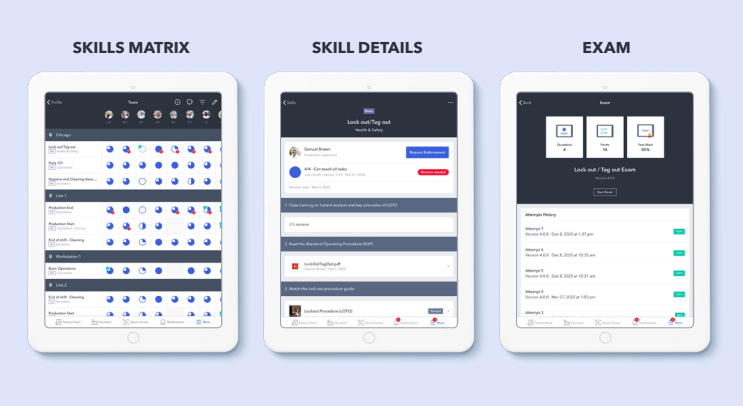
Skills in Poka are flexible multi-step training programs that can be made up of anything. In terms of content, you can include:
- Links to existing training content stored in external systems like Sharepoint or your LMS
- A mass import of your existing training content into Poka, including design documents, PDFs, PowerPoints
- Offline steps such as a mandatory shadowing period, a classroom training or an assessment by a trainer
- And last but not least, ideally your Skills in Poka include digital work instructions and troubleshooting solutions directly in the app that feature text, photo and video.
The workflow is simple: workers are automatically assigned skills based on their role and location in the plant. They can then follow the steps of the program, including reviewing the content, marking it as read/watched and then completing the exam and/or assessment. Once completed, the worker can request an endorsement and once approved, the skills matrix is automatically updated.
It’s your ability to structure and organize Skills that truly enables role-specific training.
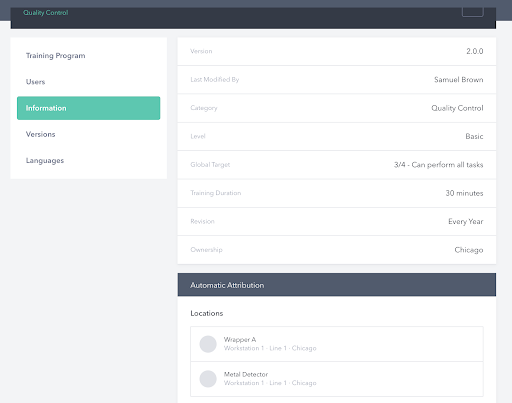
- Location: Skills can be company-wide, site-specific, or even tagged to a single piece of machinery. Factory-wide skills are primarily used for onboarding and safety or quality compliance tracking.
- Level: Skills can be classified by level to help separate out competency or pay-based distinctions.
- Job role: They can be assigned to any number of job roles to create a required skills framework for each job position. When a user is assigned a job role, all the associated skills are automatically loaded into their training plan, ensuring that nothing is accidentally left out.
Poka offers a variety of assessment options for skills mastery and compliance tracking. These include online exams with customizable formats and result analysis, hands-on assessments for practical skill observation and feedback, and self-assessments that enable trainees to evaluate their readiness ensuring skill development alignment while allowing for recordkeeping and gap discussions.
Once a skill is mastered, it’s showcased in Poka’s visual Skills Matrix, designed for easy tracking and recordkeeping for both workers and leadership. This matrix uses Harvey Balls to represent skill levels, from beginner to trainer. Symbols, like the red clock, indicate a need for skill refreshment, while a green check shows a request for endorsement. This system assists trainers in planning next steps, allows trainees to monitor their progress, aids L&D and HR in compliance checks, and enables supervisors to swiftly find qualified staff during contingencies.
Impact of Implementing Role-Specific Training
Factories that invest in overhauling their role-specific training experience see improvements in productivity, higher employee retention and lower training costs.
One cosmetics company improved OEE 5% month-over-month during the onboarding of 26 new staff members, at a complex site encompassing over 350 employees and 50 production lines. Focusing on job-related skills allowed new hires to optimize production efficiency and drive operational excellence right from the gate, instead of the decline in OEE typically experienced during an onboarding event. Without Poka the year before, the company’s OEE fell by 6% during a similar staffing situation.
Using Poka for their onboarding training, a popular power tools company was also able to improve new hire retention from 30% to 74%, year over year.
Conclusion
From comprehensive onboarding through role-specific, upskilling, cross-skilling, and reskilling, these training stages have evolved as potent strategies to combat immediate shortages and foster long-term employee growth. As manufacturing navigates technological shifts and seeks to attract new talent, training isn’t just a response to challenges—it’s a transformative force shaping a resilient, innovative, and empowered workforce ready to embrace the future.
For more information on how Poka can help you empower your workforce and fight the labour crisis, talk to one of our dedicated experts!