




Published on September 12, 2024
Discover how connected worker apps create an environment where safety compliance is a top priority across the organization.
Key Takeaways
- Building a safety-first culture saves lives and boosts productivity. A mature safety culture reduces accidents, downtime, and compliance risks while improving morale and operational performance.
- Digital tools strengthen health and safety practices. A connected worker app like Poka centralizes safety training, reporting, and communication for better visibility and control.
- Proactive safety management prevents accidents. Models like the Bradley Curve and Swiss Cheese Model highlight the importance of layered defenses and continuous improvement in safety culture.
- Real-time reporting drives continuous improvement. Digital forms for safety walks, incident reports, and near-miss tracking ensure issues are captured, shared, and resolved quickly.
- AI and digital work instructions make safety training more effective. Visual, standardized SOPs and checklists help workers follow correct procedures and maintain compliance across shifts and sites.No one should ever go home from work injured, or worse still, not go home at all. This is the number one reason for building health & safety culture maturity in manufacturing. But, it’s important to understand that workplace accidents carry costs beyond the human consequences.
Accidents disrupt production and create downtime, affect morale and even come with the risk of hefty fines for failing to meet compliance standards. In short, workplace safety is a very serious matter.
No one wants there to be an accident on the factory floor, but sometimes people make mistakes. Faulty or inadequate equipment can cause accidents too. The challenge for management is to create an environment where safety compliance is a top priority across the organization.
Beyond compliance, a strong health and safety culture demonstrates care, accountability, and operational excellence. It’s not just about preventing injuries – it’s about empowering workers to take ownership of safety and fostering trust between teams and leadership.
When employees understand that safety is everyone’s responsibility, they become more vigilant and proactive in identifying hazards before incidents occur. This shared mindset contributes to fewer accidents, greater efficiency, and a more engaged workforce.
Investing in digital safety systems, such as connected worker platforms, can make this process easier and more reliable. With tools like Poka, managers gain real-time visibility into safety performance, while workers can easily access up-to-date procedures, report near misses, and complete checklists directly from their devices. This ensures that safety compliance becomes part of the daily routine, not just a box-ticking exercise.
Ultimately, building a culture of safety is about consistency, communication, and continuous improvement – key pillars of any high-performing manufacturing organization.
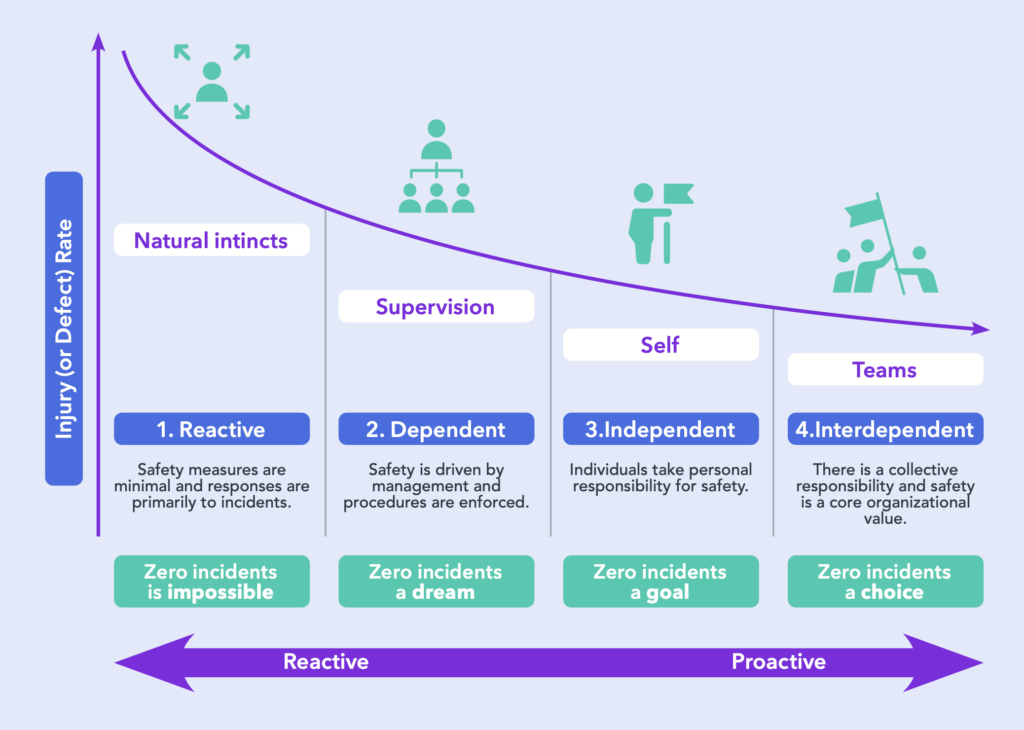
The Bradley Curve of Organizational Safety Maturity
The Bradley Curve is a model that illustrates the stages of safety culture maturity in organizations. It details the progression from a focus on compliance and reactive measures to a proactive and collaborative safety culture. It describes four phases:
You can learn more about building safety culture maturity for the factory floor by downloading Poka’s health & safety eBook.
Understanding Safety Risks and Compliance
Safety hazards take many forms. While some may be obvious, others may require more education and training for workers to take proper precautions and follow compliance standards. Take fork lift trucks (FLTs), for instance. People rarely pay them much attention on the factory floor, and yet they are responsible for many accidents and injuries. That’s why FLT awareness is an important aspect of employee safety training.
Other risks include:
- Machinery: Guards are often removed for cleaning and maintenance.
- Material handling: Sharp edges, lifting, bending and twisting can cause injuries.
- Ergonomic challenges: The position a worker has to put themselves into, the movements needed or the environment they’re exposed to.
- Chemicals: Workers should always know what they’re dealing with and the precautions to take.
- On-the-floor hazards: In the process of daily work, equipment, tools and materials can become hazards if stored or left in the wrong areas.
Companies implement safety rules to ensure workers minimize risks by following best practices, provided in the form of Standard Operating Procedures (SOPs) and delivered through (hopefully digital) work instructions. Many aspects of factory work are regulated by external agencies that require specific safeguards, training and even inspections.
The Swiss Cheese Model of Reducing Safety Risks
The Swiss Cheese Model illustrates how layers of defence (like slices of Swiss cheese) have inherent weaknesses (holes) that can align, letting hazards through. It emphasizes that while each layer may not be perfect, multiple overlapping defenses can prevent accidents by covering each other’s vulnerabilities.
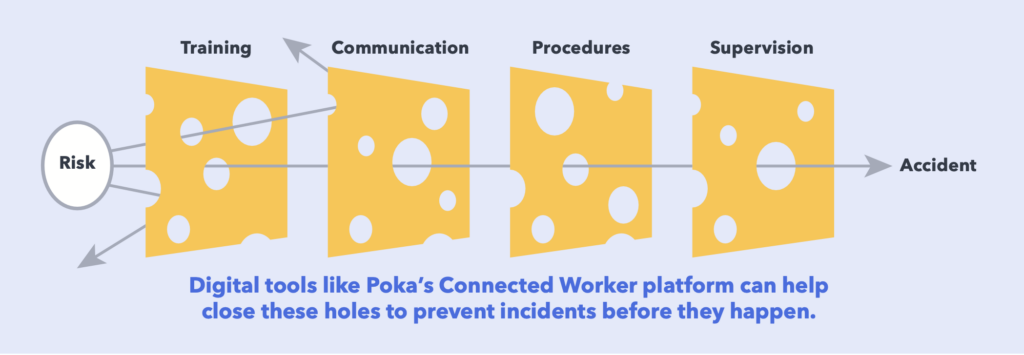
Download our health & safety eBook to explore a specific, manufacturing-focused example of the Swiss Cheese model, and learn practical strategies for building health & safety culture maturity.
The Role of a Connected Worker App in Health & Safety Best Practices
For safety-focused managers, typical challenges are:
- Providing workers with safety information in a way that can be easily understood and retained.
- Gaining insight and visibility into safety risks.
- Demonstrating compliance with the rules and regulations applied by external agencies and authorities.
A connected worker app like Poka is a tool for satisfying all three. It makes information and record management, plus regular monitoring, auditing, training and analysis, accessible from a single application. It will also integrate with your other factory systems to ensure bi-directional data flow. Specific health and safety (H&S) capabilities include:
- Visual, engaging safety training
- Documented safety standards
- Digital work instructions
- Near-miss and incident reporting
- Forms and checklists for inspections and assessments
- Communication channels to keep safety risks top of mind
Key Health and Safety Use Cases
These practical examples show the impact a connected worker app can have on organizational health and safety.
Safety Walks
Everyone should be alert to safety issues as they walk through a plant, but a structured safety walk is a valuable reinforcement mechanism. Digital work instructions on how to perform a safety walk can be stored in Poka and supported with a digital checklist to ensure it is done right.
The idea is to tour through a defined area and look for potential safety problems. This could include checking for improper material storage, faulty or misused guarding and failure to use PPE.
Issues can be captured in Poka and corrective actions to mitigate risk and improve safety can be communicated on Poka’s Factory Feed. These safety issues can then be assigned and tracked as a task, ensuring swift follow-up and resolution.

Behavior-Based Safety Observations
Like a safety walk, behavior-based safety observations (BBSO) involve looking for potential problems and improvement opportunities. Where BBSO differs is that its focus is on what people do. This requires observing activities such as routine work, cleaning, changeover and maintenance to detect deviations from SOPs.
As with the safety walk, with digital checklists a connected worker app makes BBSO easier to carry out. The app also enables scheduling and immediate requests for changes or corrective actions.
Incident Reports
Whenever an accident occurs, no matter how minor, it’s essential to capture a complete account of what happened immediately before any details are forgotten. The report must then go to the health and safety team for logging and analysis and identification of any corrective or preventive actions necessary.
Incident reporting forms can be pulled up on Poka and completed as soon as the worker has been attended to. Photos and video can be included to add more detail. The form is then routed to the health and safety team and the incident can be communicated to any production areas with similar hazards.
Forklift Inspections
Forklift inspections are mandatory in many jurisdictions. This is to ensure these heavy and powerful machines are safe for use in the crowded confines of a busy factory.
Accessing the inspection checklist through a connected worker app ensures nothing is overlooked and that a record is retained. This reduces the safety risks associated with FLTs and helps improve operational performance.
Crane and Lift Inspections
Used in many plants, lifts and overhead, gantry and derrick-style cranes are potentially very dangerous, should any component fail. To address this, various inspections, ranging from annual to daily, are mandatory.
Digital inspection checklists on a connected worker app like Poka, coupled with task assignments and reminders, are a robust way of ensuring the relevant checks are made and recorded. This guards against failure and will also satisfy any visiting inspector.
Near Miss Reporting
A near miss is a valuable opportunity to reduce safety risks and increase visibility of high-risk areas. Unfortunately, near-miss incidents are often not recorded. This changes when a connected worker app like Poka is available on the factory floor.
The app provides a means of capturing pictures and video, along with descriptive text. As well as going to the health and safety team, this can be sent out as an alert to other departments. The result is improved safety awareness and increased accident prevention.
In fact, one Poka customer reported a 20% increase in near-miss reporting, while another saw a staggering 183% increase.
Pre-Op Safety Assessments
It’s unwise to start a machine, process or line without checking that it’s in a safe condition to run. This is where pre-op safety assessments or pre-start inspections come in. Working to a checklist, the responsible worker looks for faults, damage, incorrect settings or other issues that could cause a problem.
Accessing a digital safety checklist through a connected worker app running on an industrial tablet ensures this is completed and recorded consistently. Accidents and other equipment problems are avoided, which helps improve productivity and raise OEE.
Safety Audits
Every manufacturing area should be audited periodically. This reminds people of the required practices and procedures, identifies noncompliance and captures changes requiring updates to the safety rules and practices.
Using a connected worker app for these audits ensures consistent application of standards, along with record-keeping and prompt communication of actions.
Poka customers and auditors report the time to complete audits is reduced by hours thanks to the reliable and easy to access record keeping in Poka. That increases worker safety, efficiency and compliance while minimizing incidents and the associated legal risks.
Fire Equipment Inspections
Fire extinguishers need periodic inspection, and in addition, it’s important to ensure the organization is prepared for external visits and inspections. Logging equipment and recording activities like drills in Poka helps meet fire protection inspection and readiness goals while complying with regulatory requirements.
Health & Safety Benefits of a Connected Worker App
The use cases above show just some of the ways a connected worker app supports efforts to maintain and improve workplace safety. More specifically, it:
- Improves access to critical H&S content
- Streamlines and standardizes safety training and certification
- Ensures safety standards are followed
- Helps identify and resolve issues faster
- Supports capture and analysis of H&S data to gain insight into improvement opportunities
- Streamlines the creation, access and communication of H&S content
How to Build a Mature Health & Safety Culture in Manufacturing
Safety is everyone’s responsibility. By helping to keep safety top of mind, Poka can improve compliance with regulations while reducing incident rates and safety risks. The end result is to strengthen the safety culture and make the factory a better place to work.
Building a mature health and safety culture takes more than enforcing rules – it requires engagement, communication, and shared accountability. When every worker understands how their actions contribute to overall safety, the organization moves from reactive compliance to proactive prevention. This cultural shift not only reduces accidents but also enhances productivity, morale, and trust across teams.
Manufacturers striving for safety excellence should focus on three key pillars: visibility, consistency, and empowerment. Visibility ensures management can monitor safety performance in real time; consistency guarantees that every employee follows the same standards; and empowerment gives workers the confidence and tools to report hazards, suggest improvements, and take immediate action.
Digital solutions like Poka’s Connected Worker platform make these pillars achievable. By centralizing safety training, audits, and incident reporting, Poka bridges communication gaps between teams and ensures that safety procedures are easily accessible on the factory floor. Real-time insights and digital records also support faster decision-making, better compliance tracking, and continuous improvement.
If you’re looking for tools that will support your safety initiatives, have you considered Poka? Contact our team to learn about implementing Poka for better safety and compliance.
Together, we can build safer, smarter, and more resilient factories – where every worker goes home safe, every day, and safety excellence becomes a core part of operational success.