





Published on June 15, 2023
Verbal and paper-based processes can make passing an IATF 16949 audit challenging. Poka helps digitize complex requirements, making it easier to prepare for and excel in your next audit.
Key Takeaways
- Align company practices with auditor interpretations of IATF 16949 requirements.
- Prepare personnel for interviews to manage human factors effectively.
- Use digital tools to streamline communication, training, and document control.
- Connect quality, communication, and improvement processes to reduce audit risk.
- Gain insights from Lead Auditor Michael Wolfe on auditing digital systems.
Navigating IATF 16949 audits can almost be considered an art. You have to first bridge the gap between your company’s and the auditor’s interpretation of the IATF requirements, you have to consider the human factors involved with the personnel who will be randomly selected for interviews during the audit, and you have to balance the real world aspects of daily tasks with the auditor’s theoretical desire to see controlled perfection.
With the above mentioned navigations, passing audits without nonconformances can be quite challenging, and operating an IATF compliant Quality Management System without the proper digital support only adds to this challenge. Automated links between communication, flow of information, document control, training, quality issues, and improvements are one of the most critical aspects to risk-proofing your IATF 16949 audits.
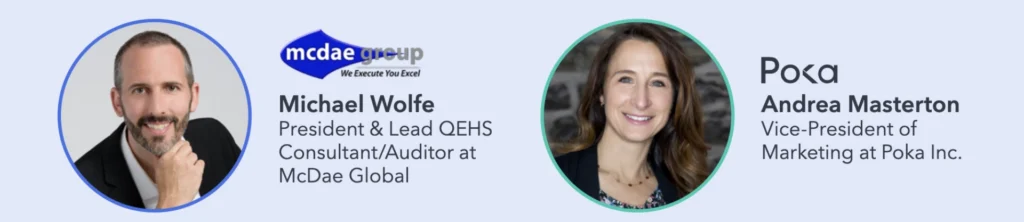
Michael Wolfe, Lead IATF Quality Auditor with McDae Global, sat down with Andrea Masterton, VP of Marketing at Connected Worker software provider Poka, for a conversation about the ins and outs of auditing work instructions, training records, stand up shift meetings, operator-led TPM activities and continual improvement initiatives.
1. Digital Access to Work Instructions for IATF 16949 Audit Readiness
MW, IATF Auditor: Current versions of standardized procedures or operator instructions must be accessible for reference at designated work areas. Normally companies manage this in one of two ways. Providing operators with paper hardcopies or soft copies on the company server accessible by a workstation. While printed work instructions aren’t against the rules, they pose a high risk and are definitely not the most effective option. Auditors are likely to hone in on this practice for a number of reasons, first, hardcopy instructions can get dirty, damaged, or easily misplaced, and second they can become obsolete if not replaced when the document is revised (again reliance upon human memory and knowledge). This is especially common when an operator creates their own personal stash of work instructions (via photocopies) that nobody else knows about. The master version is revised and gets replaced, however the operator’s personal version does not get replaced. This leads to an easy nonconformance in an audit as the operator is using obsolete work instructions.
AM, Connected Worker App: There’s a third option now, too. Digital work instructions are a lot more user-friendly because they bring together instructional videos with your typical written standards. They’re also nearly impossible to lose because operators access them by scanning a QR code posted on the equipment. They’re also updated automatically when any new changes are published, so everyone is also accessing the most current version.
2. Maintaining Training Records and Demonstrating Competency During an IATF 16949 Audit
MW, IATF Auditor: In a thorough audit, nonconformances related to training could be written nearly 80% of the time. The difficulty of this requirement centers around being able to provide evidence of both the training provided, and more importantly the effectiveness of the training provided. This is an area of weakness for companies and it is a common point of stress.
I typically see this tracked in an Excel document or some kind of manually updated training matrix. The problem with these manually updated documents is their reliance on human memory and/or a consistent “checking in” on a periodic basis. Additionally, when a production work instruction is revised, there is no automatic pathway to these manually updated documents alerting the need for updated training. Again, reliance upon human memory or communication.
AM, Connected Worker App: Automatic updates and notifications are definitely something that software can do that helps ease the burden of training administration. It can also create a closed loop between standard work and training. Going back to your example, an operator has their own personal training matrix that they can refer to, while a supervisor or HR can check the status of an entire team. Everyone knows what trainings they need to do to perform their role and they can see their real-time status.
When any work instructions or training is updated, a virtual alarm bell goes off telling operators they need to refresh their training or read the revised standard. And for auditing purposes, you have an incredibly detailed record of all your staff’s learning and development activities for the past year. You can see what the workers were trained on, who watched the training content and when, and all their assessment details.
To prove understanding and knowledge retention, there are a number of assessment options including written exams and hands-on assessments that are backed by a qualified endorser.
MW, IATF Auditor: I can definitely see how Poka’s exam and endorsement features can be powerful tools because it gives trainers the opportunity to review the exam or assessment results and decide if the training was effective or additional training is needed.
Proving competency can be difficult as it is up to the interpretation of each individual auditor. Some are satisfied with reviewing a short exam as it demonstrates to them that the operator attended the training, listened, and had some understanding of the content. Other auditors want to see stronger evidence since a simple quiz may not translate into applicational competence. The reason I like Poka’s concept of an endorsement feature is that it puts the onus on another person to say, “I’m willing to stake my name on the trainee’s applicational performance of the task they were trained to”. The endorsement provides evidence that an independent person signed off on the fact that the trainee is doing the task repeatedly and well, and they fully understand it.” This is much stronger evidence than a quick 5 question true/false test taken immediately following a training.
AM, Connected Worker App: Another step in demonstrating competency that we’ll get more into later is digital forms. Let’s say the operator is being trained on performing a CIL. First, he watches a work instruction video. Then he fills out a digital checklist to ensure he’s following the 10 steps consistently every time. Any wrong answers or deviations are going to be automatically flagged for his supervisor in a centralized dashboard.
MW, IATF Auditor: That’s another potential way to help prove competency. If you can associate staffing to repetitive mistakes, you can see performance trends associated with specific production lines or operators. This could be a leading indicator that the training program is inadequate. There are other factors that would need to be considered however at least this can provide a link to the evaluation of training effectiveness.
3. Indelible Factory-Wide Communication to Support IATF 16949 Audit Compliance
MW, IATF Auditor: Manufacturers are required to communicate customer quality issues with operators. This is typically done during daily or weekly stand-up meetings, or information posted in a designated area. To audit verbal communications, I’ll randomly select some operators and have a conversation with them to discover how they normally find out about quality issues and review what was covered in their most recent stand-up meeting. If there’s a performance dashboard or 5S area, I’ll check to see if the posted information is relevant and current. Again, reliance upon human memory and manual updating. Also, if they want to dive deeper into a specific quality issue, they either have to go to the posted information (leaving their workstation) or go back to the person who provided the verbal information.
AM, Connected Worker App: Supplementing shift meetings with a factory-wide newsfeed can provide a written record demonstrating important information was shared with the right people. Selected posts can be pushed out to specific teams and workstations, verified with a viewing history. A lot of companies will even snap a photo of their whiteboards at the end of every meeting and quickly post that for a timestamped record.
4. Digital Forms for Timestamped Production Setup, Verification, and TPM in IATF 16949 Audits
MW, IATF Auditor: IATF requires set-up information to be maintained and made available for workers. To verify production start-up, many manufacturers will have a paper checklist on a clipboard at the machine. However it isn’t uncommon to see operators preemptively completing the checklist for the coming weeks or months. I see this a lot for preventative maintenance as well. Everything is pre-signed and checked into the future!
AM, Connected Worker App: The downside is that your information is now useless, should you need to do any problem-solving or analysis. Checklists are a valuable tool to help ensure standard work is followed at startup and that preventative maintenance tasks are actually completed at the right time. The benefit of using a digital checklist is that it can be scheduled for completion at a specific time and provides timestamped verification.
MW, IATF Auditor: If a company is a TPM practitioner, operators rarely have access to the maintenance execution system. Typically this is handled via hard copy paper checklists at each piece of equipment that are completed, gathered, and scanned at the end of the month. Again, reliance upon human factors.
Companies with a good MES don’t have issues with this section of the standard. But for those without, it can be tough. If maintenance delegates any preventative maintenance tasks to operators, I have to audit that they know what tasks they’re supposed to be doing and how frequently. I have to see proof that they’re completing the work as often as prescribed.
AM, Connected Worker App: Yes, TPM is a great example of digital work instructions and scheduled forms working hand-in-hand. Operators get an alert during their shift that a preventative maintenance task is due. If they need a refresher, they can go back and review the work instruction. Once the task is done, they complete their checklist and any deviations are automatically flagged, for maintenance or the line supervisor to review.
5. Capturing Operator-Driven Continual Improvement Initiatives for IATF 16949 Audit Success
MW, IATF Auditor: Manufacturers are required to continually improve production processes by focusing on reducing process variation and waste. During an audit, I have to be able to identify improvement plans, verify that actions are being taken accordingly, and that the improvements are generating the intended results. It’s a challenging requirement to audit, and it’s challenging for companies to meet.
Implementing and tracking continual improvement can be difficult. Many companies use an Excel spreadsheet with all their improvements listed, some use a Gemba type board with the most recent or current improvements posted. Additionally, to capture operator feedback for potential improvements, it’s usually either an hard copy piece of paper being filled out, a verbal conversation, or a suggestion box.
AM, Connected Worker App: That’s a shame. Continual improvement should be a living, breathing cycle. And oftentimes, good ideas don’t have to be big and heavy to implement. Paperwork creates a barrier that’s an effective idea-killer.
Issues Management features in Connected Worker software are already used by other industries for continual improvement, outside of IATF requirements. Primarily shop floor employees use it to quickly log problems or suggestions. Once reviewed and accepted, an improvement project is displayed and tracked on a dashboard for everyone to see, keeping a running list of in-progress priorities. To meet the second portion of the mandate, tasks can be assigned to specific people and linked to the project to document progress.
Digital work instructions and troubleshoots also make it easy to make sure supporting documentation is updated.
MW, IATF Auditor: I’m a big fan of operators being able to contribute to continual improvement efforts. They’re the experts at what is happening in the manufacturing environment. Sometimes top down continual improvement ideas can get over-complicated, but operators have real-world experience and can make different kinds of suggestions that make things safer, faster, and more efficient.
Achieving Sustainable Excellence Through Digital Tools and IATF 16949 Audit Preparedness
Efficient information management is crucial for successful IATF audits, and relying on outdated filing systems and hard copies can lead to unnecessary stress and compliance issues. By leveraging the benefits of Connected Worker software, companies can streamline difficult-to-audit processes, enhance compliance, and unlock productivity gains across their operations.
Experience Seamless Digital Record-keeping with Connected Worker Software
See for yourself how Poka’s intuitive platform can help eliminate the hassle of paper-based systems and ensure seamless access to up-to-date work instructions, comprehensive training records, and efficient communication channels. Take the proactive step towards audit excellence and operational efficiency by exploring the possibilities of Poka’s Connected Worker software. Book your demo today.
Unlock Operational Strengths with Comprehensive Compliance Audits
Anytime an opportunity to streamline activities, remove human factors, and implement cross-functional automated digital information presents itself, I highly recommend taking advantage of it. If you are interested in seeing how Poka could help your organization, consider allowing McDae to perform an IATF 16949 compliance audit for you. This could highlight weaknesses and gaps in your system Poka has been created to strengthen or fill. Book your audit now.