





Published on September 29, 2025
Learn the do’s and don’ts of connected workforce initiatives to avoid silos and drive scalable transformation in manufacturing.
Key Takeaways
- Think beyond point solutions: Connected workforce tools should scale knowledge, training, and performance across sites.
- Technology + partnership drives success: Deployments work best with vendor coaching and alignment to business goals.
- Design for different roles: Operators, supervisors, and managers need tailored dashboards, analytics, and workflows.
- Build on enterprise-ready IT: APIs, SSO, SCIM, and automation make solutions secure and scalable.
- Prioritize transformation over digitization: True impact comes from workforce engagement, standardization, and continuous improvement.
LNS Research recently published a compelling breakdown of how to streamline connected workforce initiatives in manufacturing. Their insights highlight the real risks of investing in disjointed digital tools—ranging from lack of strategic alignment to ignoring the context of end users and IT. As someone who has worked closely with manufacturers across the globe to deploy frontline technology, I can say: they’re spot on.
But I’d like to offer additional thoughts on the LNS recommendations to have successful deployments.
Not every CFW initiative is doomed to stall at the pilot phase or become a digital bandaid. In fact, we’ve seen firsthand how the right approach—one that aligns strategy, personas and IT infrastructure—can radically elevate workforce capability, engagement and execution.
At Poka, our mission has always been to build more than a tool. We’re building a platform designed for scale, built with empathy and optimized for enterprise complexity. In this article, I’ll walk through some do’s and don’ts from a connected worker vendor’s perspective and how manufacturers can address the core gaps identified by LNS Research.
1. Holistic Strategy Alignment: Beyond the Digital Work Instructions App

Too often, frontline apps are built to do one thing: digitize a paper checklist. That’s useful—but it’s also limiting. It doesn’t speak to long-term workforce development, continuous improvement or operational resilience.
At Poka, we designed our product around a flywheel model of frontline excellence. This means every interaction—whether it’s capturing a defect, learning a task or completing a checklist—feeds back into a continuous loop of knowledge, standardization, training and performance. The more it’s used, the more powerful it becomes.
For large industrial organizations, this structure is critical. Standardization across global sites helps build a culture of shared knowledge, enforce consistent practices and enable rapid onboarding. It’s also what allows companies to future-proof their workforce: by embedding institutional knowledge, scaling best practices and making every worker more autonomous.
Vendor Responsibility: A Partner in Scalable Transformation
Technology alone doesn’t drive results—partnership does. At Poka, we believe our responsibility goes far beyond deploying software. Our service organization acts as a trusted advisor, working shoulder-to-shoulder with customers to align deployments with strategic objectives, frontline realities, and IT constraints.
From initial rollout planning to scaling across sites, we guide manufacturers through every step of their connected workforce journey. Our team brings deep operational expertise and proven frameworks to help customers identify high-impact use cases, accelerate adoption, and unlock measurable ROI.
This coaching-first approach ensures that Poka becomes not just another tool, but a catalyst for enterprise-wide transformation—driving standardization, agility, and continuous improvement from the plant floor up.
2. Persona-Based Interface: Built for People, Not Just Users

Another gap LNS Research rightfully identified is the lack of persona-centered design. In many tools, “the frontline worker” is treated as a single, generic user. But if you’ve spent any time on a plant floor, you know that the needs of a maintenance technician, a line operator and a production supervisor are vastly different.
Poka is built with this reality in mind. We’ve developed a series of interfaces, tools, and workflows designed to match the distinct goals, information needs, and decision-making authority of each persona.
Individual Dashboards
Each frontline worker sees a personalized homepage that displays what they need to do and learn today. It’s simple, clear and context-aware—driven by their role, their tasks and their history. Whether it’s a work instruction, a training module or a recent production alert, it’s presented in a way that respects their focus and time.
Manager-Centric Analytics
Supervisors and managers, on the other hand, need to see the big picture. Our analytics modules give them insight into team performance, knowledge gaps, procedural compliance and improvement trends—all in real time. They don’t have to guess where the problems are. Poka shows them.
Huddle Boards for Team Leaders
With Huddle Boards, we’re introducing a new layer of persona-specific value: shift leaders and operations managers. These users are the heartbeat of daily execution, and yet they’re often left out of digital solutions.
Huddle Boards are designed specifically for them. They help facilitate morning meetings, track progress toward daily targets, and capture team-level insights that feed into broader operational intelligence.
3. IT Friendliness: The Infrastructure to Scale
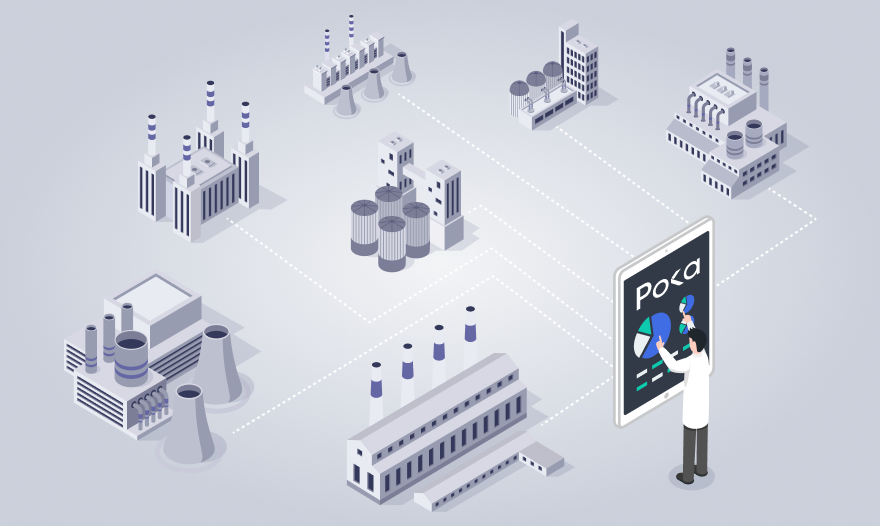
Even the most intuitive app will fail if it can’t be deployed at scale and does not sit on a strong IT infra/architecture. IT teams have a tough job—they need to safeguard data, ensure interoperability and minimize maintenance overhead. That’s why we’ve made it a priority to build Poka as an IT-friendly solution from day one. Here’s what that looks like in practice:
Open APIs & Data Lake Sync
Poka doesn’t exist in a vacuum. Our open API allows seamless integration with MES, ERP, LIMS and other systems. Data lake synchronization ensures that all operational insights captured in Poka can be analyzed alongside broader enterprise data—fueling continuous improvement and smarter decisions.
SCIM for User Provisioning
We support SCIM-based automated user provisioning, making it easy to manage users across thousands of frontline workers with minimal administrative burden.
Self-Serve SSO
Security shouldn’t come at the cost of usability. Our self-serve SSO support allows IT teams to connect Poka with their identity provider in a matter of minutes—ensuring secure, seamless access across the organization.
Poka Automate
Lastly, Poka Automate is our answer to workflow efficiency. It’s a no-code automation layer that allows teams to trigger notifications, create tasks or launch training modules based on real-time events—from system data or human input.
Taken together, these features make Poka not just a frontline tool, but a true enterprise platform—one that meets the needs of IT and OT alike.
Final Thoughts: Sustainable Transformation Starts Here
Manufacturers are hungry for scalable, strategic platforms that unify workforce knowledge, performance and collaboration.
The LNS Research article rightly warns of the pitfalls ahead. But it also lights a path toward a better way forward—one we’ve been building toward at Poka since day one.
With a strategy-aligned flywheel, persona-based design and enterprise-grade IT infrastructure, we believe Poka is uniquely positioned to help manufacturers not just digitize—but transform.\
If you’re exploring how to empower your frontline, align your sites, and future-proof your operations, we’d love to show you what that looks like.
Let’s make transformation tangible—one shift, one worker, one insight at a time.
FAQs: Connected Workforce Initiatives Explained
They often stall at the pilot stage, creating silos and failing to deliver enterprise-wide impact.
Poka uses a flywheel model where every action—learning, documenting, problem-solving—feeds into continuous improvement.
Operators, supervisors, and managers have different needs. Tailored dashboards and tools ensure each role gets relevant insights.
Through open APIs, SSO, SCIM provisioning, and no-code automation for seamless integration and security.
Not just digitization, but sustainable transformation through standardization, engagement, and operational resilience.