





Published on June 29, 2023
Unleash the potential of visual management in your operations. Explore visual factory management examples that inspire continuous improvement, boost efficiency, and empower your teams.

Key Takeaways
- Visual management empowers teams to spot issues, reinforce standard work and make faster, better decisions on the shop floor.
- Traditional whiteboards are giving way to digital dashboards that ensure accuracy, eliminate silos and provide real-time visibility.
- Visual tools can boost learning and retention by up to 400%, making them vital for effective communication in manufacturing.
- Digital dashboards reduce prep time by up to 68%, streamlining daily huddles and enabling data-driven discussions.
- Poka Huddle Boards unify KPIs, issues, and tasks into one view, driving continuous improvement and cross-shift alignment.
The Role of Visual Management in Manufacturing
In our daily lives, we often take for granted the multitude of visual controls that guide our decisions and actions, many of which serve to protect us. Consider the iconic skull and crossbones symbol that warns of poison, the surgical checklists that have played a crucial role in reducing mortality rates by a staggering 40%, or the universally recognized red stop sign that commands immediate attention. These visual cues are not merely decorative; they are essential tools that help us make the right choices at the right moments.
In the realms of Lean and visual manufacturing, visual management serves a parallel function. It plays a pivotal role in supporting daily management systems by allowing teams to closely monitor performance metrics, quickly detect deviations from expected outcomes and respond promptly to any arising issues. By fostering a highly visual factory, manufacturers can create an environment where communication flows freely, standard work processes are reinforced, and abnormalities are made immediately visible during essential daily activities, such as Gemba walks, huddles, and shift handovers.
Today, leading manufacturers are leveraging advanced visual management systems to transform data into real-time insights. Digital dashboards, visual control boards and performance tracking displays enable teams to instantly identify inefficiencies and take corrective action. These visual factory management examples showcase how organizations can align teams around shared goals, streamline operations, and improve overall equipment effectiveness (OEE). Moreover, integrating visual cues with IoT and AI technologies is paving the way for predictive and proactive management – helping companies anticipate problems before they occur. As visual management continues to evolve, its ability to enhance safety, productivity, and decision-making positions it as a cornerstone of future-ready manufacturing environments.
Why Visual Management Matters
Visual factory management is not just a trend; it is central to the success of daily management systems. This approach provides real-time insights into critical performance indicators (KPIs), fosters a culture of collaboration among team members, and empowers frontline workers to actively engage in continuous improvement initiatives. By utilizing visual factory tools—such as dashboards, boards, checklists and andon signals—organizations can effectively highlight problems, enabling swift, informed decision-making at every level of the manufacturing process.
Research conducted by 3M indicates that visual aids can enhance learning and retention by up to 400%. Given that individuals typically remember only about 20% of what they hear, the use of visual cues becomes critical in ensuring that factory teams not only comprehend but also retain and act upon the information presented to them.
In today’s competitive manufacturing landscape, visual management serves as the foundation for operational excellence. It transforms complex data into clear, actionable insights that drive accountability and engagement across all departments. Companies that adopt effective visual factory management examples – such as tiered huddle boards, digital performance dashboards, and standardized visual work instructions – can significantly reduce downtime, improve communication and sustain long-term productivity gains. By integrating visual management principles into daily operations, manufacturers can create a transparent, agile environment where teams continuously improve and deliver measurable business results.
The Goal of Visual Management in Factories

Visual factory management serves three fundamental purposes that align closely with daily management systems:
- Work Planning: Visual boards provide a clear overview of tasks, projects, and workflows, allowing for improved coordination, prioritization, and team consensus.
- Improving Operations: Teams can rapidly identify bottlenecks, inefficiencies, and areas in need of enhancement in real time, driving operational excellence.
- Highlighting Problems: Using stoplight systems, color-coded charts, or icons, deviations from the norm are made immediately visible, ensuring that issues are addressed before they escalate into larger problems.
From Whiteboards to Digital Visual Factory Solutions
For many years, physical whiteboards—often referred to as Lean Manufacturing Boards—have been fundamental to visual factory management. However, in 2026, it is evident that the trend is shifting towards digital visual management dashboards.
Physical boards present several challenges, including:
- Time-consuming manual updates that detract from productivity.
- The risk of outdated or inaccurate information being displayed.
- Lack of data history, which impedes analysis and learning from past performance.
- Creation of information silos between shifts and departments, limiting collaboration.
Digital visual factory tools effectively overcome these limitations by:
- Integrating seamlessly with live production data to ensure accuracy.
- Facilitating remote and mobile access to information, improving flexibility.
- Preserving historical data for comprehensive trend analysis and decision-making.
- Promoting faster, data-driven decision-making processes throughout the organization.
Visual Management in Daily Operations
Issue Management and Visibility
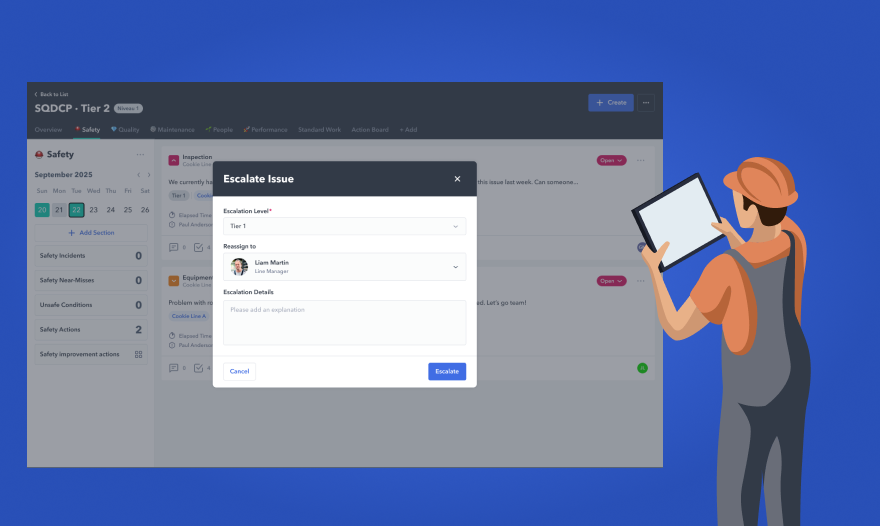
In a typical manufacturing environment, operators may log dozens of issues each day, which can overwhelm traditional physical Kanban boards. A digital issues dashboard, equipped with color-coded priorities and advanced filtering options, provides real-time visibility into these challenges, ensuring that urgent issues are escalated and addressed promptly.
Daily Planning and Huddles
Effective daily planning sessions—ranging from huddles and shift start-ups to tier meetings – are heavily reliant on accurate data. With digital dashboards, supervisors gain a consolidated view of KPIs, pending tasks, and unresolved issues, leading to more productive discussions and reducing the need for excessive meetings.
The Virtuous Circle of Continuous Improvement
Digital visual management tools, such as those found in Poka, foster a cycle of problem identification, escalation, resolution, and learning. Each issue that arises is not just a challenge but an opportunity to refine standards, enhance processes, and disseminate knowledge across shifts, thereby embedding a culture of continuous improvement within the organization.
Enter Poka Huddle Boards: The Future of Visual Factory ManagementEnter Poka Huddle Boards: The Future of Visual Factory Management
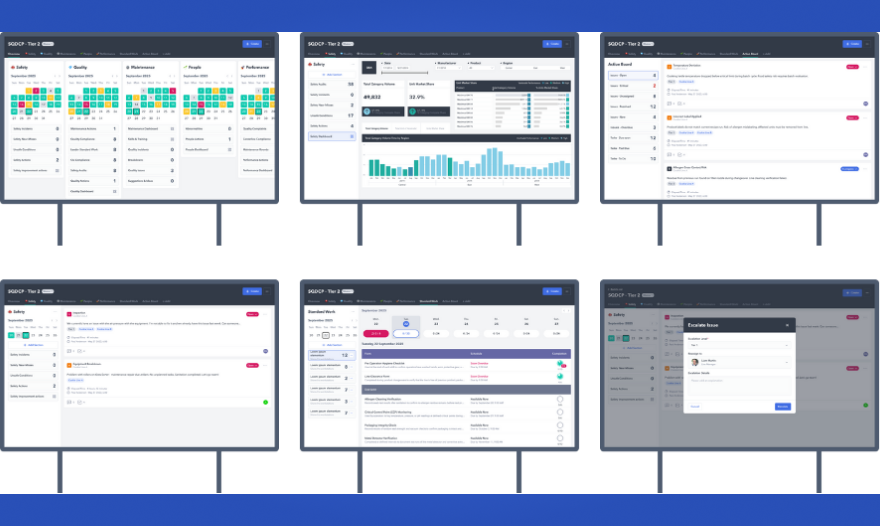
Digital dashboards are increasingly being utilized in visual manufacturing, and Poka has introduced a new approach to visual factory management through its Huddle Boards.
Poka Huddle Boards digitize and optimize daily tiered meetings, encompassing everything from shift-level huddles to comprehensive plant-wide reviews. They serve as a central hub for tracking safety, quality, delivery, cost, and people metrics (SQDCP). Key advantages of using Poka Huddle Boards include:
- Real-Time Data Integration: Effortlessly embed dashboards or connect to MES/ERP systems for live production insights and updates.
- Issue & Task Tracking: Easily prioritize, escalate, and assign accountability within a single view, enhancing workflow.
- Structured Meetings: Standardized agendas and attendance tracking tools ensure that huddles remain focused and efficient.
- Cross-Shift Alignment: Facilitate the seamless transfer of information and continuity of operations between shifts.
- Reduced Prep Time: Save up to 68% of the time spent gathering data compared to traditional physical boards, allowing teams to focus on action.
By unifying KPIs, issues, and actionable items within a single digital interface, Poka Huddle Boards transform visual factory management into a powerful engine for real-time decision-making and ongoing improvement.
Visual Factory Management in 2026: Driving Efficiency With Digital Tools

The trajectory of visual factory management is decidedly digital. The traditional physical whiteboards are on the decline, making way for dynamic dashboards that promote accuracy, accountability, and rapid response times. With advanced solutions like Poka Huddle Boards, factories can transcend mere visualization, embedding daily management systems into digital workflows that minimize downtime, enhance overall equipment effectiveness (OEE), and ensure alignment across teams operating on different shifts.
Achieving success in visual manufacturing is no longer just about making information visible; it’s about transforming that information into actionable insights that are connected and continuously evolving.
Ready to see how? Book a demo with our team and discover how Poka can help you transform your factory’s visual management. Ready to see how?
This article was updated in January 2026 for accuracy.
FAQs About Visual Factory Management
A system that uses visual tools—like dashboards, boards, and signals—to track KPIs, highlight problems and improve daily operations.
They require manual updates, create silos, and lack real-time accuracy, making them less effective in modern factories.
They integrate live data, preserve history for analysis, and provide real-time visibility across shifts and teams.
Research shows visuals boost retention by up to 400%, ensuring frontline teams understand and act on key information.
They unify KPIs, issues, and tasks in one view, enabling real-time insights, faster decision-making, and continuous improvement.