




Published on July 7, 2023
One change leads to another. Rapid tech advancements in the automotive industry give rise to another monumental challenge: reskilling and upskilling the sector’s global workforce.
In the ever-evolving automotive industry, employers face a critical labour crisis in their fight to keep pace with technological advancements.
The most recent World Economic Forum Future of Jobs Report spells out the industry’s answer in plain letters. (One word, first letter, sounds like…) Reskilling.
When asked what business practices automotive and aerospace companies are using to improve talent availability, the top answer was to improve talent progression and advancement, well above the global average. Ninety percent said the talent availability of the existing workforce would improve by 2027, meaning they expected large-scale returns from training compared to hiring replacement latent or retaining aging workers.
This blog explores the pressing need for reskilling frontline workers in the automotive industry, highlighting transformative approaches adopted by employers, the benefits of internal training and up-skilling initiatives, and the significance of leveraging digital tools like Connected Worker apps to empower employees, enhance productivity, and navigate industry changes effectively.
The Shift Toward EV
The automotive industry is experiencing a monumental transformation driven by the shift towards carbon-neutral mobility and the digitalization of road transport. This shift will impact the industry and have significant implications for the workforce employed across the automotive value chain.
The transition to carbon-neutral mobility and the digitalization of road transport represents the biggest technological turning point in the history of the automotive industry. This transformation affects all stakeholders within the automotive ecosystem, from small SMEs to major manufacturers, suppliers, dealers, and maintenance and repair workshops. The disruption caused by this shift demands a reevaluation of the skills required from employees, as certain jobs are expected to disappear while new job profiles with different skill sets emerge.
The key drivers of this transformation are the electrification of mobility and the production of batteries and fuel cells, aligned with various countries’ carbon neutrality goals. Additionally, digital developments such as complex in-vehicle software, Artificial Intelligence, and mobility-as-a-service solutions are contributing to the changing landscape. Consequently, a significant skills gap exists between the current workforce and the future needs of the automotive industry. Closing this gap requires a comprehensive approach to training and education, emphasizing both reskilling and upskilling initiatives.
Reskilling is not only part of developing and maintaining a highly skilled workforce, it’s now seen by governments and labour advocates as a social issue as much as an economic one. The International Labour Organization’s technical meetings on automotive labour find that reskilling is imperative to social protections and decent working conditions. As increasingly high degrees of uncertainty and disruption affect the industry, having employers that invest in intensive, continual reskilling provides workers with long-term employability, “providing workers with freedom from fear and insecurity.”
One example of this Herculean effort is the European industry’s ambition to provide reskilling and upskilling opportunities to approximately five percent of the workforce in the wider automotive sector each year. This translates to around 700,000 employees annually. Collaborative efforts between the private sector and public authorities will be crucial in facilitating this massive undertaking. PricewaterhouseCoopers estimates that, with an average investment of €10,000 per employee, the commitment to retrain Europe’s automotive workers will amount to approximately €7 billion. The benefits extend beyond employers, as governments can save on unemployment benefits while generating additional social and tax revenues. Studies indicate that every Euro invested in upskilling can result in savings of two to five Euros for society.
Current State of The Automotive Industry
The demand for skilled professionals is rapidly shifting as the automotive industry undergoes significant technological advancements. The main types of job profiles that are witnessing substantial growth: are technical professionals and associate professionals, and trade workers and machine operators. These groups are directly affected by the industry’s transformation, driven by Industry 4.0 practices, automation, and additive manufacturing.
Consequently, professionals in these fields must expand their skill sets, encompassing a wider range of technical competencies and soft skills to adapt to the evolving landscape. Studies assessing the emerging skills gap in automotive frontline workers have identified the need for greater technical competencies along with more complex interpersonal skills like problem-solving, flexibility and interpersonal skills. Automotive suppliers are responding to the skilled trades labour shortage by developing hybrid skills models to cross-train employees across multiple disciplines.
A new class of employees, known as “grey-collar workers,” is emerging in response to this shifting demand. These individuals are upskilled “blue-collar workers” who possess advanced technical expertise. This trend is reshaping the composition of the automotive workforce, with a decline in low-skilled workers and a corresponding increase in medium- to high-skilled professionals.
Despite increasing automation,, most companies recognize that the introduction of new technologies will not make workers obsolete. Although labour-intensive occupations may decline, they anticipate a compensatory increase in higher-value roles. This indicates a positive outlook for job opportunities, albeit with a shift towards positions that offer greater value-added contributions.
For machine operators, some jobs can be retained or retrained, but other component parts jobs will be non-transferable to EV simply because electric vehicles require fewer and different parts. According to Ontario’s Automotive Talent Strategy and Roadmap, the most sought-after skills in auto and parts manufacturing currently include machining and heavy equipment operation, computer-aided design, as well as critical thinking and complex problem-solving abilities. Over the coming years, forecasted skills shortages will change to include quality control analysis and database software, 3D printing, cybersecurity, systems engineering software, along with critical thinking and reading comprehension.
The reliance on traditional training methods and the recruitment of experienced tradespeople from outside the company will no longer be sufficient to meet the demands of diagnosing and repairing specialized equipment. As a result, employers are now placing a renewed focus on internal training, up-skilling, and collaborative partnerships with educational institutions to develop a highly skilled and adaptable workforce.
To address the challenges at hand, governments, employers and educators around the world have recognized the importance of building an educational framework to tackle this problem. However, the World Economic Forum found that in-house training departments, employer-sponsored apprenticeships and on-the-job training will remain key training providers.
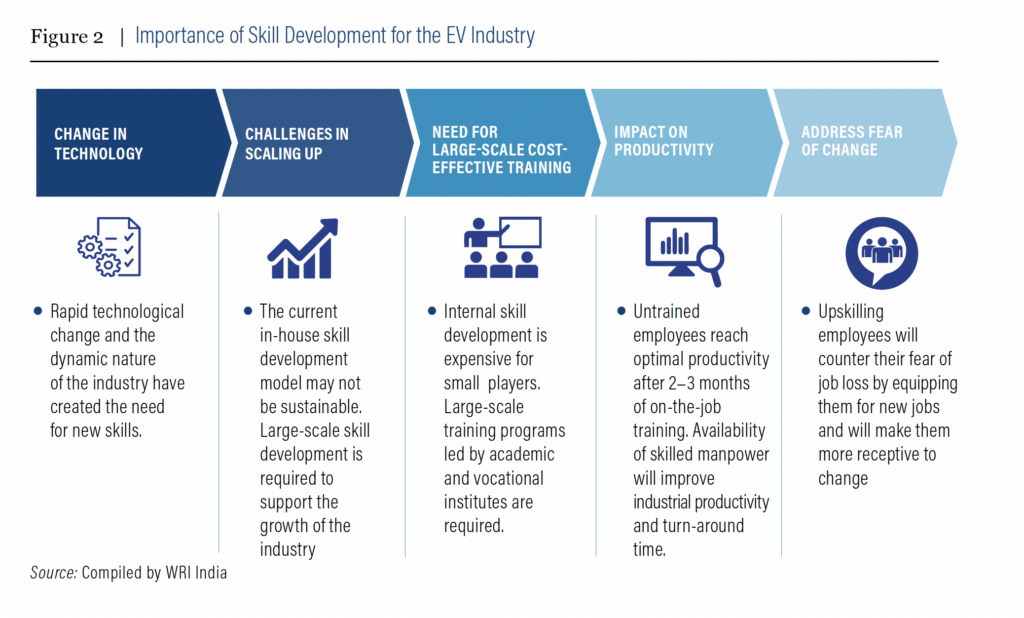
Source: https://www.wri.org/research/just-transition-and-skill-development-electric-vehicle-industry
By investing in the professional development of their employees, companies can equip them with the necessary knowledge and skills to excel in a rapidly changing automotive landscape. This strategic approach not only fills the gaps in expertise but also empowers frontline workers to navigate new technologies and emerging industry trends.
Best Practices for Identifying, Attracting, Developing, and Retaining Talent
Organizations must focus on effectively identifying, attracting, developing, and retaining talent to ensure long-term success. McKinsey published a playbook identifying talent management best practices for the automotive sector, which emphasizes the importance of leveraging digital and analytical tools, understanding future skills needs, prioritizing learning and development, and implementing upskilling initiatives.
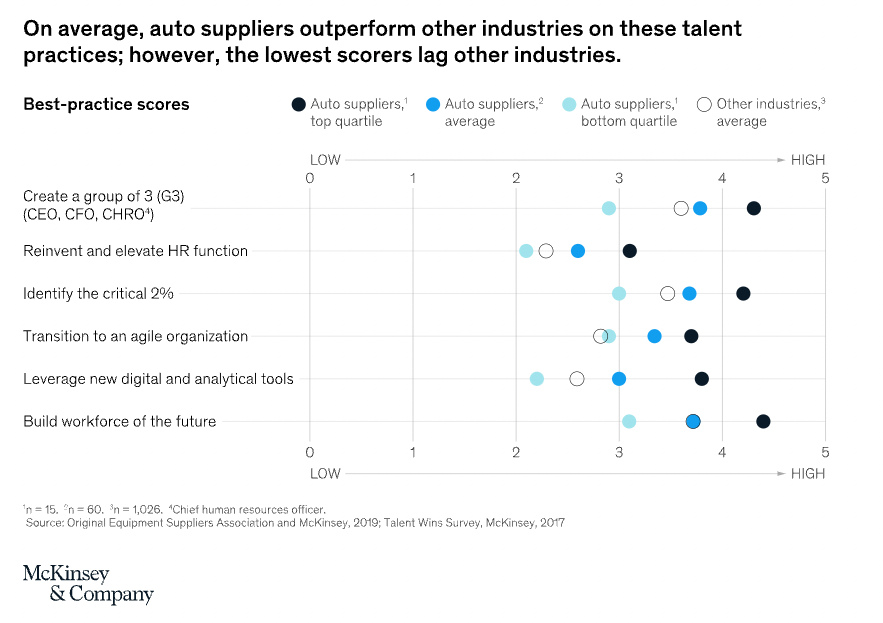
- Leverage Digital and Analytical Tools: Data and analytics play a crucial role in optimizing learning and development initiatives. By using these tools, organizations can understand the skills employees need, assess learning retention, and evaluate the return on investment of their training efforts. For instance, connected worker apps can leverage employee performance feedback, manager reviews, interactive quizzes, and career goals to create personalized learning journeys. Organizations can effectively enhance employee skills and knowledge by utilizing a mix of in-person, digital, and on-the-job training.
- Build the Workforce of the Future: A deep understanding of the skills needed to execute an organization’s strategy is essential for building the workforce of the future. This involves conducting comprehensive skills assessments, mapping future skills requirements, and aligning talent development initiatives with strategic goals. By proactively addressing future skills needs, organizations can ensure they have the right talent in place to navigate disruptions and drive innovation.
- Upskilling Initiatives: Many organizations are witnessing a strong return on investment from their upskilling efforts. Upskilling programs can include on-the-job training, classroom learning, and mentorship opportunities. The most successful organizations track the return on their upskilling investments, enabling them to identify the most effective programs and continuously improve their initiatives. Organizations can bridge skill gaps and adapt to industry disruptions by focusing on upskilling the existing workforce.
- Reskilling and Future Workforce: Importing all the necessary skills from outside the industry may not be feasible. Therefore, reskilling the existing workforce has become a crucial strategy for organizational adaptation. By investing in reskilling programs, organizations can ensure their employees possess the skills to embrace new technologies and industry shifts.
How Connected Worker Apps Can Help Overcome These Challenges
Connected Worker apps like Poka provide a platform to address the evolving needs of the industry and empower employees to thrive in a changing landscape.
According to Project Drives, in a recent survey, automotive employers said they highly value soft skills such as analytical thinking, innovation and problem-solving. Additional research has revealed that manufacturers often struggle to effectively train for these attributes internally. However, the true missing elements are connectivity and empowerment.
Connected Worker apps like Poka offer a comprehensive solution to overcome these challenges by providing a user-friendly platform that empowers employees to thrive in a changing industry landscape, fostering connectivity, personalized learning, and continuous reskilling for enhanced resilience and long-term growth.
Poka revolutionizes the process of reskilling by addressing the challenges faced by L&D and operations leaders in planning, delivering, and tracking production skill development. Traditionally, it has been difficult to plan effectively for skill development, as there was a lack of reliable and up-to-date information regarding employees’ competencies. Identifying skill gaps based on performance issues and production needs was time-consuming. Using manual methods or Excel spreadsheets to track factory floor skills was outdated, not to mention inefficient and prone to errors.
Poka revolutionizes the process of skill tracking with a streamlined and highly efficient approach. This method relies on the active involvement of both workers and managers, allowing workers to work towards target competencies and helping supervisors manage exams and skills endorsements tracked in a group skills matrix. Furthermore, Poka incorporates expiry and refresh dates to maintain the accuracy and relevance of acquired competencies.
Adopting this new system makes delivering training easier and less reliant on formal training events. Instead of waiting for scheduled sessions, employees have on-demand access to training content. Additionally, real-time notifications keep employees informed of updates to training materials and work instructions, ensuring that everyone’s skills remain up-to-date and aligned with evolving requirements.
Automotive manufacturers need an effective way to continuously reskill large swathes of their workforce to adapt to changing technology. A Connected Worker app helps drive mass training efficiency, while streamlining the administrative burden on L&D teams. Digital tools that support innovation and problem solving on the factory floor can also help supplement difficult-to-train-for soft skills. And lastly, built-in analytics that track current workforce skill development will also allow companies to plan out their long-term human capital requirements.
If you would like to learn more about how Poka can help you improve your workforce’s skills, contact one of our dedicated experts today!