





The Ultimate Guide to Industrial AI in Manufacturing
Everything You Need to Know About Industrial AI in Manufacturing
Artificial intelligence is no longer a future ambition for manufacturers — it is already reshaping how work gets done on the factory floor. From improving decision-making to accelerating problem-solving and enabling more resilient operations, Industrial AI is becoming a core pillar of modern manufacturing strategies with connected workers.
This guide provides a comprehensive deep dive into Industrial AI in manufacturing. It explores what Industrial AI is, how it has evolved, the use cases delivering value today and how emerging approaches like Agentic AI will shape the future of human-machine collaboration on the factory floor.
Achieve an AI Advantage in Manufacturing
Watch this on-demand webinar to explore how the next generation of AI-augmented connected workers will collaborate seamlessly with intelligent assistants and autonomous agents — tools capable of understanding context, learning from operations, and taking action alongside frontline teams.
Table of Contents
1. What is Industrial AI?
2. What to Look for in an Industrial AI Solution
3. Top Use Cases of Industrial AI in Manufacturing
4. Selecting the Right Industrial AI Solution
5. Where to Start with Industrial AI
6. Next Steps in Your AI Journey
7. Additional Industrial AI Resources
8. Frequently Asked Questions About Industrial AI
1. What Is Industrial AI?
Industrial AI refers to the application of artificial intelligence technologies — including machine learning, generative AI and autonomous AI agents — within industrial environments to augment human decision-making, optimize operations and improve factory-floor performance.
Unlike traditional automation, which focuses on executing predefined rules, Industrial AI focuses on intelligence. It analyzes context, learns from data, identifies patterns, and supports people in making better decisions in real time.
Crucially, Industrial AI is not about replacing workers. Manufacturing environments are too complex, variable and safety-critical for that. Instead, Industrial AI succeeds by augmenting frontline workers, supervisors and engineers, ensuring the right information and insights are available exactly when and where work happens.
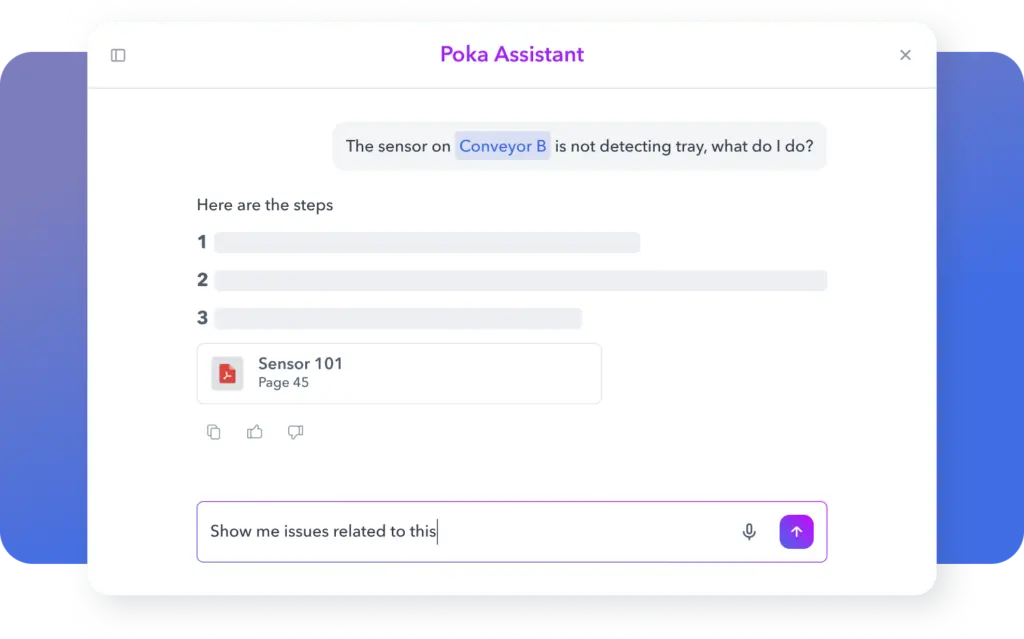
Industrial AI vs. Traditional Factory Software
Manufacturers already rely on systems like MES, SCADA, ERP, CMMS and QMS. These systems of record are essential — but they were not designed to help connected workers reason through ambiguity, adapt to change or continuously improve.
Industrial AI complements these systems by closing the decision gap between data and action. It connects structured and unstructured information, embeds intelligence into workflows and supports human judgment at the Gemba.
The Evolution of AI in Manufacturing
AI adoption in manufacturing has evolved through several phases:
- Rule-based automation and analytics, focused on monitoring and reporting
- Predictive AI, using historical data to forecast outcomes
- Generative AI, enabling natural language interaction and content creation
- Agentic AI, allowing autonomous AI agents to augment human performance
The Role of Generative AI in Manufacturing
Generative AI has been the most visible and widely adopted form of artificial intelligence to reach the manufacturing sector, marking a critical inflection point in how AI is used on the factory floor to connect workers. Unlike earlier AI approaches that required specialized expertise or complex configuration, Generative AI introduced intuitive, natural language interaction—making AI accessible to frontline workers for the first time.
At its core, Generative AI uses large language models to create, summarize, translate and contextualize information. In manufacturing environments, this capability has proven especially valuable for transforming dense, unstructured content into formats that are easier to consume and act on in the flow of work.
On the factory floor, Generative AI is already delivering tangible value by accelerating the creation and maintenance of digital work instructions, converting SOPs and manuals into step-by-step guidance and enabling intelligent search across operational knowledge. Instead of searching through binders, shared drives or multiple systems, connected workers can ask questions in natural language and receive clear, relevant answers in seconds.
Generative AI also plays a critical role in workforce enablement. By supporting multilingual translation and transcription, it helps break down language barriers in increasingly diverse manufacturing teams—improving comprehension, safety and quality without adding administrative burden.
Importantly, Generative AI operates as a supportive assistant, responding to user requests rather than acting independently. This makes it well suited for environments where trust and control are paramount. However, because it is inherently reactive, Generative AI is best understood as a foundation rather than a final destination.
By reducing the effort required to create, access and maintain knowledge, Generative AI lays the groundwork for more advanced AI capabilities. It frees up human time, standardizes information and improves data quality—creating the conditions necessary for the next evolution of AI in manufacturing.
In this way, Generative AI is not just improving today’s factory-floor workflows; it is enabling the transition toward more proactive, intelligent and agent-driven systems that will define the future of industrial operations.
The Emergence of Agentic AI: Everything You Need to Know About Augmenting Connected Workers
Agentic AI represents the next major evolution of artificial intelligence in manufacturing, moving beyond Generative AI toward autonomous, goal-driven systems that can actively support work on the factory floor. While Generative AI has proven its value by accelerating content creation, simplifying access to knowledge and enabling natural language interaction, it remains largely reactive — responding only when prompted by a user.
Agentic AI changes that dynamic.
At a foundational level, AI agents are autonomous software systems capable of perceiving their environment, reasoning about objectives, coordinating tools and proposing or executing actions with minimal human intervention. These agents do not simply generate information; they understand context, plan next steps and learn over time, adapting their behavior as conditions change.
In a manufacturing environment — where variability, time pressure and safety constraints are the norm — this shift is especially significant. Agentic AI enables AI to function not just as a tool, but as a digital co-worker: one that operates alongside frontline workers to help troubleshoot issues, surface early warnings and recommend corrective actions before problems escalate.
From Assistants to Digital Co-Workers
Over the last few years, manufacturing has moved rapidly through the AI hype cycle and into a phase where tangible, shop-floor use cases matter more than experimentation. Generative AI applications, powered by large language models, are already delivering value by converting dense SOPs into digital work instructions, creating engaging training content and enabling smarter search across operational knowledge. These capabilities have reduced deployment time, lowered content creation costs and improved comprehension across multilingual workforces.
However, this is only the beginning.
Agentic AI builds on these foundations by enabling AI systems to take initiative. Rather than waiting for a worker to ask a question, an AI agent can recognize that help may be needed, interpret intent and proactively assist. In practice, this means AI evolving from a passive assistant into a semi-autonomous, goal-directed agent that supports workers in the flow of daily operations.
Importantly, this evolution does not diminish the role of human workers. On the contrary, Agentic AI is explicitly designed to augment, not replace, human expertise. By handling repetitive background tasks, coordinating information across systems and surfacing insights workers do not have time to find themselves, AI agents free up human capacity to focus on higher-value, judgment-based work — improving both performance and job satisfaction.
Human-in-the-Loop: The Foundation of Trust
For Agentic AI to succeed on the factory floor, trust is non-negotiable. Manufacturing environments demand high reliability, safety and accountability — which is why the most effective Agentic AI implementations are built around a Human-in-the-Loop (HITL) model.
In this model, AI agents may be autonomous in how they analyze situations, coordinate tools, and propose actions, but humans always retain final authority. This distinction between autonomy and being fully autonomous is critical. AI agents can act, but they do not operate unchecked. Guardrails ensure that workers validate, approve or override AI-recommended actions before they are executed.
This approach does more than mitigate risk — it actively builds trust. By keeping humans involved in decision-making, Agentic AI becomes a collaborative partner rather than a black box. Over time, as workers see consistent, reliable support from AI agents, confidence grows and adoption accelerates.
An Evolutionary Path for Agentic AI in Manufacturing
The relationship between AI agents and frontline workers will not change overnight. Instead, it will evolve in clear phases:
Phase 1: Assistants and Automation (Today)
AI agents function primarily as conversational assistants and background automation tools. They support content creation, data retrieval, rule-based triggers and administrative tasks, reducing manual effort without altering core workflows.
Phase 2: Goal-Directed Autonomy (Near Future)
Reasoning agents emerge that can interpret user intent and coordinate multiple tools or sub-agents. For example, when an operator begins troubleshooting an issue, an orchestrator agent identifies the goal, searches relevant knowledge, prepares a draft issue report, and asks the user for approval before taking action.
Phase 3: Proactivity and Prognostics (Looking Ahead)
Agents evolve from reactive to proactive. They begin detecting early signals of breakdowns, deviations, or inefficiencies before they fully manifest. These agents not only predict what may happen, but recommend what actions to take — learning continuously and improving over time through feedback loops and operational outcomes.
Practical Agentic AI Use Cases on the Factory Floor
Agentic AI’s value becomes most tangible through practical, worker-centric use cases:
AI-Assisted Troubleshooting: Orchestrator agents interpret intent, route requests to the right knowledge sources and prepare next steps — reducing downtime and cognitive load.
Early Warning Systems for Leaders: AI agents proactively surface emerging trends, such as recurring safety checklist issues, enabling intervention before incidents occur.
Shift Performance Prediction: By analyzing workforce skills, checklist completion and line conditions, agents can identify when a shift is at risk and recommend corrective actions to protect OEE and quality.
In each case, AI acts as a supportive partner, providing a “helping hand” rather than dictating outcomes.
Building the Future, Hand in Hand
Research suggests manufacturing leaders are increasingly open to AI-driven decision support, even in critical functions. Trust in AI is already higher in manufacturing than in many other industries — creating a strong foundation for Agentic AI adoption. Still, questions remain around cultural readiness, governance and the right balance between efficiency and oversight.
What is clear is this: the true power of Agentic AI to augment connected workers lies in the partnership between human expertise and machine proactivity. Manufacturers that remain curious, open and engaged with this technology will be best positioned to unlock productivity gains and build resilient, future-ready operations.
The future of manufacturing will not be defined by machines replacing people — but by people empowered by intelligent, proactive digital co-workers.
Benefits of Industrial AI on the Factory Floor
When implemented effectively, Industrial AI delivers strong outcomes for an augmented connected workforce, such as:
- Increased productivity and OEE
- Faster time to value
- Improved safety and compliance
- Better knowledge capture and retention
- A more empowered, engaged workforce
2. What to Look for in an Industrial AI Solution
Industrial AI has enormous potential to improve manufacturing performance, but value is not guaranteed simply by adding AI to existing systems. In practice, many AI initiatives fail to scale because they are disconnected from real work, difficult to trust or misaligned with the realities of the factory floor.
To deliver sustainable value, an Industrial AI solution must be designed specifically for manufacturing environments and frontline users. The right solution should meet the following criteria.
Human-Centric, with Explainability and Trust
At its core, Industrial AI must be built to augment human expertise, not override it. Manufacturing is a domain where context, judgment and experience matter deeply, and frontline workers need to understand why an AI system is making a recommendation.
Human-centric Industrial AI provides transparency into how insights are generated and allows workers to validate, approve or override AI-suggested actions. This explainability is essential for building trust, ensuring safety and encouraging adoption. Solutions that operate as black boxes may look impressive in demos, but they rarely succeed on the factory floor.
Integrated, Not a Disconnected AI Layer
Industrial AI should not exist as a standalone analytics tool or an isolated AI overlay. Instead, it must be deeply integrated across workflows, data sources and applications.
The most effective solutions connect AI across knowledge management, tasks, issues, training and analytics, so insights flow naturally from one activity to the next. When AI is fragmented across multiple tools, workers are forced to switch contexts, duplicate effort and question which system to trust—undermining the very efficiency AI is meant to deliver.
Embedded in Daily Operations
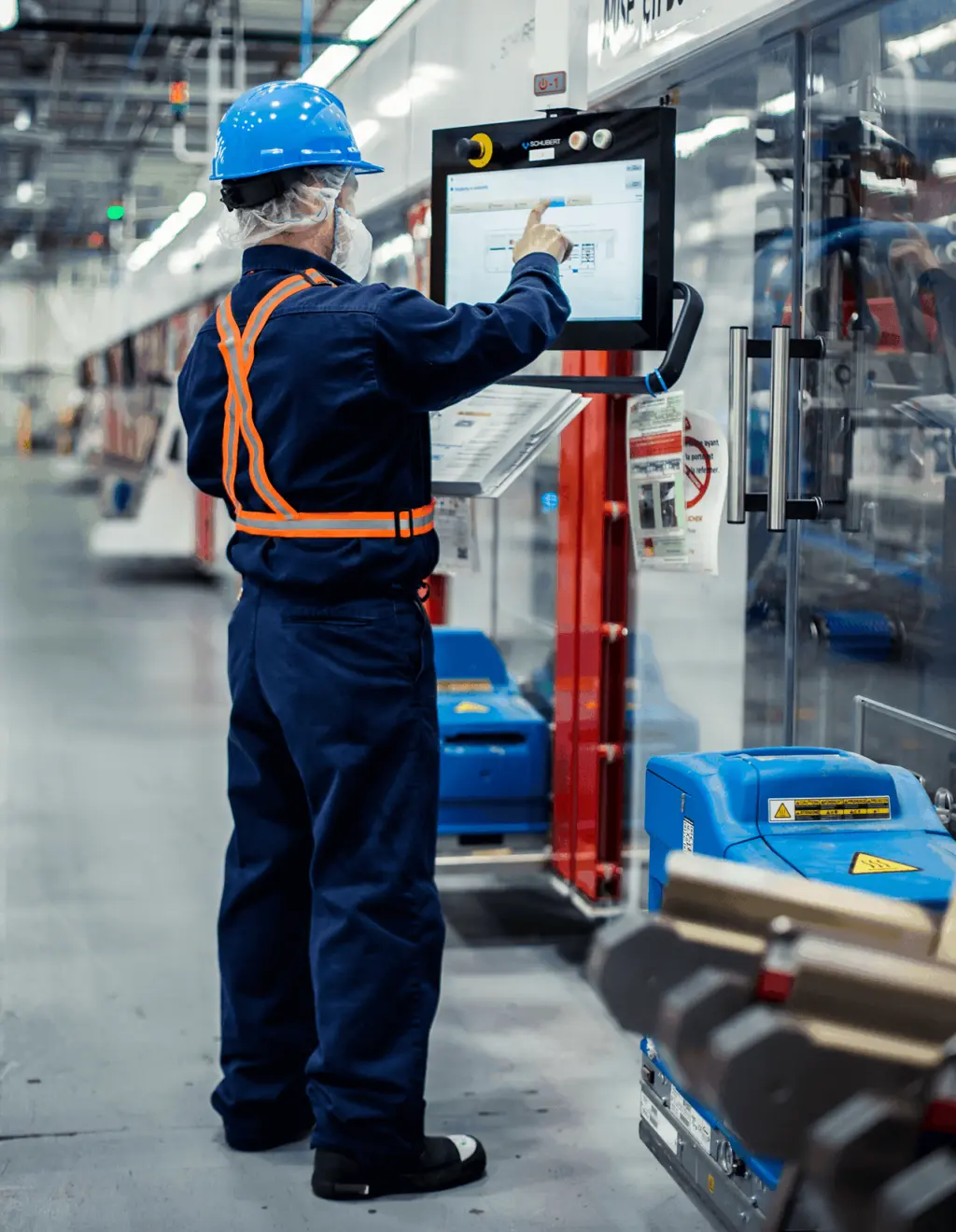
AI creates value only when it is available at the moment of work. Industrial AI should be embedded directly into daily factory-floor activities such as shift handovers, inspections, troubleshooting, maintenance rounds and continuous improvement routines.
If AI insights live exclusively in dashboards or reports that are reviewed after the fact, they will have limited impact. Embedded AI supports real-time decision-making at the Gemba, where issues occur and value is created.
Easy to Use for Non-Technical Workers
Frontline adoption depends on simplicity. An Industrial AI solution must be intuitive enough for operators, technicians and supervisors—many of whom are not data scientists or IT specialists.
Natural language interaction, clear prompts, minimal configuration and mobile-first design all contribute to ease of use. If a solution requires extensive training or technical expertise, adoption will stall and value realization will be delayed.
Built for Scale, Security, and Compliance
Manufacturing organizations operate at scale, often across multiple plants, regions and regulatory environments. Industrial AI must be enterprise-ready from day one.
This includes robust cybersecurity, data privacy controls, role-based access, auditability and compliance with industry regulations. Scalability also means supporting multilingual workforces, sharing standards across sites and maintaining consistent performance as usage grows.
Manufacturing-First, Not Retrofitted from IT
Finally, Industrial AI must be designed specifically for manufacturing—not adapted from generic enterprise or IT use cases. Manufacturing-first solutions reflect the structure of factory operations, align with continuous improvement methodologies and support the unique rhythms of shift-based work.
AI that is retrofitted from office or IT environments often fails to account for the complexity, variability and physical realities of the factory floor. Manufacturing-first design is the difference between AI that looks promising in theory and AI that delivers results in practice.
3. Top Use Cases of Industrial AI in Manufacturing
Industrial AI creates value across every function on the factory floor. The most successful manufacturers focus on use cases that augment human performance, reduce friction, and improve consistency.
Human-Centric, with Explainability and Trust
At its core, Industrial AI must be built to augment human expertise, not override it. Manufacturing is a domain where context, judgment and experience matter deeply, and frontline workers need to understand why an AI system is making a recommendation.
Human-centric Industrial AI provides transparency into how insights are generated and allows workers to validate, approve or override AI-suggested actions. This explainability is essential for building trust, ensuring safety and encouraging adoption. Solutions that operate as black boxes may look impressive in demos, but they rarely succeed on the factory floor.
Operations Use Cases: Improve Productivity and OEE
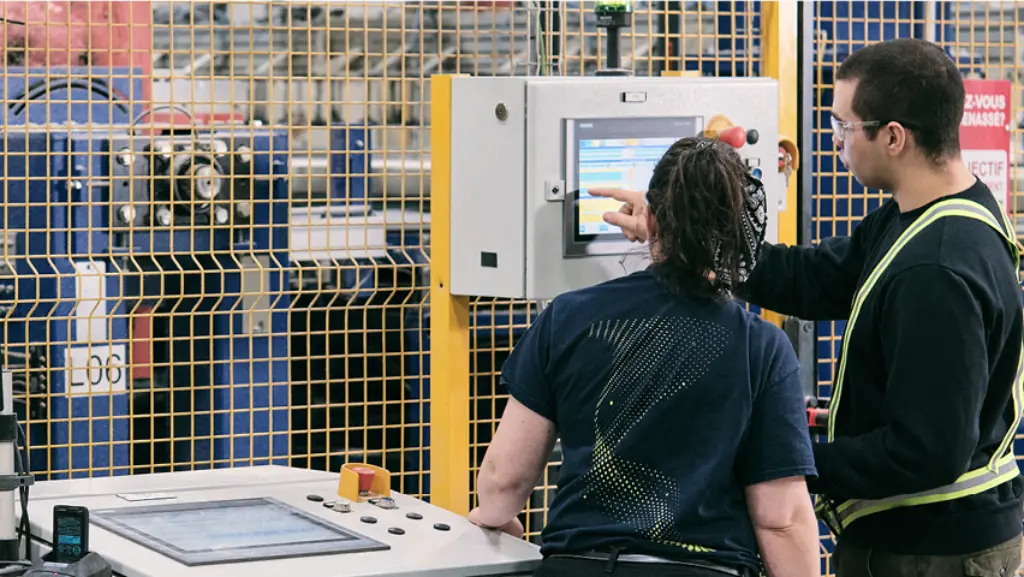
Operations teams face constant pressure to maintain output, quality and uptime — often with limited visibility and fragmented information.
Industrial AI supports operations by:
- Assisting operators during troubleshooting
- Predicting shift-level performance risks
- Highlighting deviations before they escalate
- Summarizing operational data into actionable insights
Instead of searching through systems or waiting for reports, workers receive contextual guidance in real time, enabling faster decisions and fewer disruptions.
Health & Safety Use Cases: Reduce Risk and Improve Compliance
Safety performance depends not only on procedures, but on awareness, consistency and proactive intervention.
Industrial AI enhances safety by:
- Identifying patterns in near-misses and observations
- Flagging emerging risks before incidents occur
- Supporting standardized inspections and audits
- Reinforcing safety culture through real-time feedback
AI does not replace safety professionals — it amplifies their ability to see trends and act earlier.
Maintenance Use Cases: Improve Asset Availability
Industrial AI extends maintenance effectiveness by:
- Detecting early warning signs of failure
- Supporting autonomous maintenance by operators
- Improving communication between production and maintenance
- Reducing unplanned downtime
Rather than replacing CMMS or EAM systems, Industrial AI connects maintenance intelligence directly to frontline workflows.
Continuous Improvement Use Cases: Accelerate Learning
Continuous improvement depends on identifying problems, learning from them, and standardizing better ways of working.
Industrial AI supports CI by:
- Clustering issues and recurring deviations
- Helping to find likely root causes
- Supporting PDCA cycles with data-driven insights
- Capturing improvements as institutional knowledge
This transforms CI from a reactive process into a continuous learning loop.
Learning & Development Use Cases: Build Workforce Capability
With high turnover and skills gaps, training must be faster, more relevant and more accessible.
Industrial AI enables:
- Faster creation of digital work instructions
- Personalized, role-specific learning paths
- Skills gap identification and tracking
- On-the-job learning at the moment of need
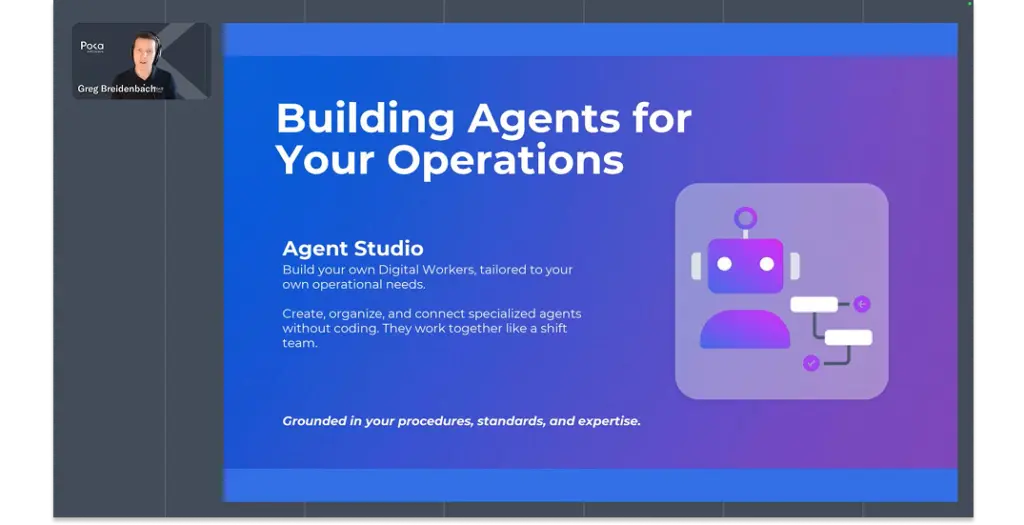
Achieve an AI Advantage in Manufacturing
Watch this on-demand webinar to explore how the next generation of AI-augmented connected workers will collaborate seamlessly with intelligent assistants and autonomous agents — tools capable of understanding context, learning from operations, and taking action alongside frontline teams.
4. Selecting the Right Industrial AI Solution
Selecting the right Industrial AI solution is a strategic decision that will influence not only operational performance, but also how artificial intelligence is perceived, trusted and adopted across the organization. A well-chosen solution can accelerate improvement and empower frontline teams, while a poor fit can reinforce skepticism and stall future innovation.
To make an informed choice, manufacturers should take a structured approach that balances business needs, workforce realities and long-term scalability.
Conduct a Needs Assessment
The selection process should begin with a clear understanding of where AI can deliver the most value. Rather than starting with technology capabilities, focus on operational challenges and decision points.
Key questions to ask include:
- Where do frontline workers lack timely or accurate information?
- Where does process variability lead to quality issues, downtime or safety risk?
- Where do the same issues resurface without lasting resolution?
These problem areas often represent decision gaps where human judgment is stretched by complexity, time pressure or fragmented data. Industrial AI is most effective when applied to these moments — augmenting human decision-making rather than adding another layer of complexity or automation.
Vendor Evaluation Criteria
Once needs are defined, manufacturers should evaluate vendors through a manufacturing-first lens. Not all AI providers are equally suited to industrial environments.
Strong Industrial AI vendors:
- Specialize in manufacturing and understand factory-floor realities
- Have proven deployments in live production environments, not just pilots
- Demonstrate a clear commitment to human-in-the-loop design
- Embed AI directly into workflows where work is performed, rather than isolating it in dashboards or reports
Experience matters. Vendors with real-world manufacturing use cases are better equipped to navigate variability, safety requirements and change management challenges.
Security, Governance, and Trust
AI adoption hinges on trust. Manufacturers must have confidence that AI systems are secure, transparent and governed appropriately.
Evaluation should include:
- Robust data security and privacy controls
- Clear explainability around how AI insights and recommendations are generated
- Defined governance mechanisms that determine when AI can act autonomously and when human approval is required
These guardrails protect the organization while reinforcing workforce confidence in AI-supported decisions.
Built for Enterprise Scale
Finally, the selected solution must be able to scale across the enterprise. Manufacturing organizations often operate multiple plants across regions, each with local nuances but shared standards.
Enterprise-ready Industrial AI should support:
- Multi-plant and multi-region deployments
- Multilingual workforces and diverse skill levels
- Global standardization with flexibility for local adaptation
By choosing a solution that aligns with both immediate needs and long-term growth, manufacturers can ensure their Industrial AI investment delivers sustained value and becomes a trusted part of daily operations.
5. Where to Start with Industrial AI
One of the most common pitfalls manufacturers encounter with Industrial AI is attempting to apply it everywhere at once. While the technology is powerful, unfocused deployments often lead to stalled initiatives, limited adoption and skepticism on the factory floor. A successful Industrial AI journey starts with focus, clarity and a strong foundation of trust.
Begin with a Business Value Assessment
The first step is to conduct a business value assessment that identifies where Industrial AI can deliver meaningful impact quickly. Rather than pursuing complex, high-risk applications out of the gate, manufacturers should prioritize high-impact, low-risk use cases that solve real operational problems.
Common starting points include:
- Knowledge conversion, such as transforming SOPs, checklists and manuals into accessible digital work instructions
- Troubleshooting assistance, where AI helps workers find relevant information, past solutions or next steps more quickly
- Reporting automation, reducing the time spent compiling shift reports, audit documentation or performance summaries
These use cases deliver quick wins, reduce manual effort, and demonstrate tangible value—helping to build confidence among both frontline teams and leadership.
Assess Organizational Readiness
Technology alone does not determine success. Industrial AI adoption depends just as much on organizational readiness as it does on technical capability.
Manufacturers should assess:
Workforce trust in AI, including perceptions around transparency, fairness and job impact
Change management readiness, ensuring leaders are prepared to communicate purpose and support adoption
Data availability and quality, as AI relies on accurate, contextual information to deliver reliable insights
Identifying gaps early allows organizations to address them proactively rather than encountering resistance later.
Steps to Implement Industrial AI
With priorities and readiness established, implementation should follow a structured, iterative approach:
- Define clear objectives tied to specific operational outcomes, such as reduced downtime or faster onboarding
- Select focused initial use cases aligned with the business value assessment
- Engage frontline stakeholders early, incorporating their feedback into design and rollout
- Monitor results and iterate, refining use cases based on real-world performance
This incremental approach minimizes risk while accelerating learning.
Tips for Successful Adoption
Finally, adoption hinges on how Industrial AI is positioned and introduced. Clear communication is critical. Manufacturers should emphasize augmentation, not replacement, reinforcing that AI exists to support connected workers, not displace them.
Starting focused on key objectives and celebrating early successes helps build momentum and trust. Over time, these foundations enable Industrial AI to become a natural, valued part of daily factory-floor operations.
6. Conclusion: Next Steps in Your Industrial AI Journey
Industrial AI is becoming essential for manufacturers navigating Industry 5.0. The future belongs to organizations that pair human expertise with intelligent digital co-workers, creating safer, more productive, and more resilient operations.
By starting with the right use cases and the right mindset, manufacturers can build trust, unlock value, and lead the next era of industrial performance.
7. Additional Industrial AI Resources

8. Frequently Asked Questions About Industrial AI
Industrial AI refers to the use of artificial intelligence technologies—such as machine learning, generative AI, and AI agents—to improve decision-making, productivity, and performance in industrial environments. Unlike traditional automation, Industrial AI focuses on augmenting human expertise by analyzing data, identifying patterns, and supporting workers directly on the factory floor.
Traditional automation executes predefined rules and repetitive tasks, while Industrial AI introduces intelligence and adaptability. Industrial AI can learn from data, reason about context, and support human judgment in dynamic situations, making it better suited for complex manufacturing environments where variability is common.
Common AI in manufacturing use cases include troubleshooting assistance, predictive maintenance, quality monitoring, safety risk identification, knowledge management, and training support. Increasingly, manufacturers are also using AI to automate reporting and surface early warnings that help prevent downtime or defects.
Agentic AI refers to autonomous, goal-driven AI systems that can perceive their environment, coordinate tools, and recommend or initiate actions—while remaining under human oversight. In manufacturing, Agentic AI acts as a digital co-worker, proactively supporting workers rather than waiting for instructions.
No. Industrial AI is designed to augment, not replace, factory workers. Its primary role is to reduce cognitive load, handle repetitive background tasks, and surface insights that help workers perform their jobs more safely, efficiently, and confidently.
Human-in-the-loop AI means that while AI systems can analyze situations and propose actions, humans retain final decision-making authority. This approach is critical in manufacturing to ensure safety, accountability, and trust while still benefiting from AI-driven insights.
Manufacturers should start by identifying high-impact, low-risk use cases such as knowledge conversion, troubleshooting assistance, or reporting automation. Beginning with a focused business value assessment helps organizations build confidence and demonstrate value before scaling AI more broadly.
Industrial AI relies on a combination of structured data (such as production metrics or maintenance records) and unstructured data (such as work instructions, issues, and observations). Contextual data—like equipment, location, and role—is especially important for delivering relevant, actionable insights.
When deployed thoughtfully, many manufacturers see measurable value from Industrial AI within weeks. Starting with targeted use cases allows organizations to realize quick wins while laying the groundwork for more advanced applications like Agentic AI.
Manufacturers should look for solutions that are manufacturing-first, human-centric, and embedded into daily workflows. Key considerations include ease of use, explainability, integration with existing systems, enterprise-grade security, and the ability to scale across multiple plants and regions.