









How Dise Streamlined Issues Management with Poka
About Dise
Manuel Fernandez, a systems analyst at Plastico Dise, shares his experience implementing Poka and Issues Management to improve their daily management processes. Dise offers a wide range of plastic packaging products for the food and pharmaceutical industries. With production sites in three South American countries and a team of over 250 employees, Dise is well-equipped to provide quality products and services to companies across the region.
Like many manufacturers, Dise wanted to reduce machine stops on their production lines and improve visibility into why these stops were happening. To address these challenges, they implemented Poka in 2018 at two production sites, Cordova in Argentina and Techfoot in Santiago, Chile.
How Dise Managed Issues Before Poka
Before implementing Poka's Connected Worker app, Dise had struggled with its issue management and resolution process. When operators encountered a problem, they would need to contact maintenance, relying on verbal communication via internal telephones and intercoms. Maintenance would then log the issues in their maintenance system, download work orders to a spreadsheet, then print and post the paperwork order schedules to a blackboard in the workshop. This manual and time-consuming process meant there was room to optimize resolution times.
Meanwhile, quality, continuous improvement and IT issues were reported by email. The typical inbox woes of pending emails and read tracking made it difficult to communicate effectively and ensure all requests were registered. Having two issue reporting systems also meant people were working in silos with limited visibility.
Improving Processes with Poka
Poka has brought about several improvements in how maintenance issues are tackled at Dise. Previously, only Area Leaders were authorized to create maintenance orders. Additionally, there was only one incident classification, making it difficult to categorize and prioritize issues effectively.
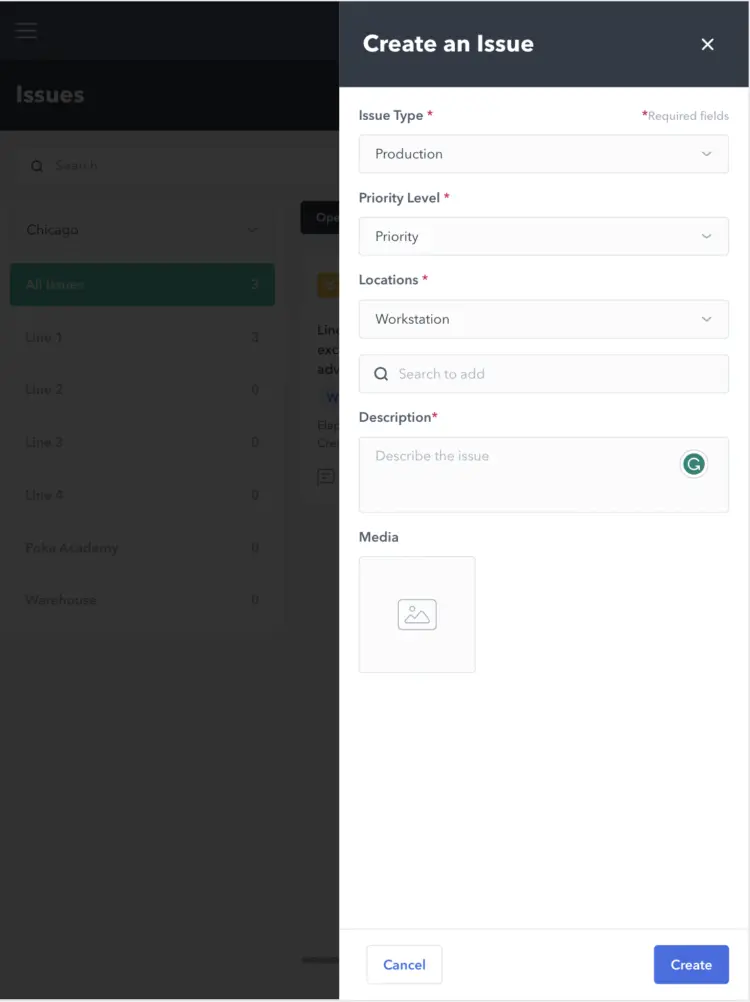
Issues Management in Poka is straightforward. To file a report, an operator simply chooses the issue type, priority level and location, adds a description, and perhaps snaps some photos and video for further context. The right department or team is immediately notified by email or push notification. The problem can also be shared to the factory newsfeed to encourage wider support and group problem-solving.
With Poka, all Dise operators can upload an incident, regardless of their position or seniority. They now use numerical codes for their customizable issue types in Poka, to help prioritize and categorize problems for faster resolution. The maintenance team can track open issues in a digital Kanban board, or easily filter them to identify the most important or persistent problems.
Furthermore, Poka effortlessly provides the itinerary for their three weekly meetings between maintenance and production, where they work through open, pending, and in-progress tasks recorded in the app. This has led to better collaboration, improved communication, and increased visibility of maintenance issues. Scheduled meetings with maintenance have been reduced from weekly to monthly, allowing staff more time to address critical issues.
Operators primarily use Poka, while maintenance works in their CMMS, Hippo. Integrating Poka with their CMMS was a fast project that enables immediate access to information and reduces the need for data reentry. Dise now only needs one of the three interns that were previously rekeying work orders into the CMMS, saving significant time and labour.
Now with Poka, all operators regardless of their position or seniority can upload an incident—we get faster time to resolution.
Manuel Fernandez
Systems Analyst
Plastico Dise Daily Management Stats
Calls for Help
Issues
Monthly CI maintenance meeting, instead of weekly
Single intern to assist with CMMS data entry, instead of three
Creating a Cycle of Continuous Improvement with Poka
Prior to implementing Poka, innovation issues were managed through the production system, and again downloaded to an Excel sheet. No one had access to what had been requested or when.
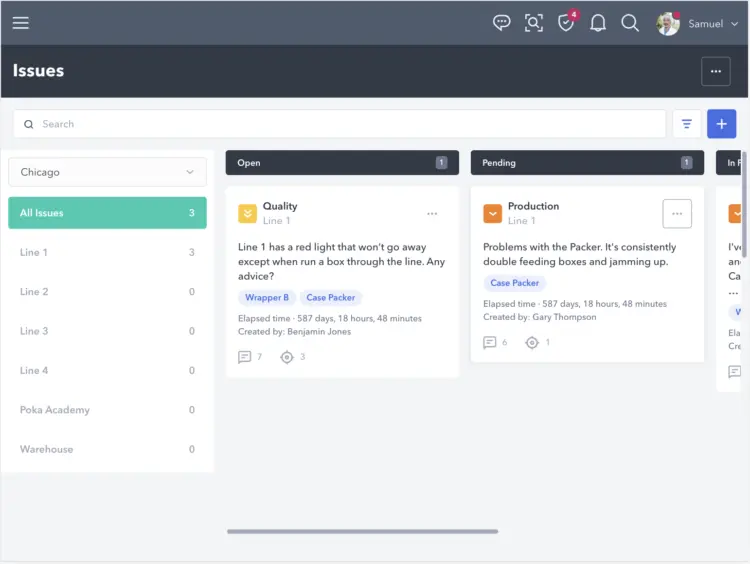
However, with the implementation of Poka, there have been significant improvements in how continuous improvement ideas are managed. The introduction of the digital Kanban board and priority rankings has improved company-wide communication so much that they have been able to reduce the frequency of interdepartmental in-person meetings with production, quality, and maintenance.
The Kanban board allows all employees to see and track the progress of ongoing issues. Using priority levels - crucial, priority, important, and minor - also helps assign jobs to the appropriate individuals, ensuring that urgent issues are addressed first.
Since implementing Poka, the number of issues identified has increased to 355 from 192, highlighting the increased engagement of employees in the continuous improvement process.
The use of Kanban as a work methodology reduced resolution time for us. That's why we want to add more areas.
Manuel Fernandez
Systems Analyst
Summary
By implementing Poka's Issue Management feature, Dise was able to streamline communication, improve visibility, and achieve faster issue resolution times. They’ve seen labour and time savings from integrating their systems and reducing unnecessary meetings. And lastly, a more transparent and accessible continuous improvement process has resulted in increased employee engagement.